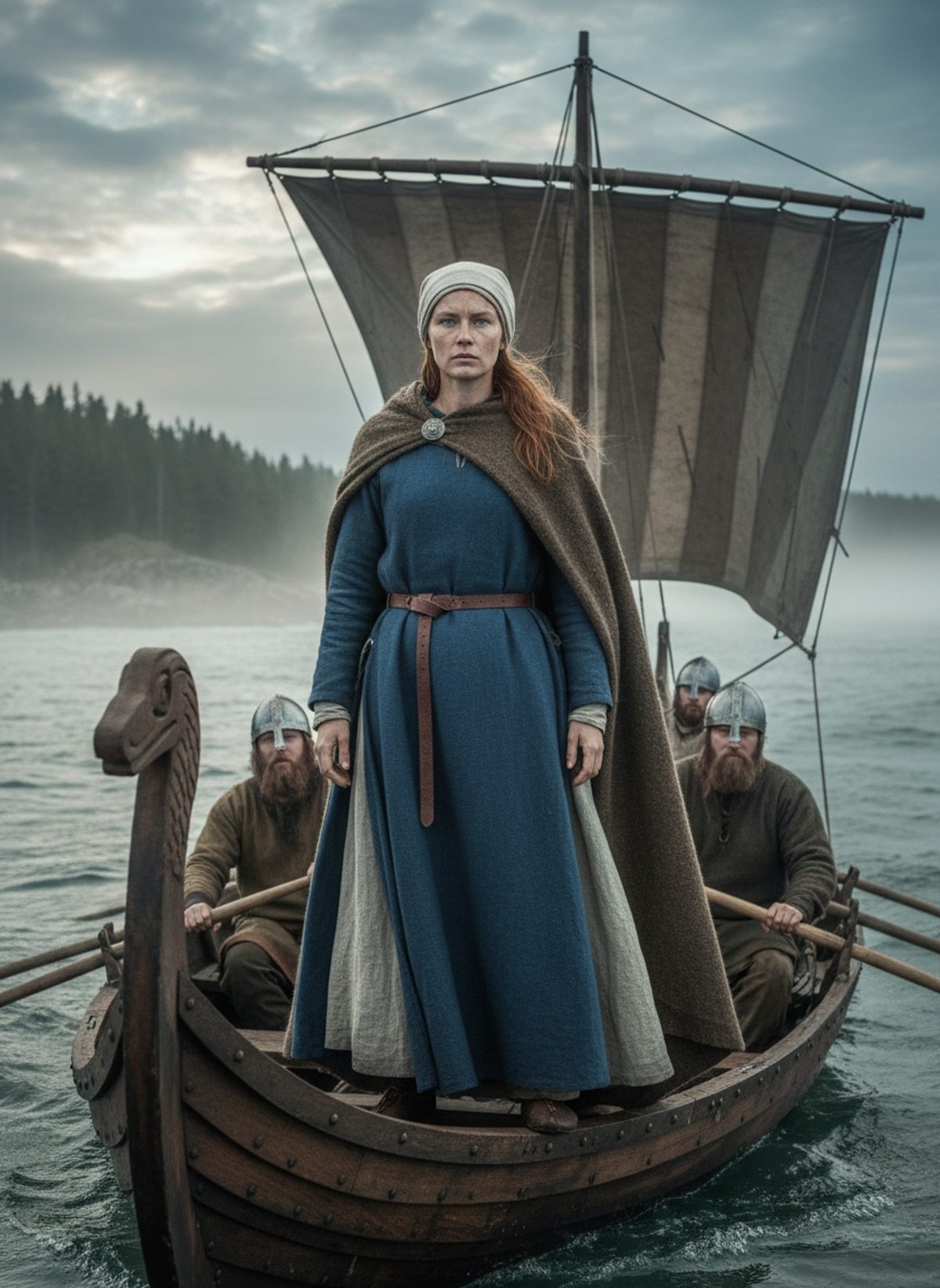
The icy grip of the North Atlantic stung Gudrid Thorbjarnardóttir’s cheeks as she stood on the deck of the knarr, her eyes fixed beyond the horizon. The sea rose and fell beneath her, each wave a daunting promise of the unknown. She had heard tales of this new world—and its rich, mysterious lands called Vinland—spoken in eager whispers around flickering fires. But now, standing at the edge of the world, she understood that the ocean was as much a barrier as it was a bridge.
Born to a family of Norse chieftains, Gudrid was no stranger to the boldness required for exploration. Her life had woven itself into a saga of daring voyages and resilient survival. The ships she sailed on, sturdy and reliable, were crafted to weather the harshest of seas—yet even they seemed dwarfed by the immensity of the ventures her family undertook. The wind howled, a haunting Icelandic lullaby, as she hugged her cloak tighter. Her thoughts drifted to the rumors of lush forests and verdant fields that lay just beyond sight—a stark contrast to the rugged, volcanic landscapes of her homeland.
In the year 1000 AD, the lands of Vinland were just whispers on the lips of sailors. The Norse sagas told of green pastures and fertile grounds, waiting to be tamed. But for Gudrid, Vinland was more than just an extension of her father’s ambition; it was a place of profound personal transformation. On this distant shore, amidst the rustling maple leaves and the gentle calls of strange birds, Gudrid brought forth a new life. Snorri Thorfinnsson, her child, became the first European born on the North American continent, a testament to both her courage and hope for a future intertwined with these alien lands.
Yet Vinland was as dangerous as it was enticing. The indigenous peoples, whose identities and stories have been largely obscured by history, were the first humans Gudrid and her group encountered in the new land. These exchanges were tense, often erupting into conflict fueled by mutual misunderstanding and the stark contrasts of their worlds. Gudrid faced these challenges with a strength born from her Norse heritage, stories of gods and giants, valor and vengeance echoed through her actions and decisions. She navigated these complex relations, knowing that survival depended not just on fierce bravado but on cooperation and mutual respect.
Read next: Óláfr Haraldsson Spared His Enemy. Norway Remembered.
The time spent in Vinland was brief yet indelible on Gudrid’s heart. Conflicts and the yearning for safe harbors eventually led her family to make the arduous journey back across the vast Atlantic, the memory of Vinland imprinted on their minds, a chapter unfinished. But Gudrid's story did not end with their return to Greenland. Unlike the tales of Viking warriors etched into history with swords and axes, Gudrid's narrative was crafted on foot and with willpower.
Her journey did not halt at the rocky shores of Iceland nor the familiar paths of Greenland. Continuing in the tradition of those Norse who saw travel as intrinsic to existence, Gudrid embarked on a pilgrimage that would place her amidst the holy relics and bustling crowds of Rome. The roads she walked were fraught with bandits and hardship, but she moved with the certainty of a woman who had crossed oceans and brought forth life in an untamed land. This pilgrimage, a spiritual journey every bit as challenging as crossing the Atlantic, was driven by a quest for meaning beyond the physical expanses she had conquered.
Gudrid’s steps took her through lands governed by rulers entrenched in the history of Christianity, a faith that was slowly spreading through the Norse society, intertwining with their own myths and the old gods. Her travel to the heart of Christianity was notable and not merely for the distance; it represented a tangible bridge between her world of seafaring sagas and the settled, land-bound narratives of European Christendom.
Lesser-known is that within Gudrid’s lifetime, the Norse footprint on North America faded, retreated as whispers of Vinland dissolved into the vast, unrecorded tales of history. Yet, Gudrid Thorbjarnardóttir’s saga endured, retold around hearth fires, skalds capturing her spirit in verses. Her life traversed from one point of the known world to its furthest reaches and back, more than geographical mileage—it was a testament to human endurance, to the resolve found when stepping into the uncertainty of the future.
Gudrid’s legacy is a narrative that has little to do with battles or regal conquests; it is shaped by her indomitable spirit and relentless drive to explore. Her story is a vivid tapestry woven from the threads of her dreams and fears, spanning worlds both familiar and strange. As we reconstruct her walk into the unknown, Gudrid's footsteps echo through time, resonating with those who dare to journey beyond—or within—their perceived limits, reminding us that history is not just a record of what has been, but a glimpse into what might be when courage and curiosity collide.