
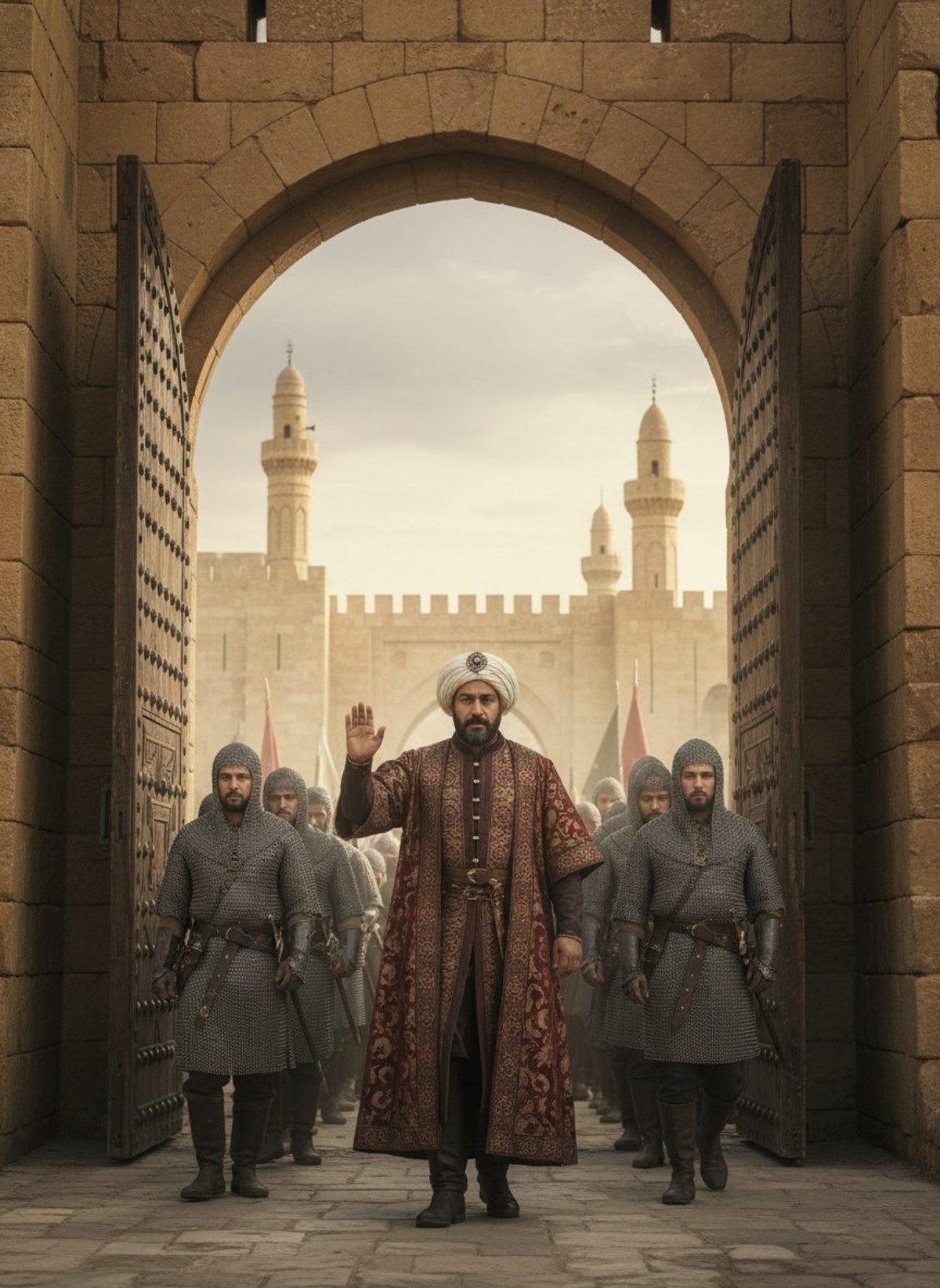
As the clamor of metal on stone echoed within the confines of the ancient city, the dusty wind carried whispered prayers and the muted anticipation of something terrible. Thousands of Christian soldiers, tired and battle-weary, knelt along the cobblestones of Jerusalem’s streets, steel helmets resting beside them like offerings. Their eyes darted from shadow to shadow, searching for the approaching blade, expecting to meet the same violent end they once delivered to others nearly a century prior. Yet, among the despair, a murmur passed through the ranks. What they heard broke from the pattern of history—a message not of death, but of unexpected reprieve.
The Conqueror’s Mercy
In the year 1187, under the fiercely brilliant sun of the Levant, Saladin, the Sultan of Egypt and Syria, stood victorious. His forces had successfully laid siege to Jerusalem in a campaign that would reshape the medieval world. Passionate yet pragmatic, Saladin had risen to legendary status, uniting the Muslim world against the Crusader states and reclaiming territories that had been lost to Islamic control for nearly 90 years. Confronting the captured Christians, the air seemed to suspend in time as he weighed his approach, mindful of both justice and compassion.
What unfolded surprised seasoned observers of warfare. Against the expectations set by the Crusaders’ own infamous slaughter of Jerusalem’s Muslim inhabitants in 1099, Saladin's decree was not one of wholesale massacre. Instead, it was terms for peace and safe passage. Every soul within the conquered walls of Jerusalem—warriors and civilians alike—were granted their freedom. A mere ransom for some, an amnesty for others. The stark contrast between expected vengeance and granted mercy stunned both friend and foe, elevating Saladin’s legacy beyond that of a conqueror.
Why would a triumphant Muslim leader spare those who had shown no such restraint decades earlier? Perhaps it was strategy. Saladin knew the war was far from over and wished to avoid further bloodshed that could solidify lasting enmity. His decision could inspire diplomatic negotiation with other Crusader fortresses—not just fear-induced submission. Compassion was a powerful tool, as effective in binding allies as it was in disarming enemies. This act of clemency did not go unnoticed by the medieval chroniclers, who spread tales of his chivalrous conduct across the known world.
Read next: Jadwiga Gave Up the Man She Loved. Poland Never Forgot It.
Jerusalem Under Siege
Before Saladin’s mercy, there had been months of relentless siege. The Crusaders, trapped within the city’s formidable walls, faced siege engines and relentless maneuvers designed not just to penetrate defenses but to break spirits. Led by Balian of Ibelin, the Christian defenders prepared for the worst. Every tower and gate was a critical point in a tense defense, like pieces on a chessboard in a high-stakes endgame. Any misstep could have meant disaster.
Though outnumbered and weary, the defenders were not without their own courage. They fought through the stifling heat, their faces marked by determination and the dire resolve that this sacred city, once won with extreme brutality, should not easily capitulate. Night after night, bonfires lit the skyline, illuminating the unyielding hope in the eyes of those who refused to forsake the city without a crippling fight.
Inside the city, civilians prepared for what many believed unavoidable—a repetition of the massacre from the First Crusade when walls fell and personal vengeance reigned. Yet, Saladin’s tactics were both psychological and militaristic. His army, drilled in sophisticated warfare, knew that the threat of the potential consequences weighed heavily on both morale and negotiation tactics. For the bloodshed of hundreds of years, it was a moment planted firmly on the edge of a razor.
The Weight of Actions Past and Present
What unfolded in October 1187 was as much about Saladin’s vision for the future as it was about the weight of experiences past. He chose not to match atrocity with atrocity. Instead, he set a precedent that history would not soon forget. His actions invited reflection on the cycles of violence that had pervaded the Crusader and Islamic cohorts for decades. In doing so, he elicited respect and estrangement in equal measure from the disparate factions of his era.
This chapter in history not only marks the turning point of the Crusader presence in the Holy Land but reveals the chess-like strategy that defined leaders who looked beyond personal vendetta to the bigger picture. Saladin’s sparing of the Christians in Jerusalem was a gamble on peace—a nuanced move that prompted reevaluation of the conflict’s narrative, urging leaders to transcend the simplistic binaries of hero versus villain, victory versus defeat, and to grasp how powerful mercy could be when employed wisely.
Why does this story matter? It matters because it speaks to an intrinsic element of human conduct—mercy in the face of triumph, and the potential for peace echoed within a world often at the mercy of conflict. Saladin’s act was more than a mere chapter in the protracted saga of the Crusades. It was a moment that defied the expectations conditioned by history, challenging us to ponder how we define strength and victory, not solely by the spoils of war, but by the breath and spirit of compassion that survive the tellings of our past.