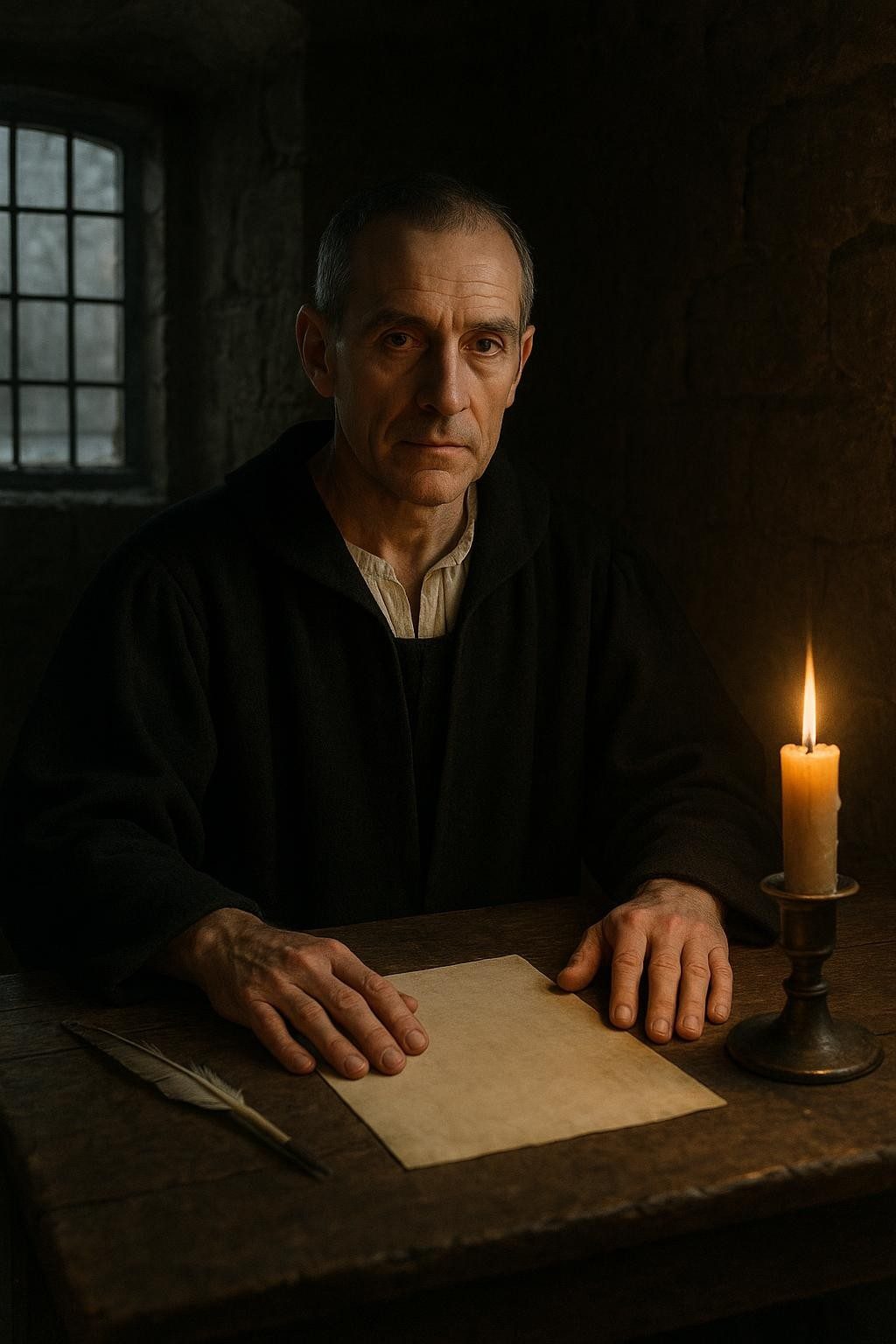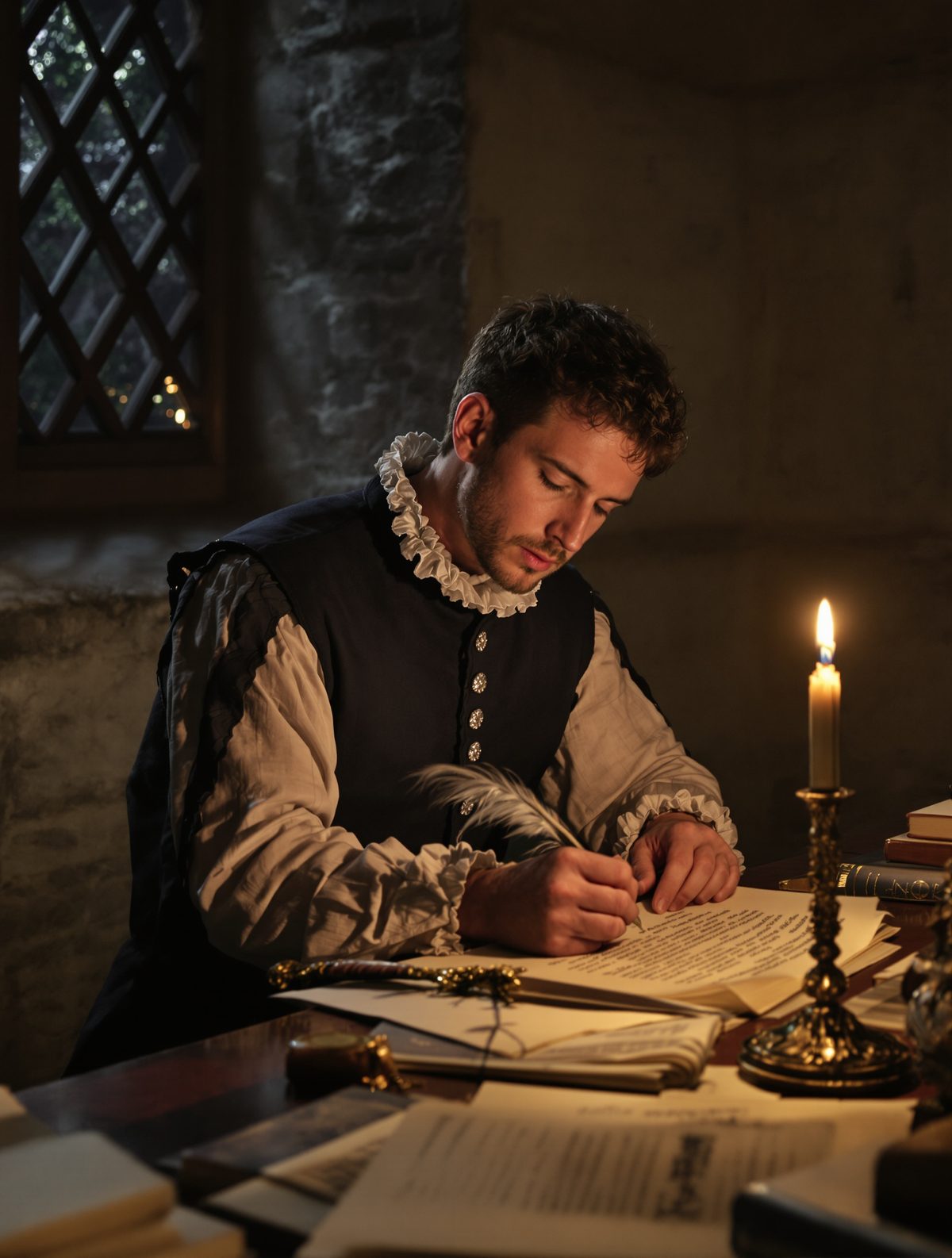
The candle flame flickered across Christopher Marlowe's manuscript as his quill scratched across the parchment, forming the immortal words: "Was this the face that launch'd a thousand ships?" But in the shadows beside his writing desk lay something that would have chilled any observer to the bone—a gleaming dagger, its blade catching the candlelight like a serpent's eye. This was no ordinary poet's study. This was the workspace of a man who lived two lives: by day, the brilliant playwright who gave English theatre its soul; by night, a government assassin whose pen was as deadly as his blade.
In the smoky taverns of Elizabethan London, where playwrights gathered to drink ale and argue about iambic pentameter, Christopher Marlowe cut a figure that was both magnetic and terrifying. While his contemporaries worried about box office receipts, Marlowe carried state secrets that could topple kingdoms. The cobbler's son from Canterbury had transformed himself into something unprecedented in English history: a poet-spy whose verses moved audiences to tears while his covert activities helped keep Elizabeth I on her throne.
The Making of a Secret Agent
The transformation began in 1580, when seventeen-year-old Christopher Marlowe arrived at Corpus Christi College, Cambridge, on a scholarship intended for future clergymen. The college's red-brick walls and ancient courtyards seemed an unlikely training ground for espionage, but Cambridge in the 1580s was a hotbed of religious and political intrigue. Catholic plots against Protestant Elizabeth were everywhere, and the government's spymaster, Sir Francis Walsingham, had learned to cast his nets wide.
Marlowe's exceptional intellect caught attention quickly. While other students struggled with Latin grammar, he was translating Ovid's erotic poetry and absorbing dangerous new ideas about religion and philosophy. But it was his extended absences from Cambridge that raised eyebrows. The official record shows that between 1584 and 1587, Marlowe frequently disappeared for weeks at a time, missing lectures and tutorials without explanation.
Read next: The Day Britain Voted to Keep a King — and Lost Him Anyway
The mystery deepened when the university threatened to deny him his Master's degree in 1587 due to these absences. Then something extraordinary happened: the Privy Council—the most powerful governing body in England—intervened directly on behalf of a mere cobbler's son. Their letter to Cambridge was carefully worded but unmistakable: Marlowe "had done her Majesty good service" and deserved his degree. No further questions would be entertained.
What "good service" had this twenty-three-year-old student performed for Queen Elizabeth? The answer lay in the shadowy world of Walsingham's intelligence network, where young men of talent were recruited to infiltrate England's enemies. Marlowe's cover was perfect: a brilliant scholar with Catholic sympathies, exactly the type the Jesuit colleges on the continent sought to recruit as future priests and potential martyrs.
Doctor Faustus by Day, Government Killer by Night
By 1587, Marlowe had established himself as London's most electrifying playwright. His Tamburlaine the Great introduced English audiences to blank verse of unprecedented power, while his Doctor Faustus explored themes of ambition and damnation that made conservative audiences squirm in their seats. But even as London's theatre-goers gasped at Faustus selling his soul to the devil, Marlowe was living out his own diabolic bargain with the English state.
The evidence of Marlowe's double life emerges from fragments scattered across government archives. In 1589, he was imprisoned in Newgate after a street fight that left a man dead. Yet he was released within days—unusual treatment for a common murderer. In 1592, he was arrested again in the Dutch town of Flushing, charged with attempting to counterfeit coins. Once more, powerful forces intervened to secure his freedom.
These weren't the scrapes of a dissolute playwright. They were the operational hazards of a deep-cover agent. Counterfeiting was a standard intelligence technique—forged currency could fund operations or destabilize enemy economies. The street violence reflected the brutal realities of espionage work, where a blown cover often meant a blade between the ribs.
Meanwhile, Marlowe's plays grew darker and more psychologically complex. His The Jew of Malta featured a protagonist who was simultaneously victim and monster, while Edward II explored forbidden themes of homosexuality and political corruption. Was this merely artistic evolution, or was Marlowe processing the moral complexity of his secret life through his art? The man who wrote of Faustus's damnation was himself dancing with devils.
The Atheist in the Shadows
As the 1590s progressed, whispers about Marlowe's beliefs grew louder and more dangerous. In a England where attendance at Protestant services was mandatory and Catholic sympathies could mean death, Marlowe was suspected of something far worse: complete rejection of Christianity itself. The government informant Richard Baines compiled a list of Marlowe's alleged blasphemies that would have made even hardened courtiers blanch.
According to Baines, Marlowe had declared that "the first beginning of Religion was only to keep men in awe" and that "Moses was but a juggler." Most shockingly, he allegedly claimed that "Christ was a bastard and his mother dishonest" and that Jesus and the disciple John "were bedfellows." These weren't mere theological disagreements—in Elizabethan England, such statements constituted treason punishable by torture and execution.
But Marlowe's atheism wasn't simply intellectual rebellion. It was operationally useful. A man who believed in no god could serve any cause without the inconvenience of genuine faith. He could infiltrate Catholic conspiracies, Protestant resistance movements, or foreign courts with equal facility. His lack of religious conviction was the perfect qualification for a career in deception.
This flexibility served him well in his most dangerous assignment: penetrating the network of Catholic exiles plotting Elizabeth's overthrow. Working under deep cover in France and the Low Countries, Marlowe gained the trust of English seminary students training to become priests and potential martyrs. These young men, burning with religious zeal, had no idea that their sympathetic new friend was cataloguing their names, plans, and contacts for Walsingham's files.
The Reckoning Approaches
By May 1593, Marlowe's luck was running out. The government that had protected him for over a decade was beginning to view him as a liability. A new generation of officials, less tolerant of their agents' eccentricities, had taken power after Walsingham's death in 1590. Worse still, Marlowe's fellow playwright Thomas Kyd had been arrested and tortured, and under extreme duress had implicated Marlowe in seditious activities.
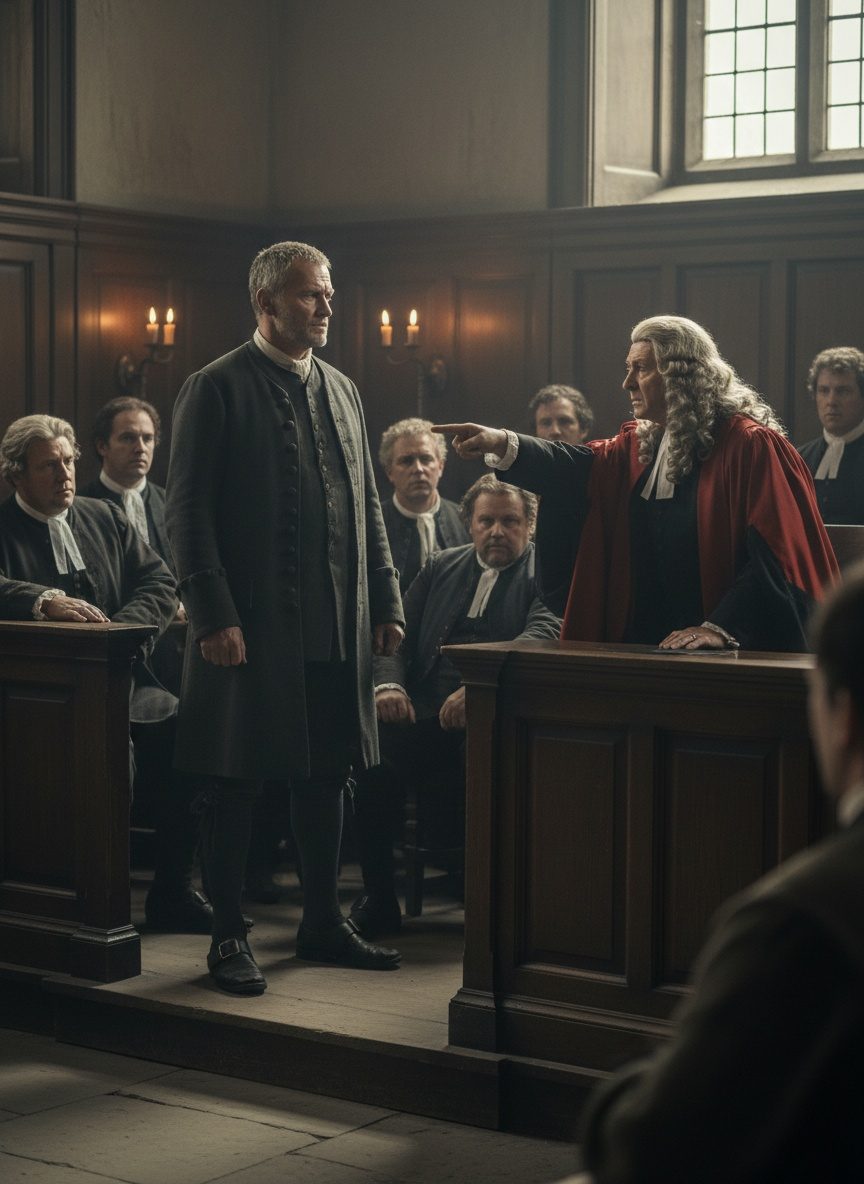
On May 18, 1593, a warrant was issued for Marlowe's arrest on charges of atheism. He appeared before the Privy Council on May 20 and was ordered to report daily until the matter was resolved. But Marlowe knew better than most how such matters were typically "resolved." The same intelligence apparatus that had made his career was now grinding toward his destruction.
The records show that on May 30, 1593, Marlowe spent the day in the company of three men at Eleanor Bull's tavern in Deptford: Ingram Frizer, Nicholas Skeres, and Robert Poley. All three were connected to government intelligence work. Poley, in particular, was a veteran agent who had played a crucial role in exposing the Babington Plot against Elizabeth in 1586. What were these four spies discussing in that Deptford tavern? Were they planning Marlowe's escape to the continent, or something far more final?
Death of a Poet-Spy
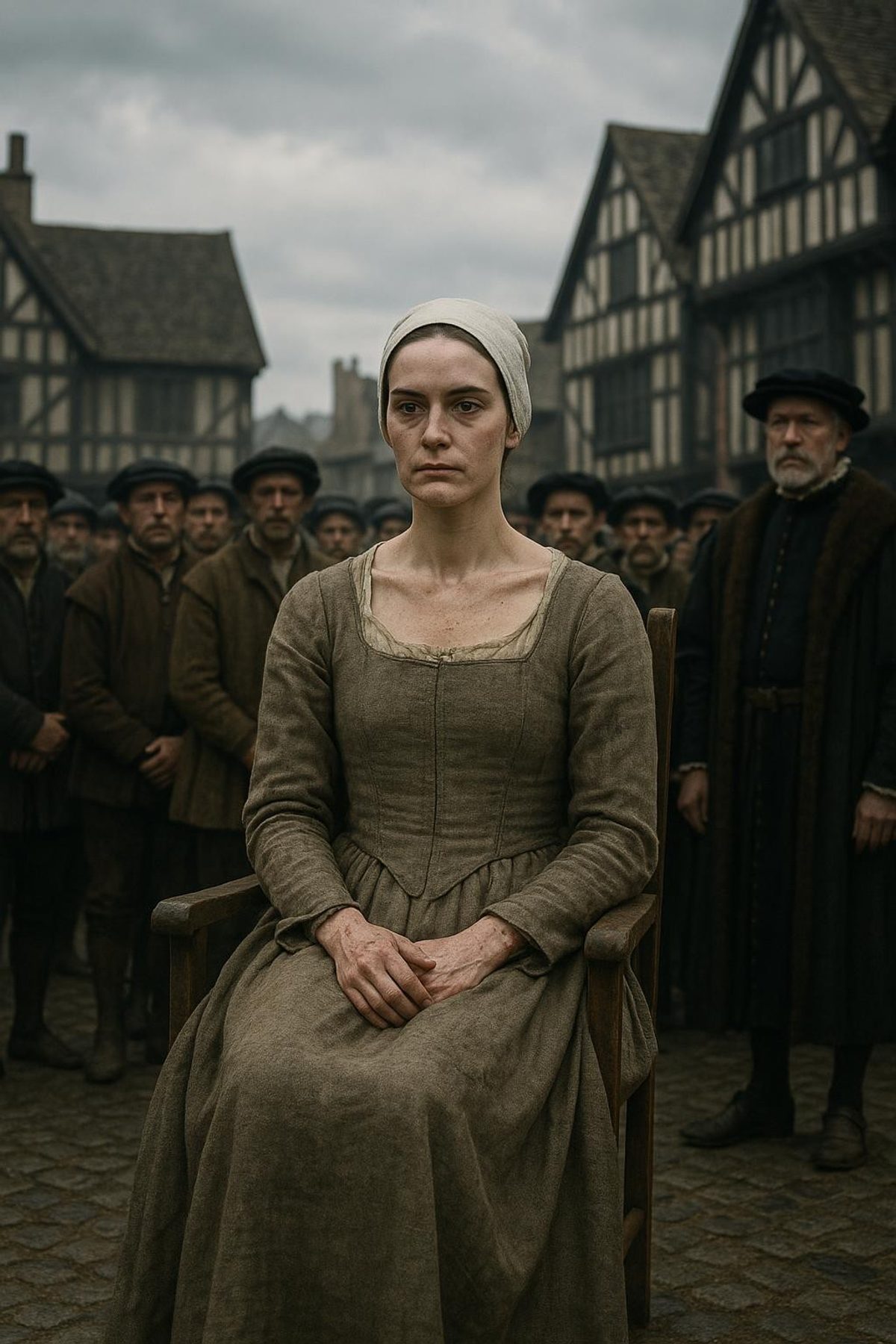
According to the official coroner's report, a dispute arose over the bill—the "reckoning"—late that afternoon. Marlowe allegedly attacked Frizer with a dagger, and in the ensuing struggle, the blade was turned on its owner, piercing his skull just above the right eye. Death was instantaneous. The man who had lived by violence died by it, aged just twenty-nine.
But even this official account raises more questions than it answers. Why would experienced intelligence operatives allow a simple tavern dispute to escalate to murder? Why was Frizer, the alleged killer, pardoned within a month? And why were Marlowe's private papers, which might have contained state secrets spanning a decade, never recovered?
The truth is probably simpler and more chilling: Christopher Marlowe knew too much. His atheism had made him unreliable, his growing fame had made him conspicuous, and his knowledge of government operations had made him dangerous. In the cold calculus of intelligence work, he had become a problem requiring a permanent solution.
The dagger that had once lain beside his quill, the tool of his secret trade, had finally claimed its master. The poet who had written of Faustus's damnation had found his own, not in Hell's flames, but in the measured violence of state necessity.
Christopher Marlowe's brief, blazing career illuminates the brutal contradictions of power in any age. His story reminds us that behind every golden age lie shadows where artists and intellectuals navigate between creation and compromise, between the idealism of their art and the ugly pragmatism of survival. In our own era of surveillance and secrecy, when writers and thinkers again find themselves caught between conscience and convenience, Marlowe's ghost still haunts the conversation. He remains English literature's most dangerous talent—the poet whose quill changed theatre forever, and whose dagger changed him from a man into a legend.