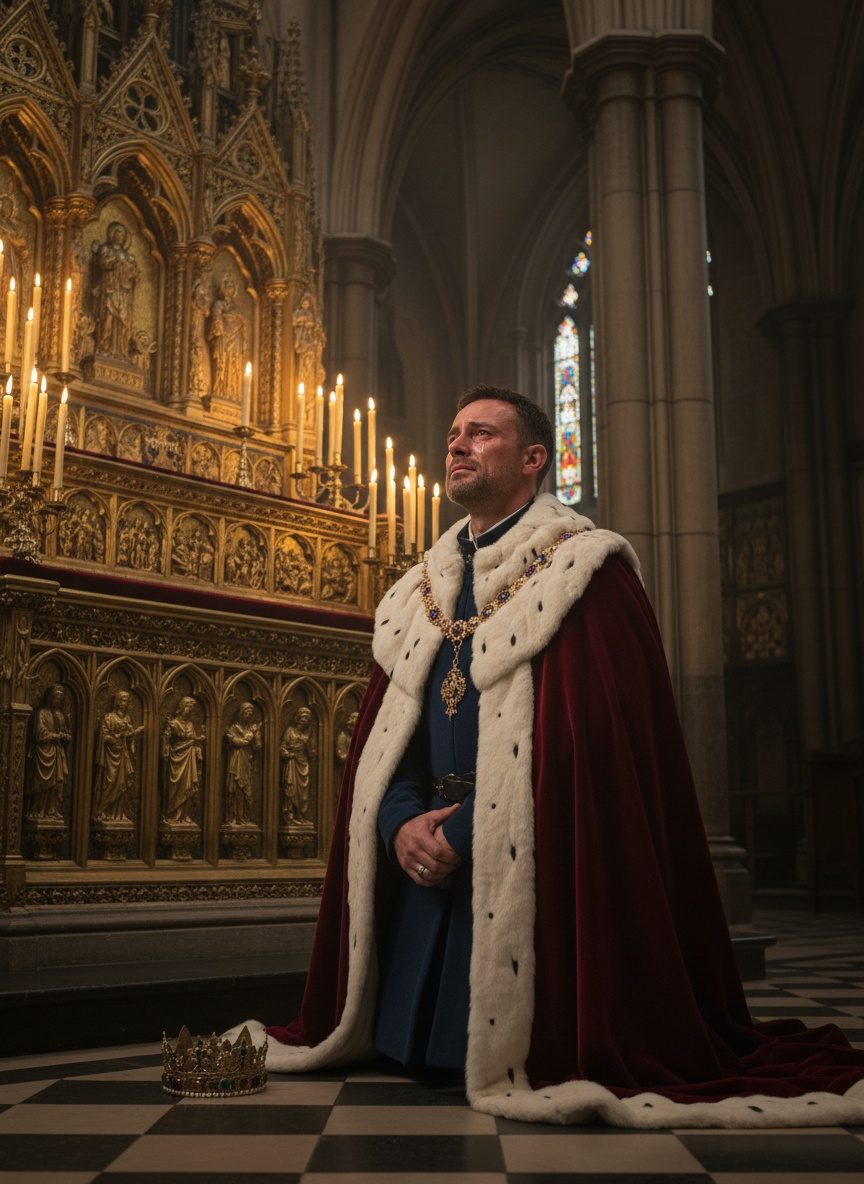
The chapel was filled with an overwhelming scent of incense, the soft glow of candlelight casting flickering shadows across cold stone walls. Edward I, newly crowned King of England, sank to his knees before the shrine of Edward the Confessor, his fingers trailing across the carved edifice as he whispered a prayer. Tears welled in his eyes, spilling over and streaming down his cheeks, testament to the weight of the crown that, though always his, now bore heavily upon him.
Beneath the vaulted roof of Westminster Abbey, the solemnity was punctuated only by the distant echoes of footsteps and the hushed reverence of those gathered. Edward's mind was a cacophony of memories: the harrowing campaigns across Christendom, the brutal clash of swords in the Holy Land, and the agonizing wait for his time to come as his father's reign decayed into obscurity. Each memory was a thread woven into the tapestry of his thwarted ambitions and youthful dreams, surfacing now in a tidal wave of emotion.
His father, Henry III, had been a ruler beset by indecision and failures, a man whose once-brilliant legacy lay tarnished by internal strife and the relentless demands of the barons. Edward had witnessed the fall from grace, the slow corrosion of a king’s power, and he had vowed to be different—to be a monarch whose reign would echo through the ages. Yet there was something deeply personal in this moment of kneeling at a saint's shrine, a communion not merely of duty but of identity; he was anointed as much by divinity as by heritage.
Outside the sanctity of the abbey, the streets of London waited—filled with subjects, soldiers, and spies. They murmured tales of his exploits, both feared and admired, whispering of the prince who had escaped shipwreck and plots, who had tested his mettle on the sands of Outremer. His return to English soil had been anticipated as both a triumph and a reckoning, stirring hearts and fears in equal measure. Now, within the sacred confines of this hallowed space, he had a respite from the immense expectations tethered to his lineage.
Read next: The Day a King Knelt to Wash a Beggar's Feet
The solemn stillness of the confessor’s shrine allowed Edward a rare intimacy, a private dialogue with the past. In the Confessor, he saw parallels to his own path—a king much venerated yet burdened by earthly trials, a sovereign whose spiritual commitment became his enduring legacy. The contrast was stark, for Edward was not known for melancholy or mysticism, but for his militaristic vigor and steely resolve. The tears he shed were not of sorrow but of resolve—the fierce determination to cast off the shadows of previous misrule.
As he rose—each ligament stretching as if to command the entirety of England with his ascent—an unspoken transformation took place. This was the inception of England's future painted in bold strokes of conquest and consolidation. Those in the nave, unaware of the fortitude steeling within him, could only surmise the motivation behind his tears. But from that moment, he would stride forth not as a tentative heir, but as a king who intended to carve his kingdom with the chisel of his will and the hammer of destiny.
Days hence, the whispers of Edward’s weeping became tales entwined with prophecy—heard by those in hamlets and halls as far as whispers could travel. Would he rival Arthur's legendary throne, seek to unite all of Britain under one banner? The barons, his father’s turbulent assailants, were now to contend with a ruler forged in turmoil, his experiences the anvil on which strategy was honed. A united crown and cross—this was the resolve molded in prayerful contemplation, now unleashed in determined action.
Yet, beneath the bold surface, echoes of the Crusades beat within his chest—a rhythm of sacred duty and knightly valor twisting in his veins. These battles had taught him dominion was neither easily granted nor lightly held, each conquest demanding its tribute in sweat and blood. Edward’s England would thus be characterized by tenacity, expansion, and meticulous governance—his ambitions stretching from Scotland’s highlands to Wales’ unyielding valleys, each conquered realm a testament to the expansive threads he wove into Britain's great tapestry.
This moment in Westminster—the sainted king’s witness—stood as a testament to the divine right of kings, an echo reverberating through each decision, each sword stroke, each legislative tenure striking at the very fabric of feudal authority. Edward would lead with polemic vigor, neither bending to dissent nor shirking from his god-given mission, bound by his sworn oath to forge an indelible mark on England’s storied shores.
His reign, expansive and unyielding, would become the stuff of both awe and caution—a lineage’s continuation cloaked in medieval grandeur, examining the balance between divine favor and political efficacy, one that would resonate among historians as both a triumph of strategic kingship and a case study in the burdens of power. As the last candle extinguished in the abbey and Edward stepped into his burgeoning kingdom, the stage was set for an era not just remembered for its breadth, but for its indomitable spirit—a reign not merely marked by its longevity but its dynamic, incomparably human touch. His kneeling endures, captured in time, as an intimate echo within the grand narrative of Britain's endless quest for identity and dominion.