The Bristol sky held a moody, slate-gray cast, the kind that promises the persistent drizzle of an English morning. Gull cries cut through the air at a distant pitch, a fitting soundtrack to the scene unfolding on the damp stone docks below. It’s 1551, and among the wharf's usual bustle of goods, whispers, and the clamor of barrels being rolled, stands a singular man of quiet charisma and aged wisdom. Sebastian Cabot, nearly eighty, his beard white as driftwood, commands attention not with a booming voice, but with the force of his reputation. His presence here today could alter the course of England’s maritime future.
Few men can say they have walked the decks both of the hopes and terrors of the New World and the perfumed courts of the Spanish crown. Cabot is one of those rare few. As a boy, he crossed the Atlantic with his father, John Cabot, seeing for himself the promise of lands beyond the horizon. The Atlantic, once a forbidden barrier, had become his learning ground, a sea of secrets he would navigate with growing expertise. Over the decades, his life unfurled like a canvas map — at times under the Spanish flag, at others under English pensions — each voyage an inked line drawn to the edges of known world.
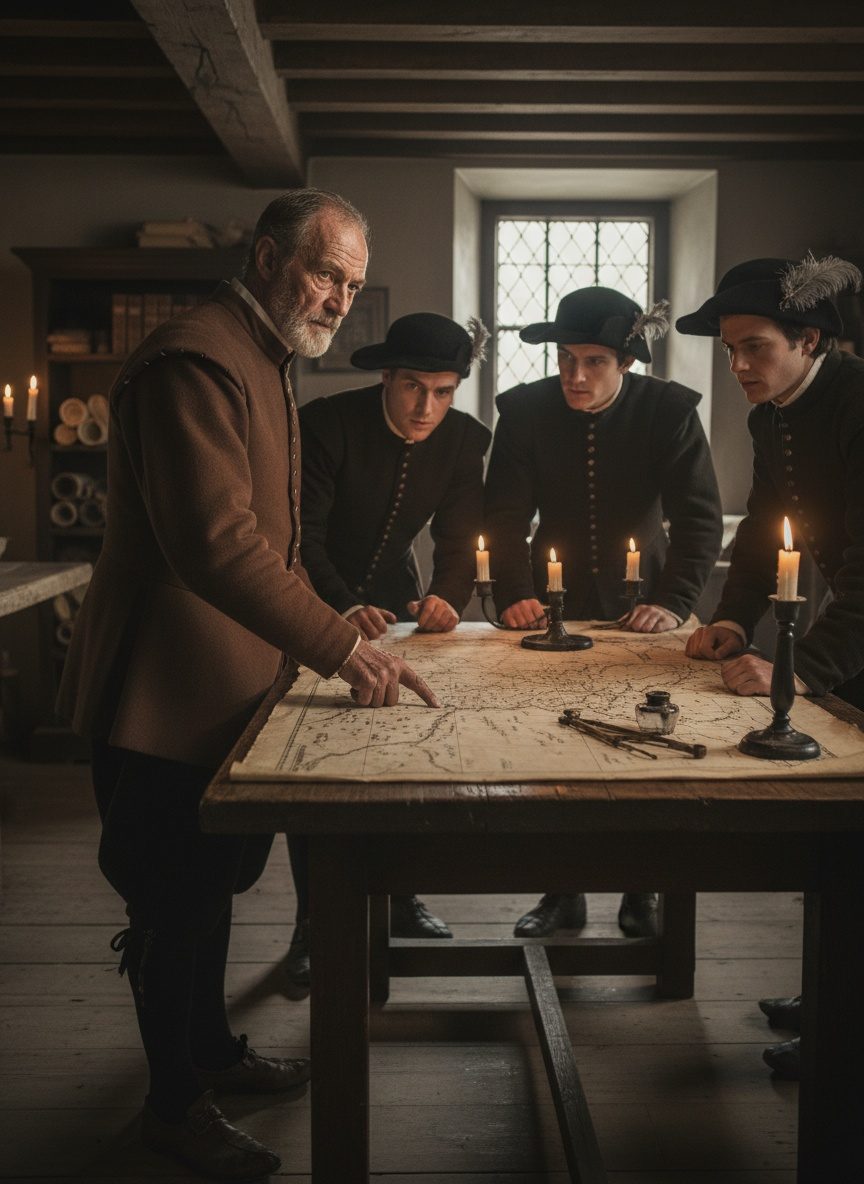
This morning, however, Cabot’s audience is not a king or an emperor, but a motley group of merchants. Their ambitions, much like the seaswain's charts, lack boundaries. His makeshift classroom is a sun-bleached wooden table, upon which he has laid out a map. Not just any map, but one he had drawn with meticulous skill, combining Ptolemaic wisdom with the seafaring knowledge gleaned from decades of exploration. The merchants lean in as Cabot, worn fingers tracing inky lines on the parchment, points north — not toward the famed treasures of India, but toward untested waters, toward the endless potential of the Arctic seas.
Cabot’s return to England is more than the homecoming of a prodigal sailor. His vision has a sharper focus, one set on a daring enterprise. British merchants are emerging from the shadows of Spanish and Portuguese dominion, yearning for a northern route that might finally join them with the wealth of Cathay, cutting a swifter path through icy passages previously ignored in fear. It is here in 1551, beside the Thames, that the Muscovy Company flickers into life. Born from Cabot’s knowledge and the merchants’ ambition, it becomes the genesis of systematic (and profitable) English exploration.
Read next: The Day a Stuart King Walked Calmly to His Own Execution
You can sense the weight of expectation in the air almost as palpably as the salty tang of the nearby sea breezes. Cabot’s vision is audacious. The notion of trading with Russia and possibly beyond via an Arctic route seems, to some, as fanciful as tales of mermaids and krakens. Yet, his true genius lies not only in mapping the contours of faraway coasts, but in guiding this new generation of English enterprise to boldly confront the unknown.
As Cabot shares his hard-won knowledge of tides and winds, currents and reefs, he is doing more than merely recounting destinations. He's fostering a form of navigational literacy, turning a ragtag group of traders into the seedbed of England’s maritime grandeur. Every notation he makes with charcoal sticks, every tale regaled from the bow of a ship, burgeons into lessons that chart a course for more than one vessel’s journey. Among his students is the young boy seated closest to him, a boy with ambitions of his own. He dreams not of merchant riches, but finds within Cabot’s teachings the kindling for his own convictions.
That boy, whose name remains lost to history, could be anyone, from noble scion to street urchin. What matters most is not who he is today, but who he might become — perhaps a critical navigator for monarchs, a reliable captain for far-flung fleets, or an inspiration to others as yet unborn. In Cabot, he sees the tapestry of vast, unexplored territories waiting not just for maps but for mastery. Here, he learns to see the world through the weathered eyes of ancient traders and the hopeful lens of burgeoning explorers.
The elder Cabot’s tale is one of reciprocity as much as revelation. England needed maps as much as gold. It needed knowledge as much as plunder. The chart he unrolls today may not contain rubies or silver, but it holds the promise of a mercantile engine, and perhaps the start of imperial dreams. It is a silent treaty, built on trade winds and aspirations, aligning the son of a Venetian adventurer with the sons of England.
As winter mists slowly retreated over the breath of the Thames, Sebastian Cabot offered more than just the memory of his travels — he imparted a toolset, a mindset that would drive England as a maritime power on the world stage. His impeccable skills and tireless spirit transcended mere maps, nurturing a cultural legacy that has weathered centuries. His own adventurous spirit, not unlike those tides he so expertly navigated, washed over others, instilling exploration genes into England’s very lifeblood.
In those final years of his life, Cabot did more than secure a position within English waters; he tethered the island's future to the idea of itself as a navigating nation, one that could steer into the fog of the unknown with alacrity and courage. His efforts did not just point a way northwards but illuminated an entire horizon of possibilities. And so, from the modest table beside the Thames, he set a course that would ripple through history, proving the greatest treasures are those borne from enlightenment and audacity — the most invaluable cargo only found when a mariner's lines converge not just on paper, but upon the sparkling horizon itself.