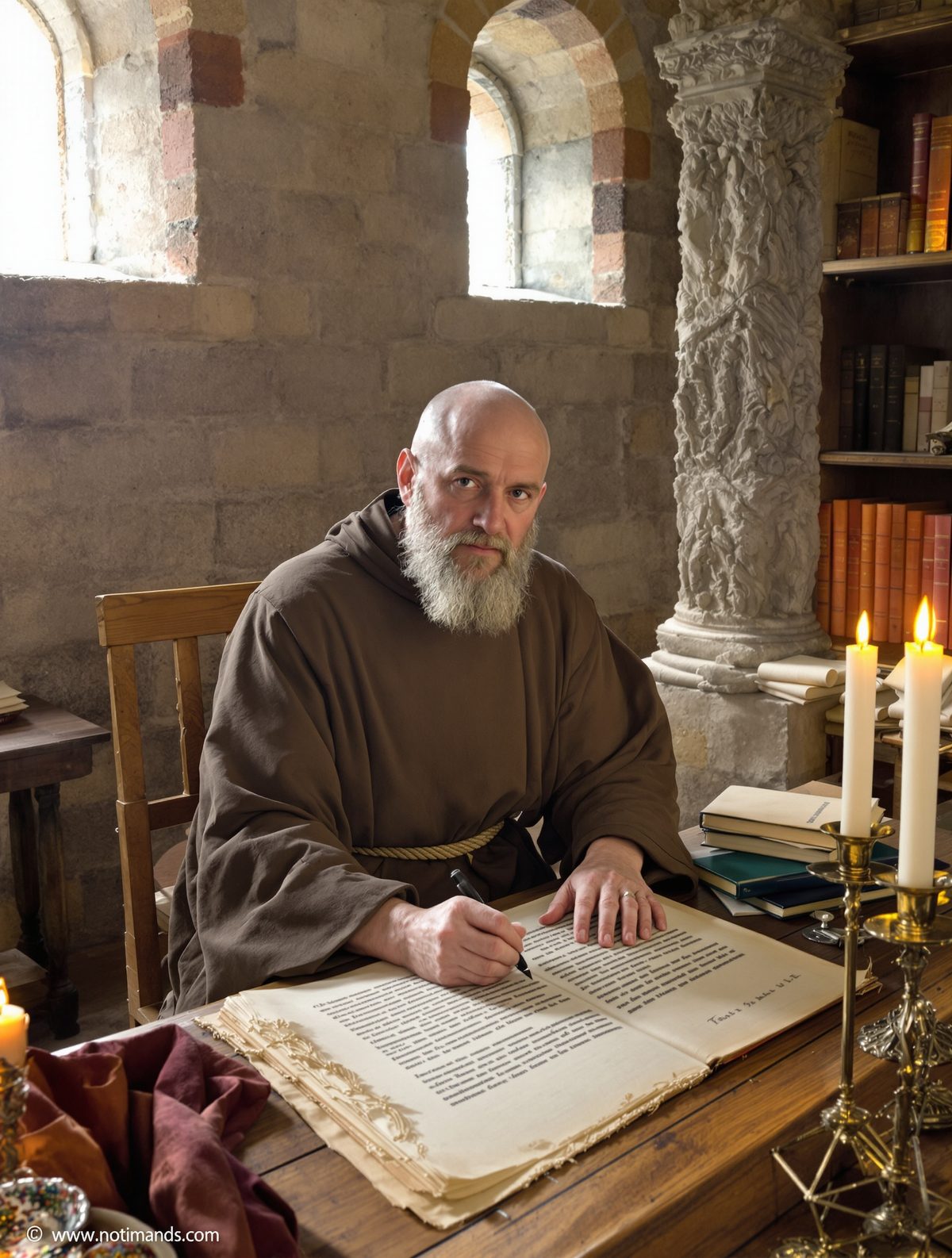
The scratching of quill on vellum echoed through the stone corridors of Jarrow monastery as Brother Bede dipped his pen for the final time. Outside, the North Sea winds howled across the Northumbrian coast, carrying salt spray and the distant threat of dragon-prowed ships. It was 731 AD, and this ageing monk had just completed what would become the most important book in English history—though he could never have known that his Ecclesiastical History of the English People would outlive empires, survive the flames of countless raids, and become the sole thread connecting us to a vanished world.
Without Bede's courage to chronicle his turbulent times, we would know virtually nothing about the centuries that forged England. The very names we remember—Hengist and Horsa, King Arthur's possible existence, the arrival of Augustine—survive only because one determined monk refused to let the stories die with their tellers.
The Scholar of the Edge of the World
Jarrow in 731 was quite literally at the edge of the known world. This twin monastery, paired with nearby Wearmouth, perched on the windswept coast of what we now call Tyne and Wear, was about as far from civilization as one could get while still calling oneself Christian. Yet here, in this seemingly remote outpost, lived perhaps the most learned man in all of Europe.
Bede had arrived at Wearmouth as a seven-year-old oblate in 679, given to God by parents whose names history has forgotten. By his own account, he spent his entire life within the walls of these twin monasteries, never traveling more than a few miles from his birthplace. Yet from this isolated corner of Northumbria, he commanded a scholarly network that stretched from Ireland to Rome, from Canterbury to the monasteries of Francia.
Read next: The Day a Saxon King Knelt and Washed a Leper's Feet
The monastery's library was extraordinary for its time—containing over 300 volumes when most religious houses might boast a dozen. Here were works by Pliny, Aristotle, and Virgil alongside Christian texts by Jerome, Augustine, and Gregory the Great. Benedict Biscop, the monastery's founder, had made six journeys to Rome, each time returning with armloads of manuscripts that transformed Jarrow into an unlikely beacon of learning.
But Bede's genius wasn't just in absorbing this knowledge—it was in understanding what was being lost forever, right before his eyes.
Racing Against the Dying of the Light
When Bede began his great work around 725, he was witnessing the end of an era. The generation that remembered the conversion of the Anglo-Saxon kingdoms was dying off. The last companions of missionaries like Aidan and Cuthbert were taking their irreplaceable memories to their graves. Within living memory, these lands had been pagan; now, the old stories were fading like morning mist.
What makes Bede's achievement so remarkable is that he understood the urgency. This wasn't academic exercise—it was rescue archaeology of the mind. He frantically wrote to monasteries across Britain, begging for documents, charters, and most importantly, the testimonies of those who had witnessed history firsthand. His letters reveal a man obsessed with accuracy, constantly cross-referencing sources and admitting when evidence was thin.
Consider the challenge he faced: there were no newspapers, no government records as we understand them, no systematic archives. The Anglo-Saxon kingdoms kept few written records, preferring oral tradition. Most "documents" were maintained in the memories of aging monks and nobles. Bede was essentially trying to reconstruct 300 years of history from fragments, rumors, and the fading recollections of old men.
Yet he succeeded brilliantly. Modern archaeologists and historians continue to be amazed by Bede's accuracy. Where we can check his facts against independent sources—coins, inscriptions, continental chronicles—he's almost invariably correct. This wasn't luck; it was painstaking, methodical scholarship of the highest order.
The Innovations That Changed History Forever
Bede didn't just preserve history—he revolutionized how history itself was recorded. Before the Ecclesiastical History, most chronicles were dry lists of kings and battles. Bede created something entirely new: a narrative that wove together politics, religion, culture, and human character into a compelling story.
His most enduring innovation was popularizing the Anno Domini dating system. While this method had been devised by Dionysius Exiguus in the 6th century, it was Bede who made it standard practice. Before this, dating was chaos—events might be recorded as happening "in the third year of King Oswald" or "when Aethelbald was bishop." Bede's consistent use of AD dating allowed readers to place events in a universal timeline. Every time you write a date with AD or refer to years numbered from Christ's birth, you're using Bede's system.
But perhaps his most surprising innovation was his treatment of sources. Unlike earlier chroniclers who simply accepted whatever they were told, Bede was constantly evaluating reliability. He distinguished between eyewitness accounts and hearsay, noted when stories seemed dubious, and openly admitted the limitations of his knowledge. This critical approach to evidence was revolutionary—and wouldn't become standard practice for centuries.
Even more remarkably, Bede wrote in accessible Latin rather than the elevated, flowery style preferred by most scholars. He wanted his history to be read and copied, not admired for its linguistic sophistication. This practical decision proved crucial to the work's survival—monks across Europe could understand and reproduce it without requiring advanced classical education.
Survival Against Impossible Odds
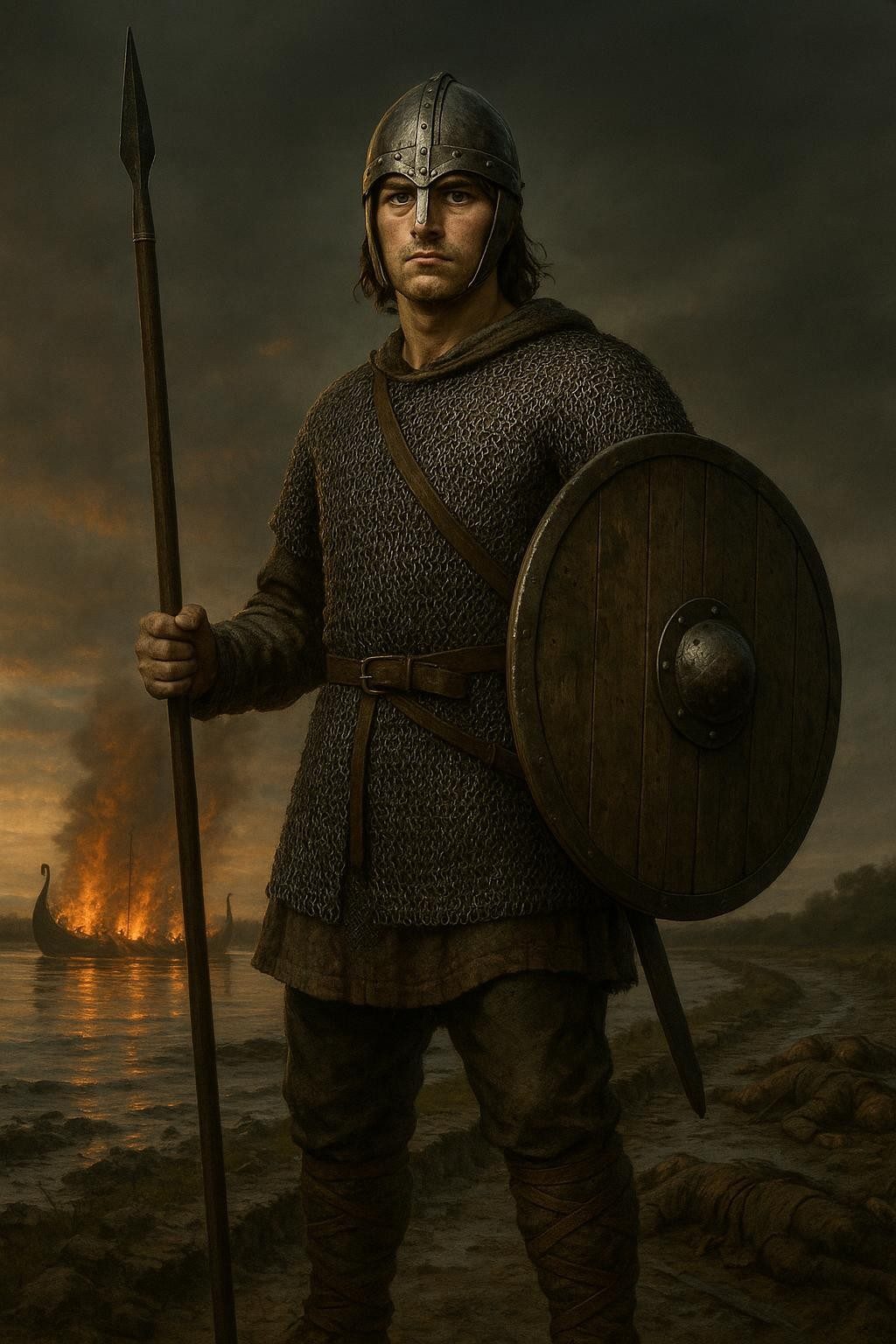
That any copy of Bede's masterwork survived to reach us borders on miraculous. Within 150 years of its completion, the Viking raids began in earnest. Jarrow itself was attacked in 794, just 63 years after Bede's death. The raiders specifically targeted monasteries, not just for their wealth, but because they were centers of the Christian culture the Vikings sought to destroy.
Across Britain and Ireland, entire libraries went up in flames. Centuries of learning—chronicles, poetry, theological works, scientific treatises—vanished forever. The monastery at Lindisfarne, where some of the greatest illuminated manuscripts in history were created, was sacked so thoroughly that virtually nothing from its original library survives. The same fate befell dozens of other centers of learning.
But Bede's work had already spread. Copies had been made and distributed across the continent before the Viking raids intensified. Manuscripts found their way to monasteries in Francia, Germany, and Italy. When one copy was destroyed, others survived in distant scriptoriums. The very accessibility that Bede had built into his work—his clear Latin, his engaging narrative style—meant that monks everywhere wanted to copy it.
Even so, survival was touch and go. Of the hundreds of copies that must have existed in medieval times, only about 160 manuscripts survive today, and many of those are fragmentary. The oldest complete manuscript dates to around 737—copied within just six years of the original. It now resides in the Russian National Library in St. Petersburg, having traveled an improbable route from 8th-century Britain to 21st-century Russia.
The Man Behind the Miracle
Who was this monk who single-handedly preserved the memory of early England? The picture that emerges from his writings is of a man consumed by intellectual curiosity but anchored by deep faith. Bede wrote over 60 works on subjects ranging from biblical commentary to astronomy, from grammar to calendar calculation. He was probably the most scientifically sophisticated mind in early 8th-century Europe, correctly explaining tides and planetary motion while his contemporaries still believed in various magical explanations.
Yet he remained humble about his achievements. In the autobiographical note that concludes the Ecclesiastical History, he writes simply: "I have spent all my life in this monastery, applying myself entirely to the study of the scriptures; and, amid the observance of the discipline of the Rule and the daily task of singing in the church, it has always been my delight to learn or to teach or to write."
This modesty masks an extraordinary achievement. Working alone, with limited resources, in a monastery at the very edge of the civilized world, Bede created a work that modern scholars still consider essential reading. No serious study of Anglo-Saxon England can proceed without reference to his Ecclesiastical History. He remains our primary source for entire centuries of British history.
But perhaps most remarkably, Bede understood that he was writing for posterity. His work wasn't just chronicle—it was a love letter to future generations, a determination that the struggles, achievements, and faith of his people would not be forgotten.
Why Bede's Courage Still Matters
In our digital age, when information seems permanent and infinitely reproducible, Bede's achievement might seem less remarkable. But consider: how much of our own history depends on the courage of individual chroniclers? How many stories have been lost because no one thought them worth preserving?
Bede reminds us that history isn't inevitable—it's created by people who care enough to write it down, to check their sources, to tell the truth as they understand it. Without his lonely vigil in that Northumbrian monastery, scratching away by candlelight while the wind howled outside, we would know virtually nothing about how England became England.
His legacy extends far beyond the facts he preserved. Bede established principles of historical writing that remain valid today: the importance of reliable sources, the value of eyewitness testimony, the need to distinguish between fact and legend. He showed that history could be both accurate and engaging, scholarly and accessible.
Most profoundly, Bede demonstrated that preserving the past is a moral obligation. In an age when knowledge could disappear overnight, when entire cultures could vanish without trace, he chose to become memory's guardian. That choice—made by one monk in one monastery 1,300 years ago—is why we can still hear the voices of Anglo-Saxon England echoing across the centuries.