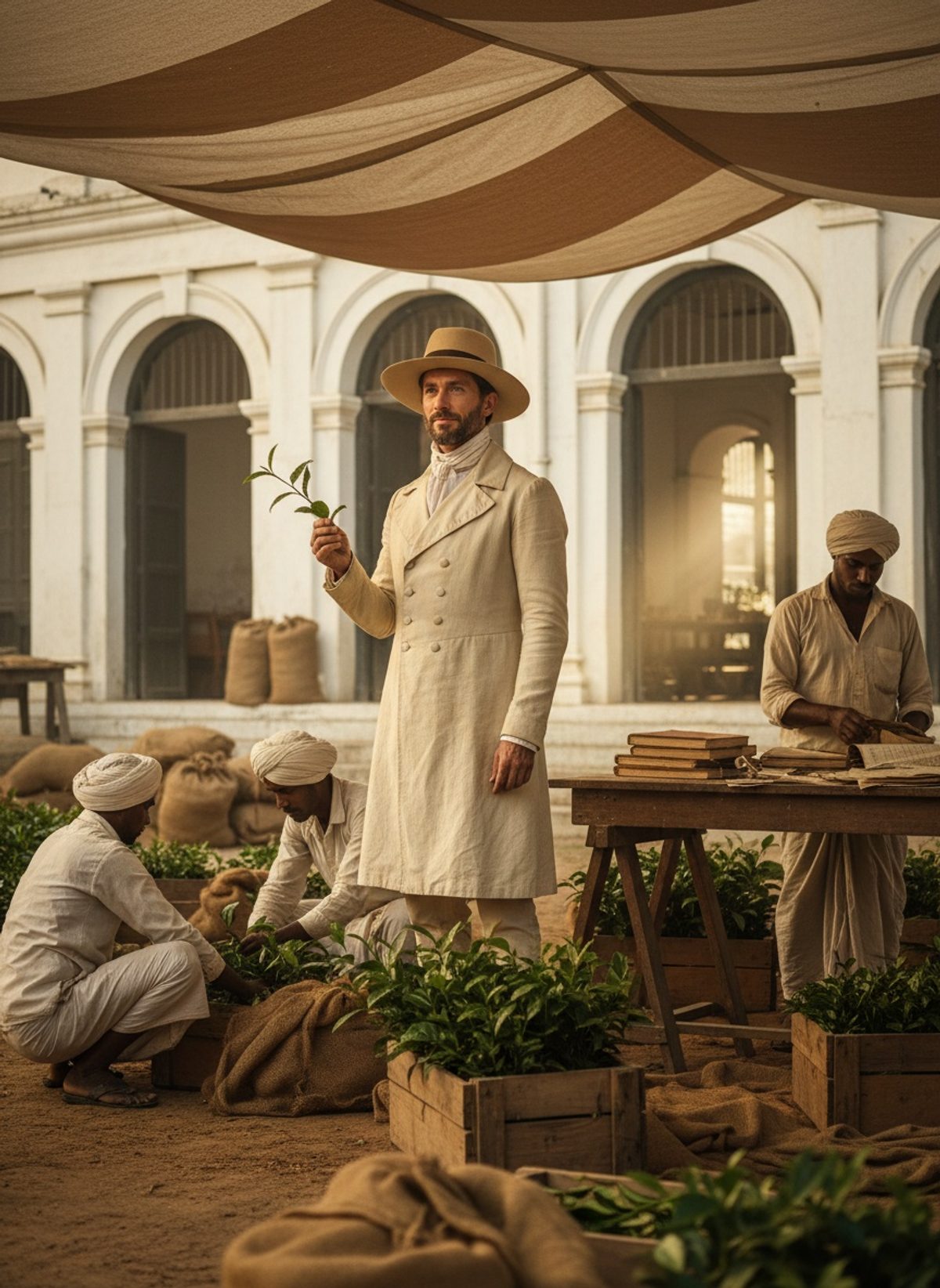
Most people have never heard of Robert Fortune. They should have.
The Secret Mission
In the shadows of the Victorian era, amid the flickering ambitions of empires expanding under the guise of global trade, there stood a man whose clandestine journey would change the economic tides between two great civilizations. Robert Fortune, a Scottish botanist with an adventurous spirit and a cunning mind, embarked on a treacherous mission at the behest of the British East India Company. His task seemed simple enough to state but dangerous beyond comprehension: infiltrate the closed-off tea districts of China and gather the living secrets of its tea production.
The year was 1848 when Fortune, disguised as a native merchant, slipped through the stern gaze of guards and bureaucrats who believed their rustic tea gardens remained untouchable by outsiders. Fortune pressed his way into the sacred heartlands of China's tea industry, where the lush terrains were both picturesque and enigmatic. With fluid landscapes rolling into the horizon and rivers whispering secrets to the clattering bamboo groves, Fortune recognized this land was rich not only in beauty but in the treasure of its plants.
These serene groves, however, were shrouded in complex politics and tradition. For two centuries, the tea was an opulent resource fiercely protected by the Chinese empire, and Britain paid dearly for every aromatic leaf steeped into its iconic afternoon tea. The balance of power had to shift—or so the British Empire believed—and Fortune was there to tip the scales.
Read next: When Joshua Wedgwood's Cameo Killed the Slave Trade's Wealth
A Botanic Heist
Fortune's meticulous journey was reminiscent of an espionage saga far removed from the dry pages of a textbook. Armed with the pseudonym of a Chinese merchant, the botanist navigated the rugged terrains and bustling markets, his notebook scribbling a cure for Britain's dependency. His adept use of a disguise wasn't merely for show—he understood the deep ideograms of a society that trusted no foreign gaze upon their fields.
It was in the shadowed corners of local teahouses and under the wide-brimmed hats of friendly tradesmen that Fortune began to unravel the secrets of China's famous teas. With tempered patience, he gathered both the seeds and valuable botanical insights, insights that went beyond mere cultivation. He learned the nuanced craft of tea processing—the polished method of withering, rolling, oxidizing, and firing that gave each tea its distinctive character.
The irony stood stark: many Britons revered Fortune's botanical pursuits as an act of heroism, but the same acts rendered him a crafty thief to another audience. Yet, neither reputation mattered to Fortune as much as the cargo he so lovingly secured within his voyage back: living treasures destined to upend a global industry.
Calcutta and the Seeds of Change
Fortune's journey did not end on Chinese shores. It was in 1851 in the bustling city of Calcutta—where the Ganges merged into the Indian Ocean, spraying a salty greeting to incoming ships—that his featherweight cargo found completion. The seedlings, some no bigger than a child’s sapling but profound in their economic potential, lay nestled as he delivered them to the planters of Assam, the north-eastern frontier of British India.
Assam, with its fertile lands and favorable climate, quickly embraced its new green guests. The humble seedlings and expertly captured techniques sparked the beginnings of what would morph into a monumental tea industry. Guided by Fortune’s instructions, the British Empire planted its seed of independence from China’s tenacious grip on the tea trade.
The transaction in Calcutta was simple, yet it echoed loudly across continents. It was an act not merely of trade but of geopolitical realignment. With the ingenuity planted firmly in foreign soil, the British no longer needed to bow to China's monopoly. Fortune secured his place in history, even if unseen by most.
An Unseen Legacy
Today, as steaming cups are lovingly sipped in drawing rooms across Britain, few pause to trace the echoes that crash through time from that pivotal year of 1851. Fortune's tale is not just about tea; it is about how the spirits entrenched in trade and commerce can alter the course of nations. The shifting tides he set into motion encompassed economic prowess, cultural transitions, and the spread of agricultural prosperity—weaving unseen stories into the very fabric of the Empire.
The intricacies he navigated stretch far beyond the surface of a tea-soaked biscuit; they ripple through the global economic weave. As the sun never set on the British Empire, it indeed never ceased upon the vast tea estates of India, which owed much to a solitary man's silent victory. In living plants that changed empires, Fortune’s legacy remains as steeped in mystery as the first adored brew drawn from those Assam fields.