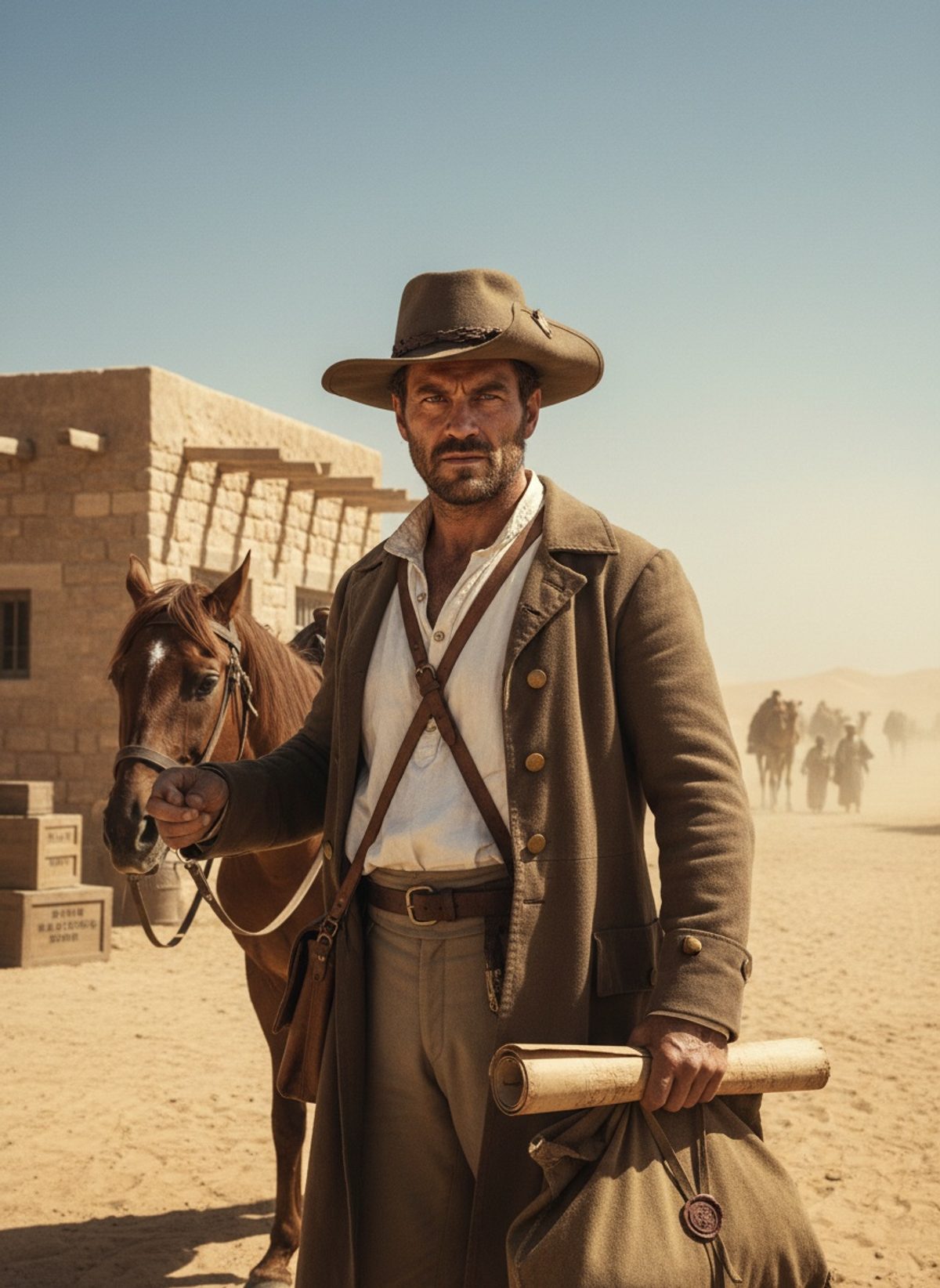
Thomas Waghorn was not a seasoned explorer. He was a postal officer and a dreamer with an audacious plan. In 1835, he would transform the entire British Empire’s communications with India.
The Restless Innovator
Thomas Waghorn's journey began not in the bustling metropolises of London or Calcutta but rather from a distinct sense of dissatisfaction and possibility. The monotonous four-month voyage of the empire's mail to India was an affront to his innately restless spirit. In a time when sea routes dictated the tempo of communication, Waghorn envisioned a daring alternative. Through the seemingly impenetrable sands of Egypt and its treacherous terrain, he saw a beacon of speed that others failed to perceive.
Born to a maritime world that prided itself on the might of its fleets, Waghorn dared challenge its hegemony by reverting to land. Geographically audacious and modestly resourced, he had the ingenuity to recalibrate the passage of critical information across continents by cutting through the heart of the desert.
Deserts, Deals, and Determination
The Overland Route was not merely a line on a map; it was a feat of sheer human resolve. Waghorn set off to journey through Egypt, beginning an epic tale of the lone rider against the vastness of sand and time. Armed with little more than his determination and understanding of how bureaucracies worked, he found himself negotiating passage rights and ever-fluctuating tolls—bribing where persuasion failed, bargaining where demands were steep.
Read next: When Robert Fortune Stole China's Tea Secrets, 1848
His encounters were as diverse as the landscapes he crossed. From thrifty camel drivers to bemused local officials, Waghorn navigated not only physical but also cultural terrains with agility. The stories of him paying out of his own pocket to grease palms for passage rights spread like wildfire, underlying a determination to see his endeavor succeed no matter the personal cost.
The Proving Ground
Egypt, in 1835, was not the tourist-heavy, semi-modern crossroads of antiquity it is today. It was a harsh, unpredictable frontier. Waghorn’s solitary trek was marked by blistering heat, unpredictable desert storms, and the ever-present threat of marauders. Yet these challenges fortified his resolve. As he charted the route, each mile offered new insights and unexpected stories, each adversary turned ally marked another triumph against improbability.
The culmination of his efforts presented itself not merely in reaching the other side of the Suez Isthmus but in the exponential reduction of time—cutting the mail service from several months to just over half that time. His experiments in desert-crossing logistics had forged a new artery for commerce and communication with India, both central to cementing Britain’s global influence.
Though the Hourglass
Waghorn’s pioneering Overland Route was not just a logistical triumph; it reshaped the conception of empire altogether. His successes prompted imitators and inspired innovators, leading to the establishment of more structured services. This postal artery became thicker over the years—first came travelers, then investors, and eventually, a wave of imperial investment that would forever alter Egypt’s infrastructure.
Although not Waghorn’s original intention, his quest indirectly sowed the seeds for the Suez Canal, further changing the dynamics of global trade and communication. The Overland Route and the eventual canal symbolized more than a shortening of delivery times. They represented the shrinking of the world, the knitting of distant shores through shared stories and dreams, and the relentless, if complicated, march towards modern connectivity.
Beyond the Route
Waghorn's audacious vision went beyond mere logistics. It posed significant questions about British imperial politics and expansion, and the role a single, determined individual could play in shifting an empire’s trajectory. In a world moving at the pace of sail and steam, Waghorn’s exploration of overland speed merged the realms of possibility with practical reality. It’s a story that reminds us that paths less traveled and people often underestimated can redefine the contours of an age.
As technology marches forward and global communication becomes instantaneous, Waghorn's legacy invites reflection on the power of human tenacity. The persistence that led to the creation of the Overland Route has echoes today, calling into question the constraints we knowingly accept and the unknown opportunities we dare not face. Such stories shape not just our past but provide blueprints for a bolder, more interconnected world.