Most people have never heard of Robert Fortune. They should have.
The Kingdom of Tea
In the mid-19th century, the world was in the grip of a fervent thirst for tea—a commodity more precious than gold to the British elite. China, with its lush, misty hills of Fujian and Yunnan, was the unrivalled tea kingdom. The British Empire, ever thirsty and financially starved by the costly Chinese monopoly, found its coffers hemorrhaging silver to satiate the endless demand for this fragrant brew. Tea was an essential component of British culture but came at a painful price. The intricate art of tea cultivation and processing was a closely guarded treasure of the Chinese, a secret that would elude British grasp if not for an audacious gamble involving a single botanist.
The Secret Agent in Disguise
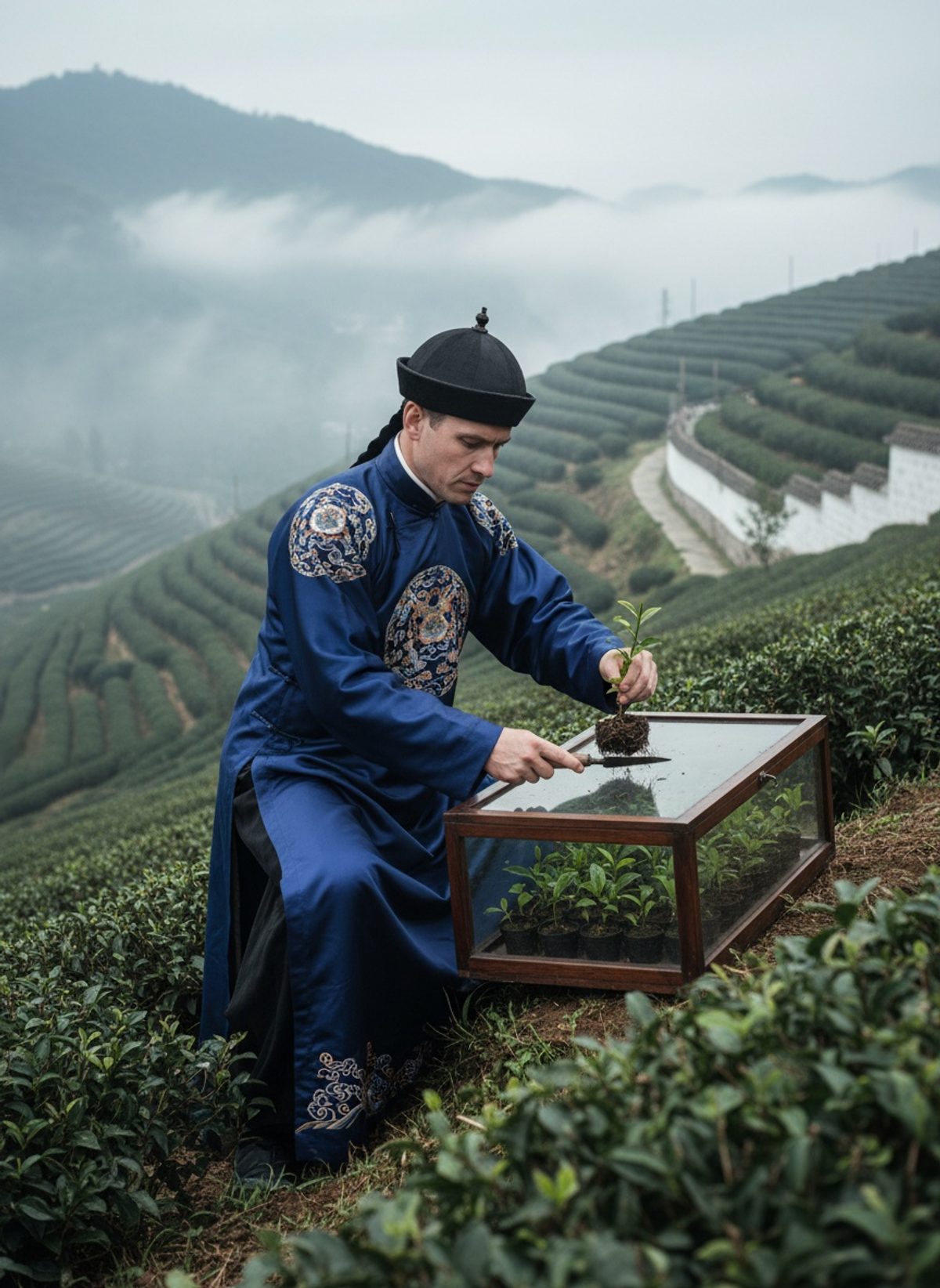
Enter Robert Fortune, a Scottish botanist employed by the British East India Company. In 1848, Fortune embarked on a clandestine mission that reads more like an espionage thriller than a botanical expedition. Accepting the perilous mission, Fortune ventured into the heart of forbidden Chinese landscapes. Donning the disguise of a Chinese Mandarin, complete with traditional garb and a shaved head with a delicate pigtail, Fortune risked everything, including his life, to procure the secrets of tea production locked away in China's remote plantations.
The initial stages of his journey saw Fortune navigating rivers on local junks and trailing through village markets with a controlled nonchalance. Speaking Mandarin proficiently, a skill he had diligently acquired, enabled him to seep effortlessly into environments that no Westerner had dared enter. Fortune had little beyond the clothes on his back, an insatiable curiosity, and the famed Wardian case—a forerunner of the modern terrarium—to make one of the most pivotal acquisitions in commercial history.
Read next: When Thomas Lipton Auctioned His First Chest of Ceylon Tea, 1890
The Great Tea Heist
Fortune's daring exploit was not merely a tale of navigating unknown territories but rather of collecting entire ecosystems in miniature. He meticulously gathered tea seeds, plants, and shrubs, ensuring their preservation through the Wardian cases. These seminal vessels allowed for a microcosm of the Chinese tea gardens to be transported over great distances, shielding the plants from the harsh elements of sea travel. Each leaf or bud was more than green gold; it was a living secret of centuries-old cultivation and processing techniques.
Fortune traversed the perilous terranes of China, from the verdant slopes of Wuyi Mountains to the bustling workshops of Hangzhou, absorbing the alchemy of tea. He watched the dexterous hands of tea masters rolling and drying leaves, capturing the wisdom that could transform British India into a rival empire of tea cultivation. It took not only singular intellectual acumen but also a shrewd understanding of human nature—aided by bribes and bluff—allowing him to extract pivotal knowledge that went beyond mere botany.
Scripting a New World Order
Upon his return, Fortune's successes reverberated across the British Empire. The transplanted tea gardens in the hills of Darjeeling and Assam flourished, blooming into a vast new industry that would break China's monopoly. By enabling the British to cultivate their own tea, he altered the arc of economic dependency, shifting the power dynamics of global trade. British high society sipped afternoon tea, unaware that every sip was steeped in a tale of surreptitious adventure and espionage.
Fortune’s daring expedition exemplifies the lengths to which empires would go to subvert monopolies even as they built others. His journey altered international trade, diminished British dependency on China, and laid the groundwork for India to become a significant player in the global tea market. Robert Fortune’s covert operation was not just a botanical procurement—it was a reconfiguration of power, culture, and industry.
In a world where trade often hinges on the tenacity to cross frontiers, both physical and ethical, Fortune’s legacy beckons us to reconsider the murky intersections of commerce, culture, and innovation. As history unfolds, it reveals stories that were never penned, written in the language of risk and reward—a language Robert Fortune understood fluently.