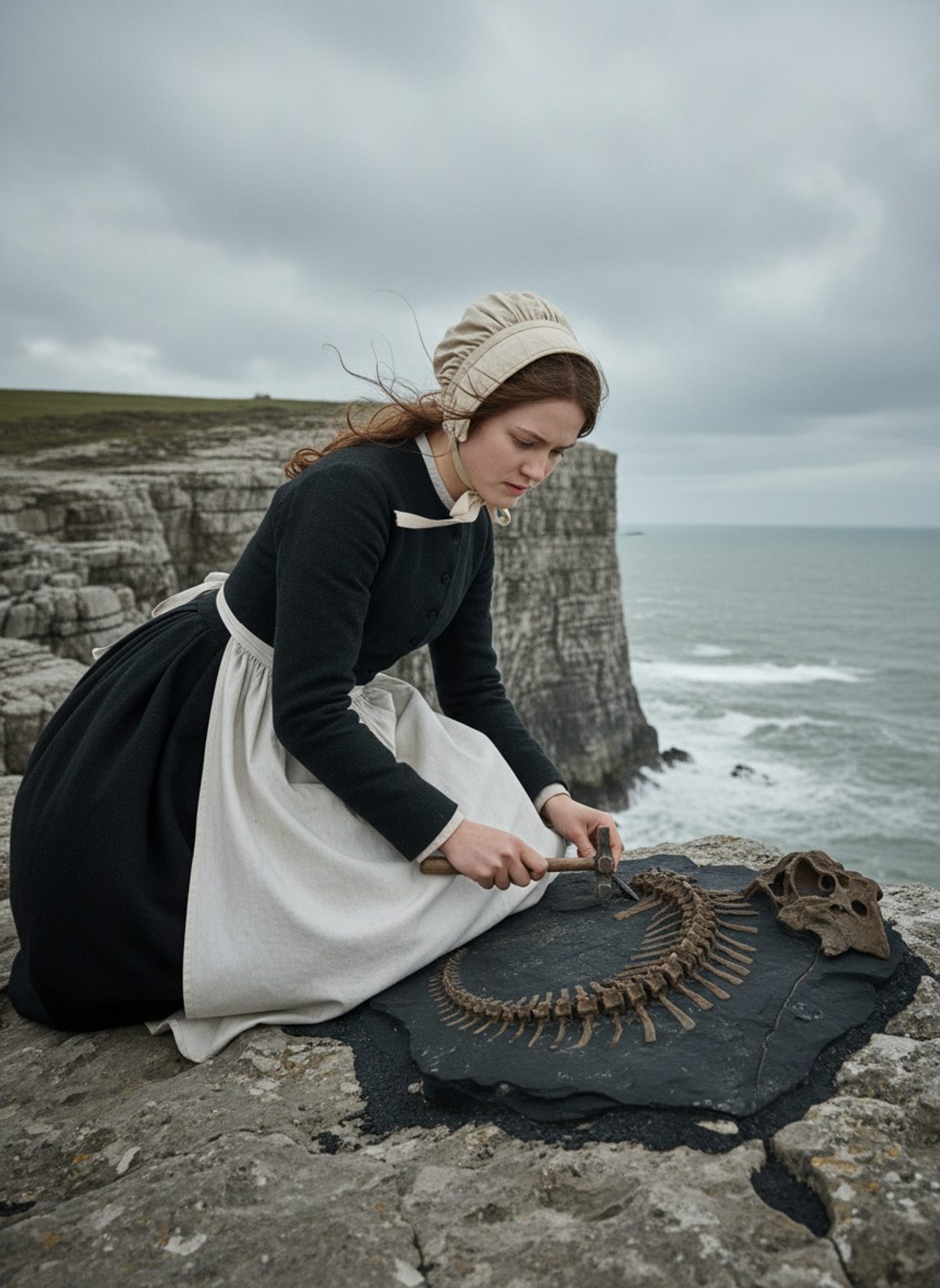
1811. The rugged cliffs of Dorset stood defiantly against the ceaseless erosion of the pounding waves.
The Serpent in the Stones
On that quiet coastline, against a backdrop of grey skies and crashing seas, a discovery awaited that would shake scientific understanding to its core. Mary Anning, a twelve-year-old girl armed with nothing but her curiosity and a rudimentary paleontological hammer, unearthed a reptilian skull unlike any other. The sea-washed stones of Lyme Regis held secrets older than time, as Mary and her brother Joseph would soon uncover.
Scrambling over jagged rocks and dodging landslides was part of Mary's daily routine. Her eyes, sharp and intuitive from years of scanning for curiosities, caught sight of something extraordinary—a fossil so mammoth that it announced itself even before it was fully freed from its ancient grave. The skull of an enormous creature—what would later be identified as an Ichthyosaurus, or a "fish lizard”—emerged from the cliffside. This prehistoric sea monster seemed to leap through time, connecting the present day with a primordial past.
The Silent Avenger of Science
In an era where women were relegated to the fringes of scientific discourse, Mary's finds spoke for her. Yet, they spoke louder for the men who translated her discoveries into scientific acclaim. Her Ichthyosaurus was displayed and scrutinized in London, achieving a blend of awe and academic excitement. It begged the question—what other creatures lurked beneath the cliffs, waiting for someone brave enough to uncover them?
Read next: Valentina Tereshkova Had No Parachute Training. She Flew Anyway.
Behind the curtain of these academic achievements was Mary, barely acknowledged, rarely credited. Science at the time was dominated by men, and women, let alone young girls from working-class backgrounds, had little stake in the unfolding narratives. However, her relentless pursuits quietly seized the attention of eminent scientists, even if the credit did not always follow.
The Library of Lost Worlds
Between 1811 and 1823, Mary’s endeavors were unyielding. Her subsequent discoveries would include two more gigantic creatures. Each one challenged contemporary understanding of natural history. The Plesiosaurus—which resembled something from the depths of mythical imagination—and a Dimorphodon, an early flying reptile, expanded the roster of paleontological wonders.
The residents of Lyme Regis knew Mary as something of a local legend, but the halls of academia echoed with different names. Notably, Georges Cuvier, the formidable French naturalist, even doubted the authenticity of the Plesiosaurus until further evidence compelled him to rescind his skepticism. These fossils were given lives on paper by men who interpreted them from afar, with little mention of the girl scraping away rock on the wind-battered shores.
The Quiet Catalyst
What drove Mary Anning was more than personal interest. The perilous work on unstable terrain was not just a childhood adventure—it was a livelihood. The Anning family, like many of their time, faced economic hardships. Each discovery was both a scientific breakthrough and a means to put bread on the table. Selling these fossilized fragments of history to collectors and scientists kept the family afloat.
But Mary’s work resonated beyond her personal circumstances. Her finds prompted discussions about extinction, an idea still controversial at the time. They nudged the scientific community toward a deeper inquiry into Earth's distant past, long before Charles Darwin's *On the Origin of Species* would spark its revolution. Mary, with her unending patience and unyielding spirit, became the quiet catalyst for these monumental shifts in thought.
The Echoes of a Silent Legacy
Mary Anning’s life did not culminate in accolades or widespread recognition. She passed away largely uncelebrated, her name absent from the formal scientific records. Yet, the imprints she left on the cliff faces of Lyme Regis continue to reverberate through history. With each species she revealed, she chipped away at the rigid structure of scientific hierarchies, illuminating paths for those who would follow.
In our contemporary world, the story of Mary Anning speaks volumes about the unsung architects behind groundbreaking advancements. It challenges us to reconsider who holds authority over knowledge, whose stories are told, and who remains at the margins. As history continues to unfold, her legacy serves as an endless reminder of the profound contributions made by those history nearly forgot. From the shadows of an ancient shore, Mary Anning continues to tell her tale.