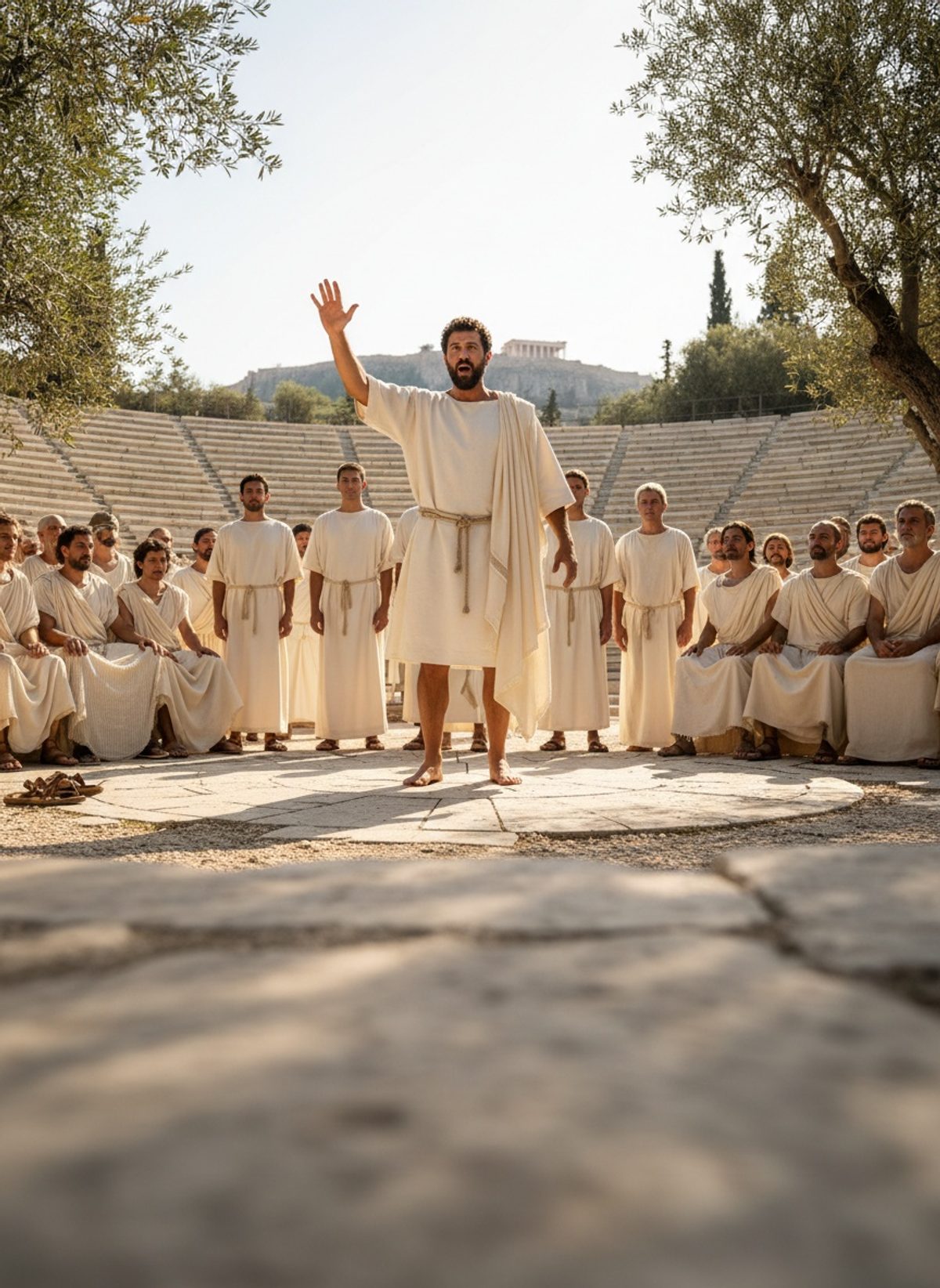
The sea of expectant faces shifted like restless waves, mingled with laughter and anticipation as the sun-drenched air buzzed with festival excitement. The smell of roasted meat and sweet wine saturated the vibrant setting, where the heart of Athens pulsed with dramatic expectancy. Amidst the echo of footsteps and murmured conversations of the gathered masses, a single figure emerged from the throng, stepping forward with a deliberate, transformative purpose. Thespis stood on the makeshift stage, the air electric with unspoken potential. Then, his voice broke through the cacophony, not as a collective chant but singular and distinct, claiming the persona of a character all his own. In that powerful moment, without fanfare or grand announcement, something extraordinary unfolded—a new art form was born.
The Chorus Dominates the Stage
Before Thespis, the spiritual and cultural tapestry of Athens was embroidered with grand festivals dedicated to the gods, most notably Dionysus, the deity of wine, fertility, and theatre. These gatherings were as much a staple of Athenian society as the newly rebuilt Acropolis would become a symbol of their national identity. Central to these festivities was the chorus. A synchronized body of performers who, like an ancient Greek Instagram feed, provided a consistent, communal narrative to relay the tales of gods and heroes. They moved and spoke as one, weaving stories with a rhythm and harmony designed to hypnotize their onlookers.
The role of the chorus was both spiritual and entertaining, believed to invoke and honor the divine. Green laurel wreaths adorned their heads as their voices soared, often accompanied by the haunting melodies of the lyre and aulos. Crowds were swept up in these mythic retellings, driven by collective energy and emotion. Yet, with all its grandeur, the chorus remained a faceless entity, where individuality was overshadowed by collective unity. Until Thespis's audacious departure, the idea of a singular voice—a protagonist—had remained unthought. But change was in the Athenian air, fertile with curiosity and innovation.
A Lone Voice Rises
Thespis's choice to step forward from the chorus that day in 534 BCE was as bold as it was revolutionary. Clad in garb worthy of a character's plight, he did the unthinkable—he spoke not merely as part of the ensemble but as a distinct persona. His voice adopted inflections imbued with the emotions and perspectives of another being. Suddenly, an artifice emerged. His audience, initially stunned, became enraptured as they experienced, perhaps for the first time, the confluence of art and empathy. A man became another in spirit, revealing the potential for storytelling to portray the deep, varied complexities of human experience.
Read next: Valentina Tereshkova Had No Parachute Training. She Flew Anyway.
This lone voice, carving through the crowd's murmurs, showcased the essence of human creativity and interpretative power. It was not himself speaking; it wasn't even Thespis by any traditional sense. It was a character from the past—someone who lived in stories and legends. With every word, Thespis brought forth a tapestry of emotion and conflict, the likes of which the world had never seen. His innovation—a confluence of theatrical audacity and narrative magic—laid the cornerstone for all acting, for the play was no longer simply a tale told by many but a dialogue driven between personalities.
Birth of the Actor, Seeds of Drama
Thus, Thespis became the world's first known actor, a title immortalized in the annals of history with terms we've grown familiar with today. Thespians, actors, drama—all these terms owe their origins to that singular moment of inspiration. Perhaps unbeknownst to Thespis himself, his immortal step out of the chorus did far more than birth acting. It laid the ground for a culture to reimagine theatre's capacity to mirror the human soul and ponder existential questions.
Actors, henceforth, could slip between myriad roles, transcending their own identities. They could convey diverse emotions, question ideals, and reflect deeply on societal norms. Each play became a microcosm, encapsulating human dynamics that were as varied and endless as the grains of sand on Athens' shores. Without Thespis, there would be neither Oedipus nor Hamlet, no Stage of Epidaurus nor Globe Theatre. The ramifications of his innovation rippled out, providing a framework within which storytellers could weave their tales of intrigue, tragedy, and comedy alike.
Why It Matters
In contemporary terms, Thespis's leap from the chorus is a story that resonates on many levels. It was more than a simple act of innovation; it was a disruption of cultural norms that fostered a new realm of expression. His bold departure speaks to the power of individual voices—how they can herald change and ignite inspiration across ages. Through the ages, theatre has served as a vessel for societal reflection, offering mirrors into personal and collective human experience. In today's world, where stories help shape identities and global communities, Thespis's legacy remains a timeless testament to the power of stepping forward from the comfort of the crowd.
The ancient Greeks may not have grasped the full spectrum of transformation that Thespis's solo performance embodied, but his spirit echoes continuously in the spontaneous standing ovations of Broadway and the revered silences of Shakespearean theatres. Every actor today, knowingly or not, harks back to that historical act of creativity that saw Thespis do something none before him dared—speak alone, and in doing so, speak for everyone.