The midday sun poured over the small town of Corinth, its rays cutting through the cool spring breeze and casting long shadows on the cobbled streets. Amidst the bustling marketplace and echoing laughter of children, an aura of excitement charged the air as rumors spread like wildfire. There, in a patch of reclaimed sun, lay Diogenes of Sinope, a man of simple wants but unwavering spirit, soaking in the warm light. Unbeknownst to him, the tide of history was about to shift dramatically with the arrival of Alexander the Great, a man whose ambitions stretched well beyond the Greek mainland.
The Meeting of Titans
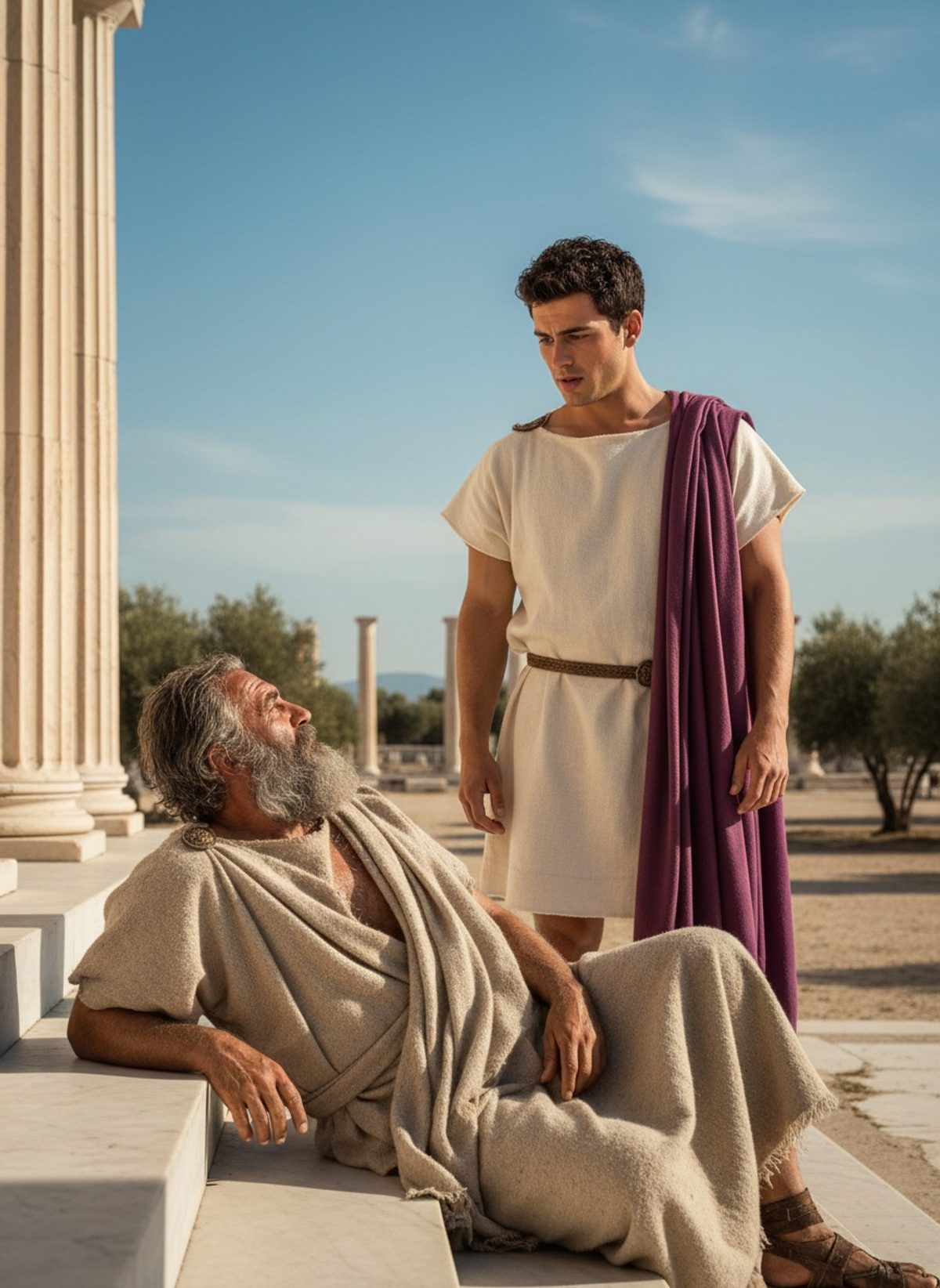
Diogenes, often seen as a curiosity himself, had long settled in Corinth after years of wandering. Living in a large, hollowed-out ceramic jar, he relished a lifestyle stripped of all but the most basic necessities. The legendary philosopher was notorious for provoking society with his audacious challenges to convention and status. As the story goes, even when the most powerful man of the known world, Alexander the Great, came seeking him out, Diogenes was unruffled. Sitting comfortably in his modest corner of the marketplace, he did not rise to honor the conqueror nor did he feign respect or awe.
Alexander, renowned for his strategic brilliance and charismatic leadership, had recently become the commander of all Greece, with plans to carve an even larger empire from the world map. Hearing tales of Diogenes' radical wit and independence, he decided to seek wisdom from the philosopher who seemed immune to the trappings of power. Alexander approached Diogenes and, perhaps intrigued by the philosopher's notorious reputation, inquired if there was anything he could do for him. It was at this moment, in the heart of the bustling city with all eyes on these two colossal figures, that Diogenes famously requested, "Yes, stand aside. You are blocking my sun."
The Philosophy of the Sun
This scene resonates deeply within the rich tapestry of history for its simplicity and profound wisdom. To someone like Alexander, who had grown up in a world where power equaled respect, such a request was shocking in its boldness. To Diogenes, the sun represented life's simplest pleasures and the one thing he valued most: the freedom to exist unencumbered. It was a stark contrast to the glorified vision of a ruler's role according to Macedonian culture. In Diogenes' worldview, the trappings of physical luxury and universal domination meant little compared to the warmth of the sun.
Read next: Pheidippides Ran to Sparta. They Said No. He Ran Back.
This seemingly trivial exchange was a masterclass in Diogenes' cynicism, a school of thought that he personified with flair. It was a belief system that eschewed societal norms and encouraged a life of virtue in agreement with nature. Diogenes believed true happiness and freedom could only be achieved through self-sufficiency, which was not something Alexander or his retinue could easily comprehend. This simple request left an indelible mark on history: it served as a provocative reminder that power and wealth may indeed pale in comparison to the sheer, unadulterated pleasures life naturally offers.
Alexander's Reflection
Alexander reputedly said afterward, "If I were not Alexander, then I should wish to be Diogenes." This statement reflects a moment of introspection for a conqueror who had everything - wealth, power, armies - but perhaps envied the fabled philosopher for his inner peace and freedom. Historians, philosophers, and scholars have long debated the veracity of this encounter. Yet, its symbolic nature transcends its historical accuracy, capturing the fundamental clash between worldly ambition and philosophical contentment.
The young king, on some level, may have recognized that Diogenes epitomized a different kind of ruler's grace - one that governed only the self, ungoverned by empire or ambition. In this brief encounter, the very essence of competing worldviews stood exposed. Alexander, who dedicated his life to expanding realms and busting barriers, faced Diogenes, who found liberation in the confines of his ascetic life.
Lessons from the Sunlit Philosopher
As the story of Diogenes and Alexander reverberates through history, its narrative remains compelling because it confronts contemporary society's own values. What is power if not a shadow cast over the individual freedoms that comprise true happiness? In Diogenes' request, we find a challenge to rethink notions of satisfaction, success, and the true essence of wealth. Here lies a reminder that the sun’s warmth, uninterrupted, provides a metaphorical illumination far richer than any golden crown.
In its simplicity, the tale of Diogenes and Alexander speaks to something elemental in the human condition: the seemingly eternal quest for more versus the philosophical contentment with less. As with many anecdotes from antiquity, the specifics may blur with time, but their lessons endure. A sunbeam, it turns out, may sometimes outshine an empire.