The Portuguese had a plan. Queen Nzinga had something else entirely.
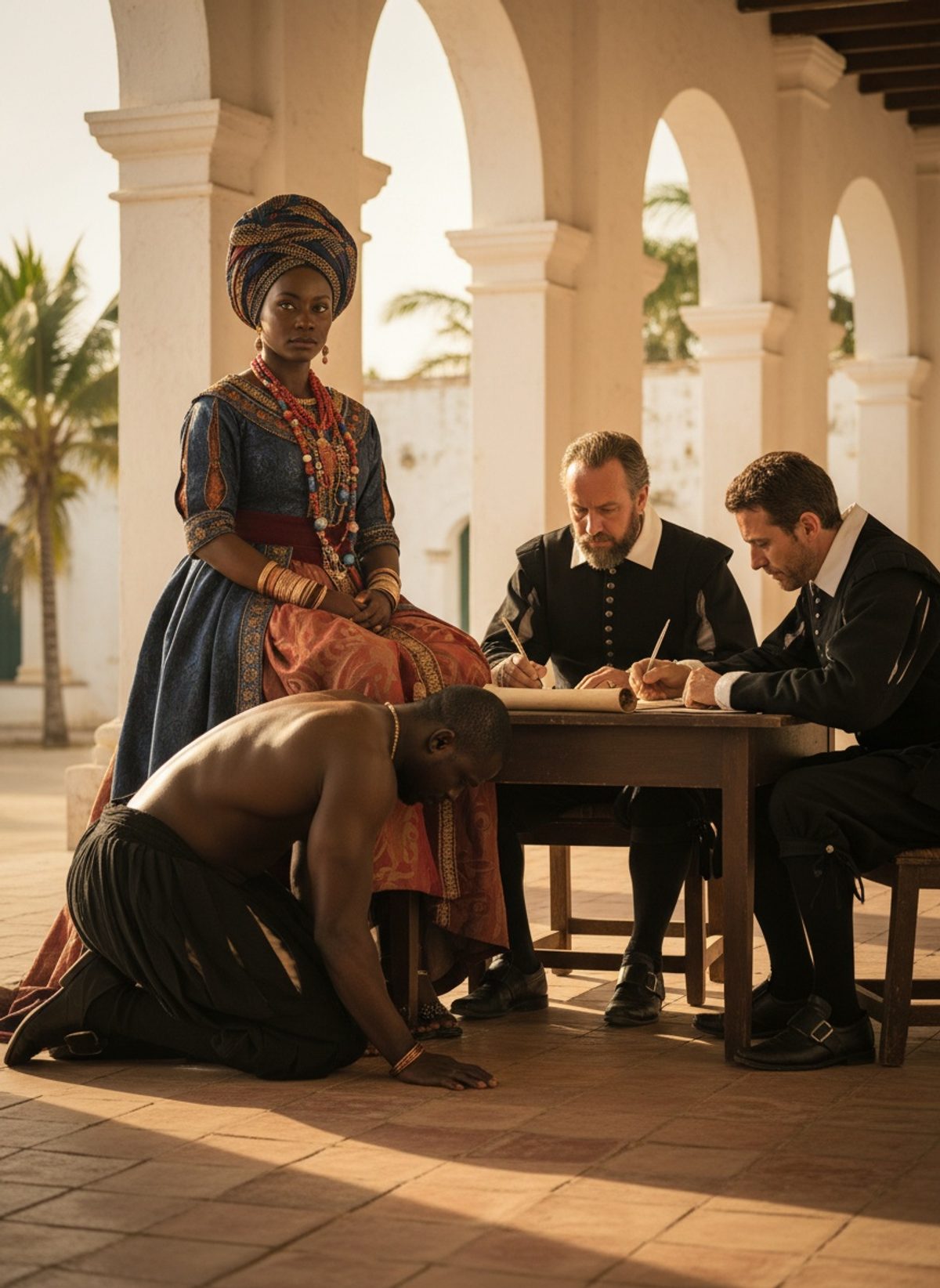
In 1622, the grand halls of the Portuguese colonial outpost in Luanda, present-day Angola, were primed for what was supposed to be a triumphant moment for the European power. They had summoned Queen Nzinga Mbande of the Kingdom of Ndongo for peace negotiations, intending to force her into subservience. Such meetings were diplomatic chess matches, and every detail was a calculated move. The Portuguese governor, fully aware of this, had made sure that their strategy was clear as Nzinga entered: there was no chair for her, merely a mat on the floor. This seemingly small act was a considerable affront—an attempt to visually and symbolically establish European dominance by physically lowering the queen's status. But Nzinga was no ordinary ruler, and she was not to be easily dismissed or humiliated.
Nzinga assessed the room, her gaze unyielding and unfazed despite the anticipated attempt at degradation. She knew exactly what was at stake; beneath the veneer of diplomacy lay the brutal ambitions of colonial conquest, which had already laid waste to numerous African kingdoms. Allowing herself to be looked down upon would not only humiliate her personally but also her kingdom and its people. Her decision in those few tense moments would reverberate through history.
With a cool, commanding presence, Nzinga turned to one of her attendants and issued a silent signal. In an unexpected and audacious move, the attendant lowered himself onto all fours, creating a makeshift throne of flesh and bone for his queen. Nzinga calmly settled onto his back, elevating herself to look her Portuguese adversaries squarely in the eyes. This was no mere affront nor a display of defiance; it was a power move in its purest form, laying a foundation for parity and mutual respect. The air in the room shifted palpably. The Portuguese were taken aback, outmaneuvered in a single, silent stroke that spoke volumes about the strength of the woman they were dealing with. This was the moment Queen Nzinga began negotiating, embodying her equal standing and dignity with every word she spoke.
Read next: Ahmad Baba Was Dragged in Chains. He Taught Anyway.
Nzinga's story is one often glossed over in classrooms, yet it offers profound insights into the nature of resistance against colonial forces. Born into the royal family of Ndongo, Nzinga Mbande was shaped by a world on the brink of transformation, where traditional kingdoms faced European incursion and its attendant challenges. Her ascent to power came amidst chaos; her brother's reign was marred by constant warfare with Portuguese colonizers and African rivalries, and upon his death, Nzinga seized the moment to take the helm. Her people's plight—not merely the machinations of external enemies—demanded a leader who was astute, cunning, and above all, adaptable.
The meeting in Luanda was a turning point, showcasing Nzinga's uncanny ability to leverage a seemingly disadvantageous position to her benefit. But this instance was only one facet of her multifaceted resistance, strategies that unfolded over decades. While many European powers sought to divide and conquer African nations through a combination of force, religion, and commerce, Nzinga demonstrated an unparalleled savvy by manipulating these very tools to her advantage. Switching religious affiliations as needed to secure alliances and adopting tactical retreats, she crafted a narrative of fierce sovereignty. It was a complex, often precarious stance, but it was one that kept her kingdom not just afloat, but resilient against perpetual pressure from foreign interlopers.
Nzinga's reign was marked by cunning alliances, fierce battles, and deft political maneuvers. Not one to shy away from conflict, she engaged in numerous battles with the Portuguese, understanding that kinetic warfare was as much a bargaining tool as any diplomatic truce. These exertions were not in vain; her kingdom served as a bulwark against further colonial encroachments, a beacon of resistance that inspired both fear and admiration. Through a carefully choreographed series of treaties and confrontations, Nzinga carved out a precarious peace for her people at a time when their very existence was under threat.
To many, Nzinga became a symbol of unyielding defiance—a queen who, in her refusal to be downtrodden, embodied both the struggle of her people and the indefatigable spirit necessary to retain their dignity. Her efforts bought her people precious time, delaying full colonization efforts and providing a model for resistance that would resonate through the centuries. It demonstrated that even under the harshest conditions, leadership could weaponize respect and dignity as thoroughly as steel and powder.
Nzinga Mbande's legacy extended beyond her immediate victories and defeats; the stance she took that day in 1622 laid a foundation of resilience and potential for unity among African kingdoms. Her story is a testament to the indomitable spirit of those who stood against the tide of colonialism and offers a striking reminder of the many narratives sidelined in traditional historical discourse. Her courage and ingenuity are not just relics of a distant past, but enduring testimonies to the power of agency and autonomy—a lesson that echoes profoundly as communities and nations continue to navigate the complex legacies of colonialism. The queen who sat on a human throne defied gravity imposed by an empire, teaching the world that dignity and power are self-determined truths. Even empires couldn't overlook her lesson. Portugal, indeed, never forgot it.