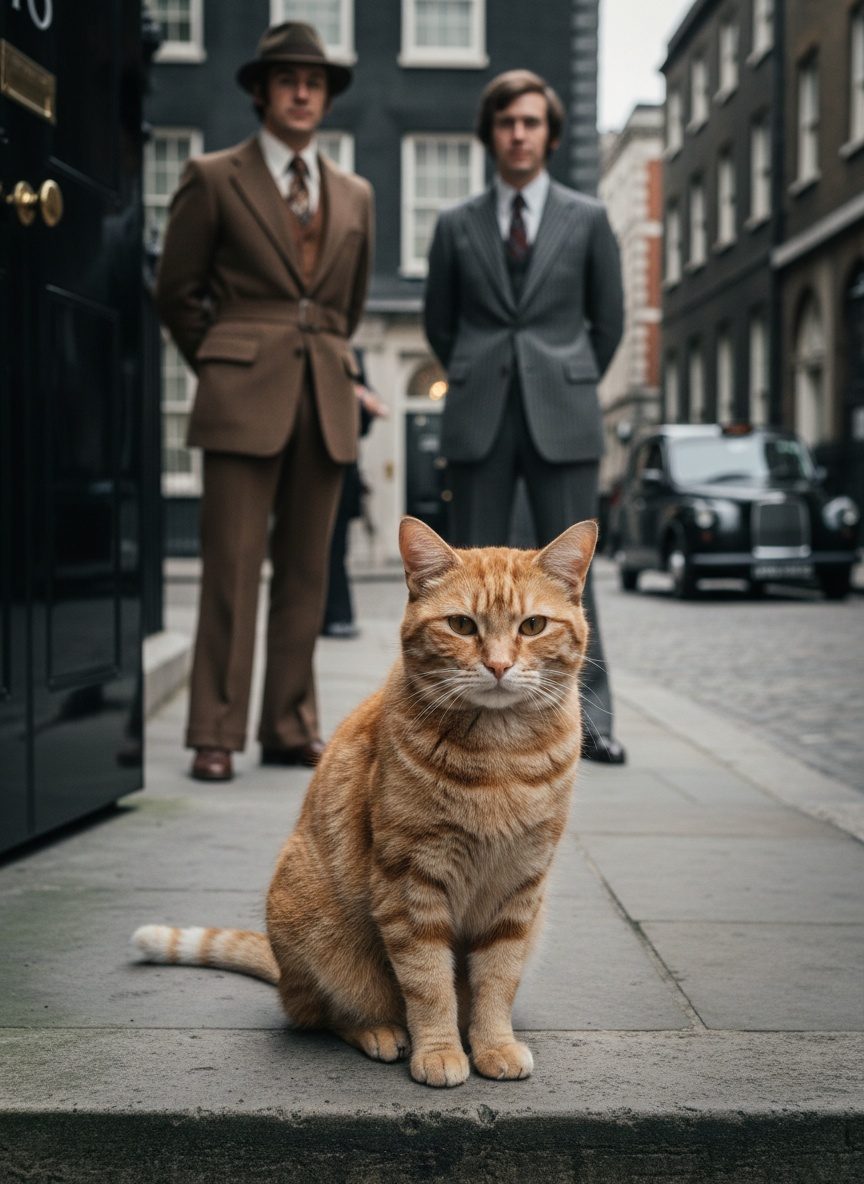
Imagine this: the heart of British political power, 10 Downing Street, with its stately black door, brass letterbox, and tumultuous history. The prime ministers came and went, riding the tides of war and peace, scandal and reform. Yet amidst the ever-changing human landscape, a quiet, furry constant prowled the halls, a tiny bureaucrat with a formidable title: Chief Mouser to the Cabinet Office. Beginning in 1929, the legacy of the official Downing Street cat is a tale of resilience, charm, and the curious intersections between power and purr.
The Inception: A Feline Tradition Begins
It was the year 1929 when the corridors of British power took an indelibly whiskered turn. The stock market had recently crashed, the Roaring Twenties ground to a halt, and Ramsay MacDonald was helming a fragile Labour government. In the face of adversities, even Downing Street was not immune to a very practical problem: mice. The solution, brilliant yet unassuming, lay in the employ of a tabby dispatched by the civil service to tackle this four-legged menace.
The first official Chief Mouser, a nameless tabby, cost a mere penny a day for sustenance — beguilingly economic for a solution that worked tirelessly, requiring neither pension nor paid leave. This tabby, like many of its successors, quietly patrolled 10 Downing Street’s shadows, attending to the rodent problem efficiently and elegantly.
Four Prime Ministers and a Singular Cat: Wilberforce's Reign
When it came to longevity, perhaps no Downing Street cat made a mark as distinct as Wilberforce. Appointed in 1973, he served through four prime ministers: Edward Heath, Harold Wilson, James Callaghan, and Margaret Thatcher. A smoky-black feline with penetrating eyes, Wilberforce was more than just a working mouser; he became a fixture, a solemn presence that outlasted the shifting sands at the top.
Read next: The Day a Blind Pauper Boy Sang Before a Queen
An epitome of feline gravity, Wilberforce once reportedly startled Margaret Thatcher by nonchalantly strolling through a pivotal meeting, a testament to his characteristic disregard for protocol. His dedication extended beyond mere mousing — one tale tells of Thatcher requesting Wilberforce’s advice on a speech, whimsically implying the cat’s silent wisdom in moments of human trial.
Old and New: Humphrey and the Winds of Change
As Thatcher’s era concluded, a new chapter opened with a successor, John Major. Yet it was another kind of major shift that marked the end of Wilberforce's dynasty when Humphrey arrived in 1989. This black-and-white cat became notable not just for his effective mousing but for his remarkable ability to headline the tabloids with his disappearances and returns.
Humphrey wasn’t just any cat; he became a symbol in his own right, inspiring tongue-in-cheek debate in Parliament and causing a stir with his "disappearance" in 1994 — a saga that would result in a comeback worthy of a soap opera. Unlike Wilberforce’s quiet service, Humphrey's time at Downing Street was peppered with drama, speculation, and a media-savvy retort to the new politics of the 1990s.
Larry the Untouchable: A New Era at No. 10
Then came Larry. In 2011, a pivotal feline arrived, sealing his place in British history. Introduced during David Cameron’s tenure, Larry’s appointment came amidst heightened media scrutiny and a rather public mouse sighting caught on live TV. Rescued from Battersea Dogs & Cats Home, he quickly adapted to the challenges of high office with a confidence born of his tabby lineage.
Larry's reign was remarkable not just for its duration — he held his post through Cameron, Theresa May, and Boris Johnson — but for his unshakeable claim to the residence. Unlike his predecessors, he revolved around the media limelight, courtesy of a dedicated Twitter presence chronicling his escapades. Resistant, independent, and immovable, Larry symbolizes continuity in an era of uncertainty.
Nine Lives and Counting: What the Mouser Teaches Us
As we near a century since the first cat earned its keep at No. 10, the Chief Mouser’s role is more than ceremonial. Each feline has been a silent observer of profound change: through crashes and booms, through war and peace, as Britain itself metamorphosed on the global stage.
Their stories, interwoven with the fabric of iconic administrations, remind us of the juxtaposition between the transient nature of politics and the enduring simplicity of daily life. Even as governments fall and renew, the humble mouser continues, unperturbed, demonstrating a contentment we might envy — or emulate.
In a world marred by constant rapid change, the presence of a cat at Downing Street is an uncommon constant. They teach by example that longevity and wisdom are crafted quietly, one scratch on the post at a time. These are the legends they left out of the textbooks — but in their quiet service, these felines have captured their own corner of British legend.