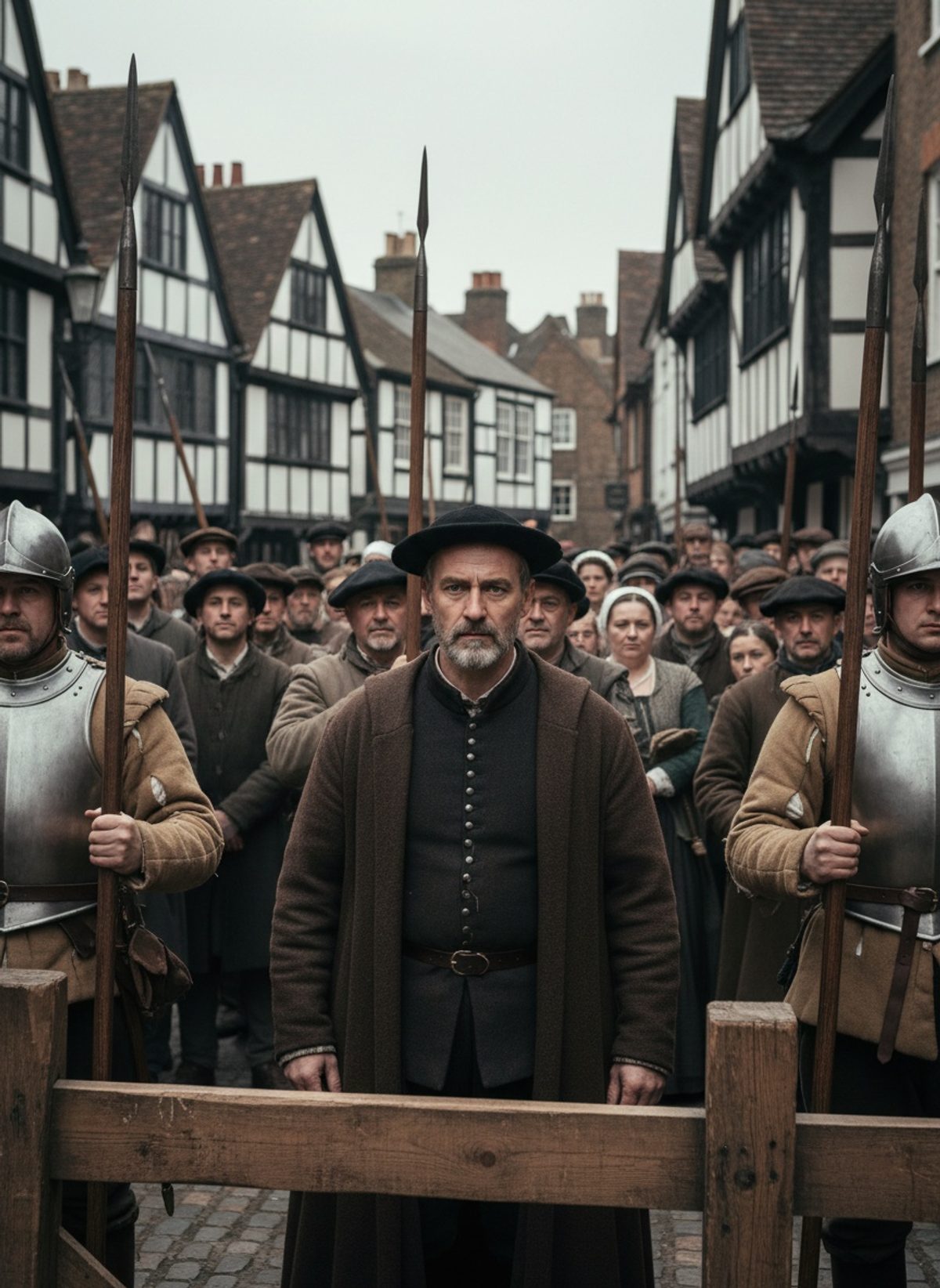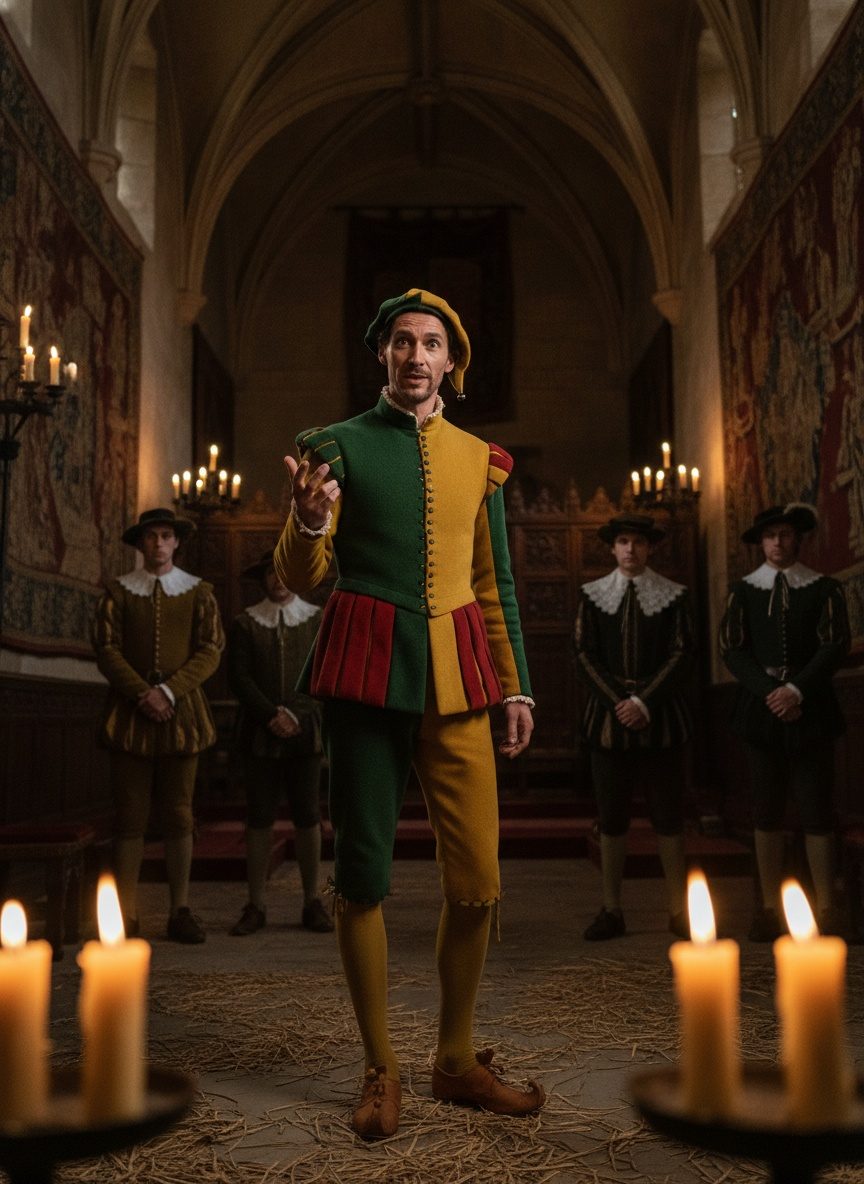
The air in the Great Hall of Hampton Court was thick with the scent of sweat and fear. The clinking of goblets and clattering of plates came to an abrupt halt, leaving a silence that hung ominously in the air. Every eye was fixed upon the jester in motley, his presence oddly commanding amidst the finery. Will Somers, with his quizzical grin and sharp eyes, stood before the most powerful man in England, ready to speak the unspeakable.
Henry VIII, a magnificent yet terrifying figure, reclined in his great chair, a chalice of wine poised between his fingers. The king's mood was as volatile as the North Sea; a wrong glance could lead to the Tower, a misplaced word to something far worse. Yet Somers, his fool, possessed a rare gift: the ability to speak truths that others only dared to think. Will's tongue, sharpened by wit and tempered by lunacy, could cut through the court’s layers of political deceit and shallow flattery as no sword ever could. It was a feat as perilous as walking a tightrope over molten steel.
On this day in 1535, Somers had decided to perform such a feat. It began with a jest, a typical start for the fool, one that quickly danced into dangerous realms. Courtiers shifted in their seats, exchanging nervous glances like startled birds. The present conversation, merely a jest about wealth and taxes, held all the potential of a brewing storm. Unwavering, Somers continued, a mischievous twinkle in his eye betraying none of the tension that etched his audience's faces. He had a knack for using humor's disarming nature to approach topics that were otherwise forbidden.
“Your Majesty's coffers must groan heavier than the weight of the crown itself,” he quipped. A ripple of chuckles rolled through the hall, edged with unease. Every courtier knew the outrage over the king’s financial excesses was growing beyond the walls of Hampton Court. The laughter was a gamble — one that bet against the king’s sharpened ire and penchant for vengeance. Yet Somers showed no sign of retreat. “But perhaps,” Will added slyly, “it's the headsman's axe that should whet its edge against this gold you so cherish?” The room drew breath, silence once again its master.
Read next: The Day a Stuart King Walked Calmly to His Own Execution
Henry’s expression remained inscrutable, demanding answers from each eye turned toward him, yet finding no solace in another’s gaze. And then, a glimmer of something unexpected: mirth. The corners of the king's lips twitched, betraying a quiet reverie. The absurdity of the fool’s words peeled back layers of fear and formality, leaving only the humble human truth that no fear could silence. Henry laughed, a low rumble that crescendoed into a booming echo. The hall, hesitantly at first and then with increasing vigor, shared in his humor.
Once the laughter had ebbed, the room marinated in a fragile peace. This was Somers' kingdom: where candor thrived, even in the shadow of tyranny. He understood the nuanced dance over the chasm between jest and offense; he knew exactly when to tread close to the edge and when to pull back. His genius lay not just in his humor, but in the unerring skill with which he steadied himself under the king’s focused gaze.
Despite the jovial reprieve, the moment left an aftertaste of revelation. In the softening glow of torchlight, Henry VIII, known for his infamous fickleness and cruelty, appeared surprisingly vulnerable. It was as though Somers had held a mirror to his soul, and what the king saw there was both laughable and lamentable. Perhaps it was the reflection, and the piercing isolation of power, that brought a glisten of moisture to his eyes — a glimpse of the grieving man beneath the kingly facade.
Though the fool enjoyed a unique immunity, his service was perhaps more vital than any advisor, though less acknowledged. Within the hierarchy that feared and failed to challenge Henry's will, Will Somers played a singular role. He was the court's compass, guiding the king's conscience by holding a fun house mirror to his ruling methods, coaxing out a side of Henry that monarchs rarely allowed to surface: reflection and possibly even remorse.
And so the day moved on, as days inevitably do, carrying with it whispers of amusement and cautionary tales that fluttered through the hallowed halls. In these corridors, lined with tapestries of blood and grandeur, Will Somers continued to patch the fabric of an empire with stitches of humor and truth. His legacy, left out of the textbooks but ever present in the hearts of historians, was not merely to entertain, but to remind a monarch — and indeed, all humanity — that truth, even draped in jest, holds unparalleled power.
While entertainments at court came and went, Will's marvel was his ability to inspire reflection in a king known for an empire of shadows and forgetfulness. Through Somers, we see a king never fully detached from his humanity, despite the iron core he projected. This day — when laughter intertwined with the shadows of fear and folly — offers a poignant glimpse into the heart of the Tudor court, presenting timeless considerations about power, truth, and the delicate thread that separates them.