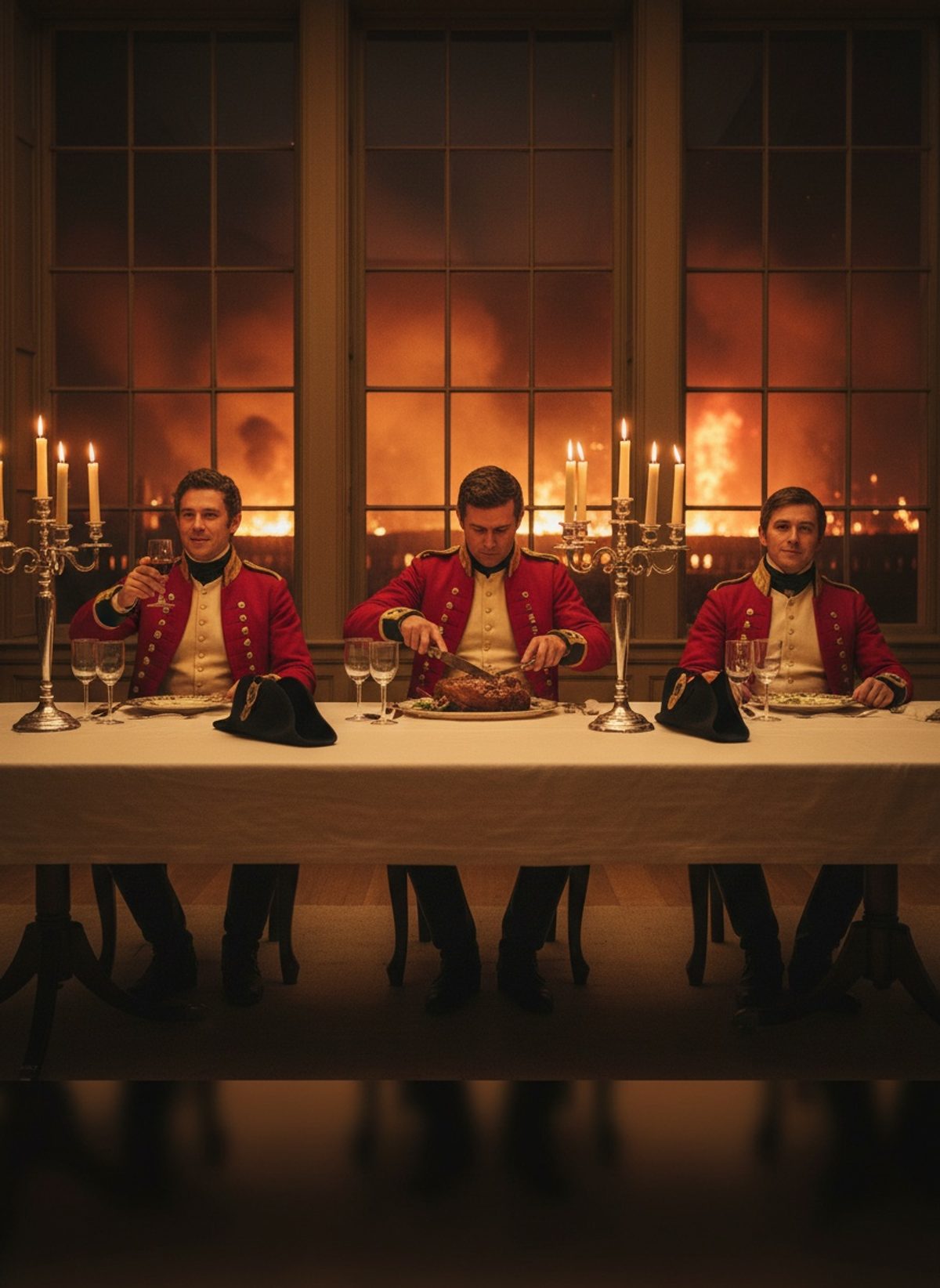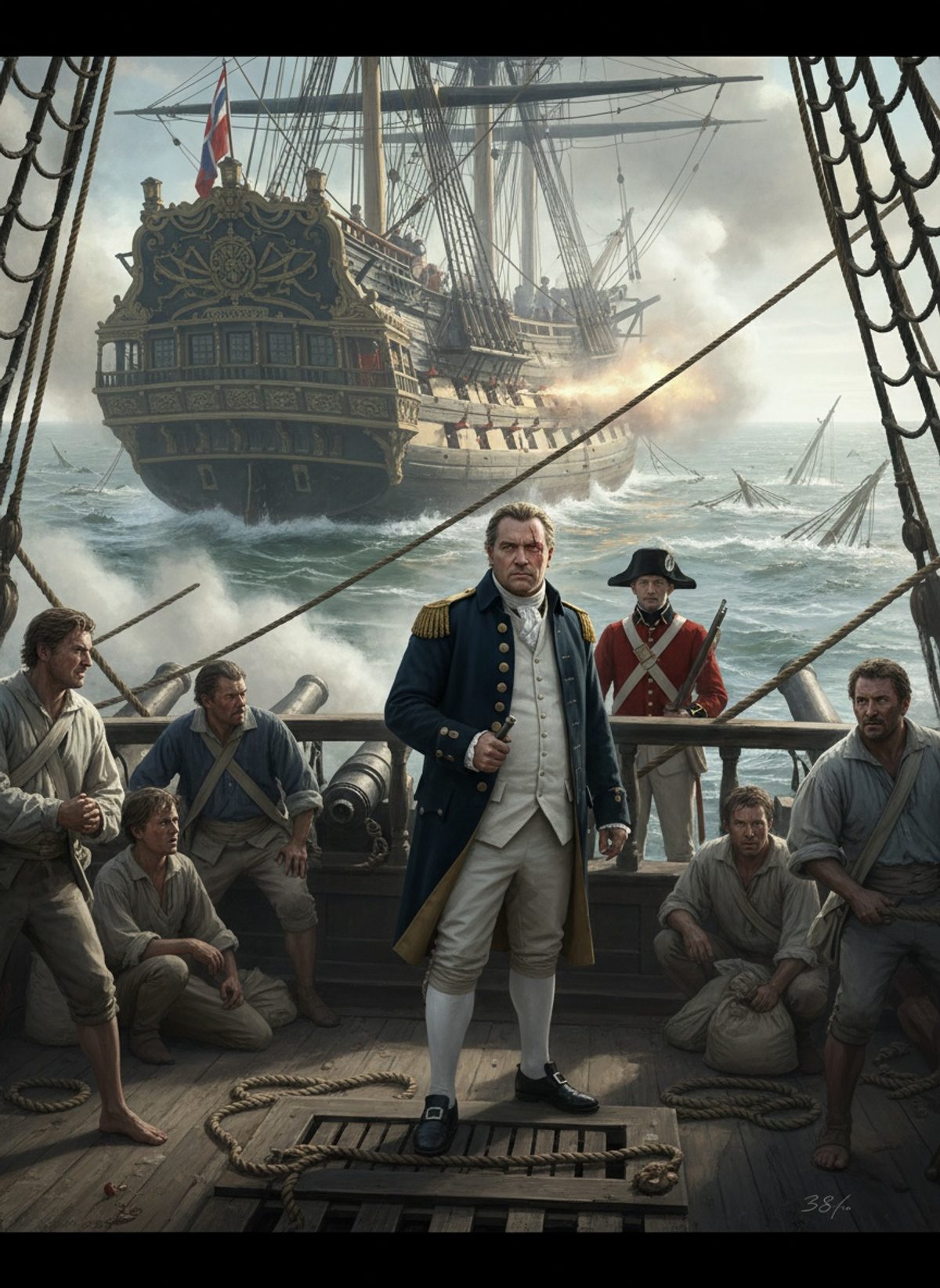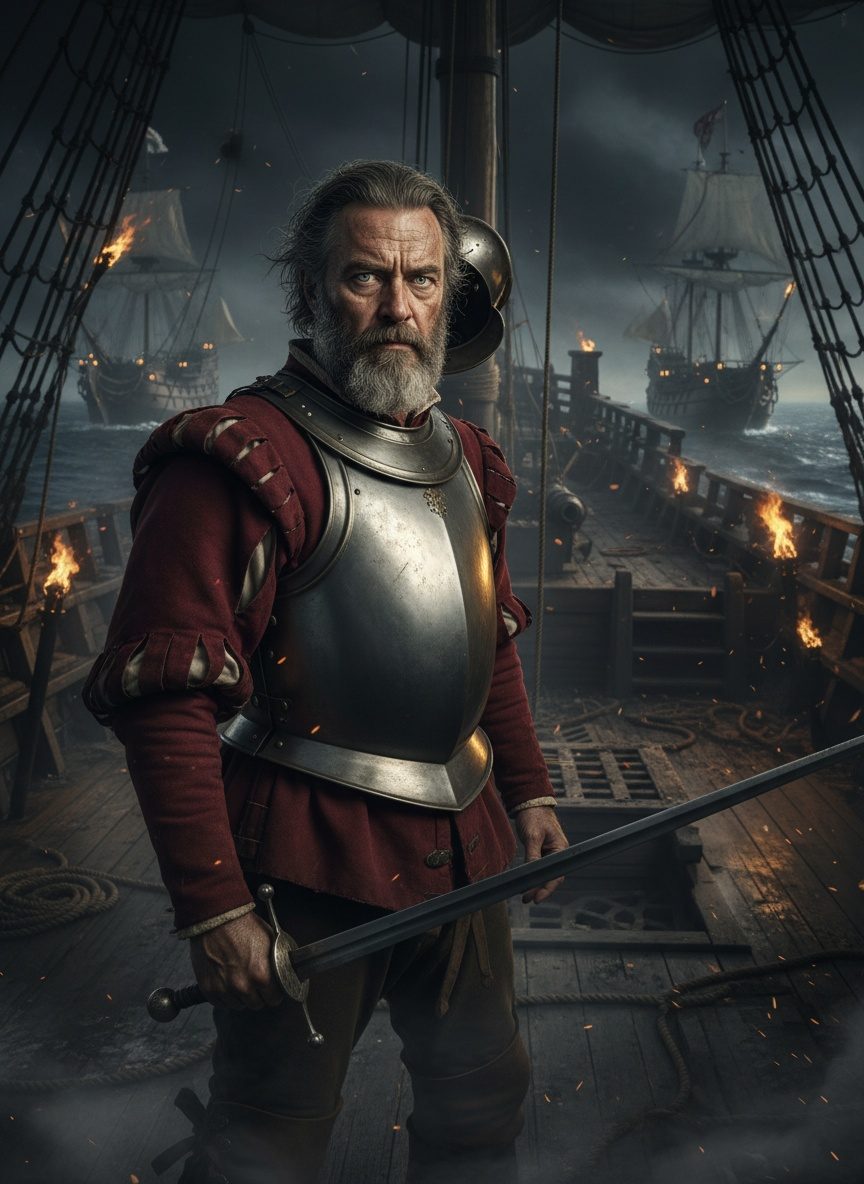
The roar of cannon fire split the night as the sea around HMS Revenge heaved with fury. The deck under Sir Richard Grenville's feet quivered with every hit, shuddering beneath the relentless onslaught. The salt-laden wind whipped through the rigging, meshing with the cries of his men as they fired back at the oncoming Spanish galleons. Grenville, commanding the ship with a stubborn resolve, refused to yield, his presence a formidable anchor amidst the chaos. His voice, unwavering and commanding, rang out through the din, rallying his crew even as the Revenge lay beleaguered by a foe fifty-three times its number.
The Courage to Stand Alone
It was August 1591, and the jagged waters of the Azores formed the stage for a desperate theatre of war. Around Grenville and his ill-fated vessel surged the Spanish fleet, fifty-three ships strong, a formidable wall of maritime might determined to crush the lone English ship. The Revenge, though renowned for its strength and speed, seemed a frail piece of timber in the vastness of the Atlantic. This was a time when the dominance of the seas defined empires, and the Spanish Armada—a past terror that had once sought to subdue England—loomed as a spectral reminder of Spain’s maritime prowess.
Sir Richard Grenville, both feared and revered among men, was a captain known for his fierce valor, yet even more so for his unyielding pride. An experienced sailor and a formidable tactician, he chose defiance over escape when surrounded by the Spanish forces. While discretion might have dictated a calculated retreat to fight another day, Grenville’s honor and steadfast nature would not countenance such a course. Instead, he ordered his gunners to prepare for battle.
The Revenge was trapped, betrayed by the fickle winds and a tactical misjudgment. Grenville was outnumbered and outgunned, but he had no intention of surrendering his command nor his life without a fight. As the Spanish closed in, Grenville rallied his men with the promise that they would take as many Spaniards down with them as the sea would allow. Through the long night, the echo of cannon blasts shook the heavens, the sound of grenades and firearms mixing with the howling winds as the battle etched itself into eternity.
Read next: The Day a British Captain Stood Between Slaves and the Sea
A Ship and Her Captain
As dawn approached, the destruction dished out by Grenville’s Revenge was evident even in the dim pre-dawn light. The ship, by then a mangled shadow of its former self, had taken a severe beating. Wood splintered and sails ragged, the ship was inundated by Spanish fire. Amidst the ghastly chaos, the spirit of its captain remained unbroken. Sir Richard Grenville, though gravely wounded, still moved upon the deck with the air of a lion, his resolve as steadfast as the day he first set foot upon its timbers.
His men, loyal to their core, followed his lead, reloading and firing, dodging explosions, and managing battle stations with grim tenacity. To fight under Grenville was to grasp a piece of the immortality that he seemed to command, the legend in the making right there in the throes of the battlefield. Still, as overpowering as the spirit was, the flesh eventually wore thin.
Grenville, bullets having found their mark, lay severely injured as the battle drew to a close. Yet, even as life ebbed from him, he refused to succumb to the tide of defeat. He commanded the battle until his very breath became too fragile a whisper to carry orders. Legend foretells that until his last, he implored his men to never surrender, preferring death to dishonor—an echo of those Elizabethan times where satisfaction came not from victory alone, but from the manner in which one faced the inevitability of fate.
The Memory of Resistance
By the time the sun rose, painting the Atlantic with the soft brush of dawn, the Revenge was a smoldering wreck amidst the silent armada, the battle above the sea matched only by the one beneath its depths. The Spanish ships, though victorious, could lay little claim to the dignity that the crew of the Revenge had flaunted so openly. The effort to subdue one ship against such overwhelming odds became a testament not to Spanish might, but to the British spirit epitomized by Grenville.
It's said that the remaining survivors, when finally overpowered, were forcibly taken as prisoners, with an indelible mark of respect inked in the eyes of their captors. The battle was over; the sea turned red with remembrance; yet, the fierce resistance of the Revenge lingered on far beyond the horizon. Richard Grenville died from his injuries, his last murmurs reportedly a defiant snub to the enemy—an act both of self-authored prophecy and of sealed fate.
The tale of Sir Richard Grenville and the HMS Revenge is etched into the annals of history as a narrative of fierce independence, emblematic of the turbulent tides of the Elizabethan Age. It serves to remind us that in the theater of war, the number of opponents pales in comparison to the indomitable force of the human will, when it's bound by duty, honor, and a refusal to yield. Grenville's story, lost perhaps within many textbooks, speaks to the timeless notion that valor does not require victory—it demands only the courage to stand your ground when the world seems set against you.