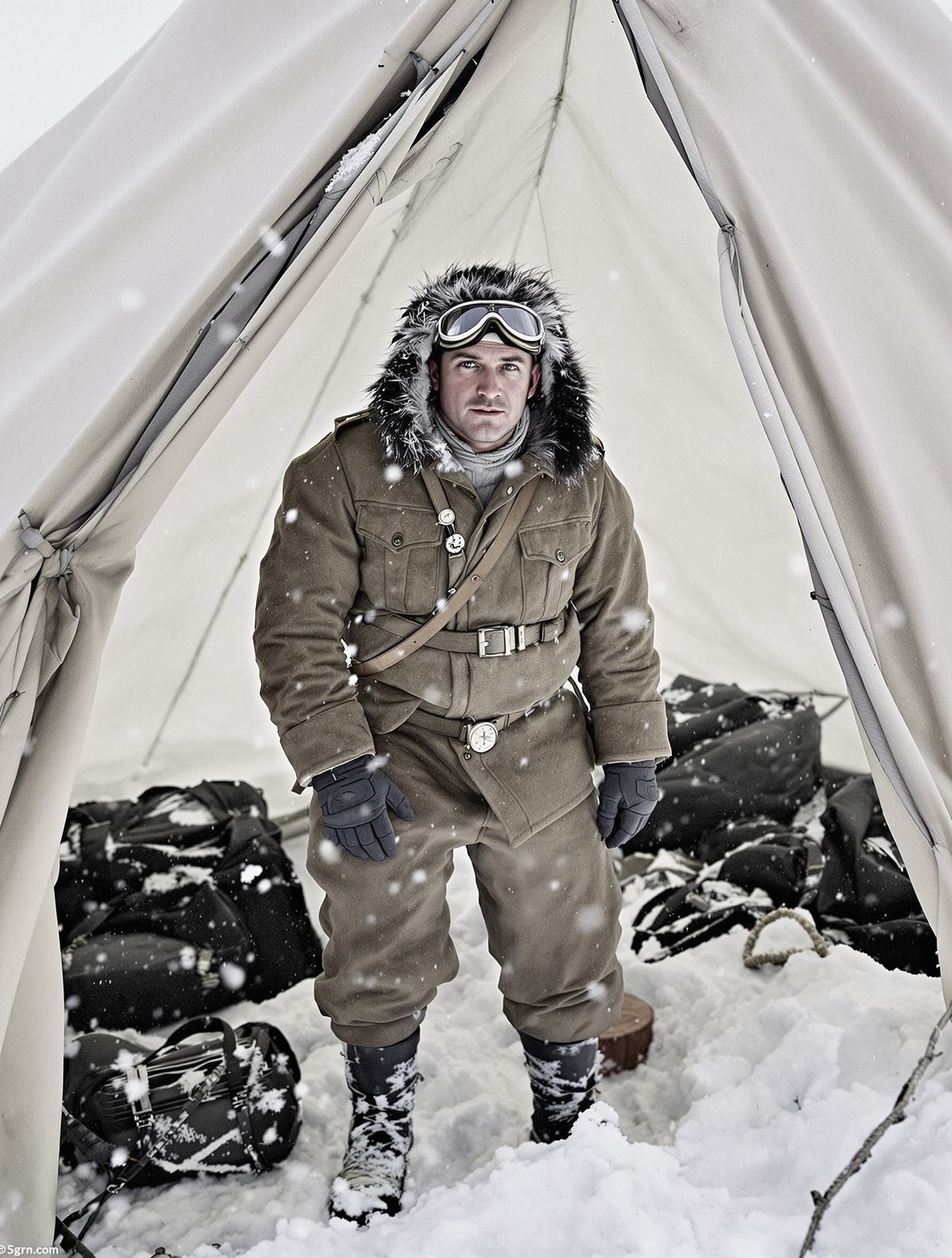
The wind screamed across the Ross Ice Shelf like a banshee, carrying crystals of ice that cut like glass. Inside the green canvas tent, four men huddled around the flickering flame of a Primus stove, their breath forming clouds in the -40°F air. Outside lay 150 miles of the most hostile terrain on Earth. Inside, Captain Lawrence Edward Grace Oates was making a decision that would echo through history.
It was March 17th, 1912. The return journey from the South Pole had become a death march, and Oates knew he was the reason his companions were dying.
The Soldier Who Bought His Way to Hell
Lawrence Oates wasn't supposed to be there. Unlike his companions—seasoned polar explorers, scientists, and naval officers—the 32-year-old cavalry captain had essentially bought his place on Captain Robert Falcon Scott's Terra Nova Expedition. When Scott needed £1,000 to help fund the venture, Oates stepped forward with his family fortune, earned from his mother's inheritance. The transaction was brutal in its simplicity: money for a berth to the bottom of the world.
What Scott got was more than a benefactor. Oates was a decorated Boer War veteran who had been shot through the thigh at the Battle of Aberdeen—a wound that left his left leg an inch shorter than his right. He walked with a slight limp for the rest of his life, though he rarely complained. His fellow officers knew him as "Titus," a man of few words but unshakeable determination.
Read next: The Day Napoleon Surrendered to the Ship That Shot at Him
The irony was crushing: the man who limped would be chosen for the final polar party, a group that would need to walk over 1,800 miles across the most unforgiving landscape on the planet.
Race to Nowhere
By January 1912, what had begun as a scientific expedition had devolved into something far more desperate. Scott's British team was racing Norwegian explorer Roald Amundsen to become the first humans to reach the South Pole. The stakes couldn't have been higher—national pride, scientific glory, and personal legacy all hung in the balance.
On January 17th, 1912, Scott, Oates, Dr. Edward Wilson, Petty Officer Edgar Evans, and Lieutenant Henry "Birdie" Bowers finally reached their goal. What they found there broke their spirits: a Norwegian flag snapping in the polar wind, and a tent containing a note from Amundsen. The Norwegians had beaten them by 34 days.
"Great God! This is an awful place," Scott wrote in his diary that night. They had walked 900 miles to come second in a race that would define their legacies forever. But the real nightmare was just beginning. They still had to get home.
When Heroes Start to Die
The return journey began to unravel almost immediately. The weather was worse than expected—temperatures that should have been around -20°F were plummeting to -47°F. Their fuel supplies, carefully cached on the way south, were mysteriously running low. Some historians now believe the leather gaskets on their fuel containers had shrunk in the extreme cold, allowing precious paraffin to evaporate.
Edgar Evans was the first to crack. The burly petty officer, once the strongest man in the party, began suffering from severe frostbite and what was likely a traumatic brain injury from an earlier fall. On February 17th—exactly one month after their polar disappointment—Evans collapsed and died at the foot of the Beardmore Glacier.
Now they were four, but their troubles were only beginning. Oates' old war wound was betraying him in the most horrific way imaginable. The Antarctic cold was destroying his feet, turning his toes black with frostbite. Every step became agony, every mile a marathon of pain. Worse still, his suffering was slowing the entire party when speed was their only hope of survival.
The Arithmetic of Sacrifice
By early March, the mathematics of survival had become brutally simple. The party needed to cover at least 10 miles per day to reach their supply depots before their food ran out. With Oates barely able to walk, they were managing only 6 or 7 miles. At their current pace, they would all starve long before reaching safety.
Oates understood the equation perfectly. His companions were dying because of him.
On March 15th, his 32nd birthday, Oates asked Wilson for enough opium pills to end his life. Wilson refused. The next morning, Oates couldn't get his boots on—his feet were too swollen and blackened with frostbite. His companions spent precious time cutting open his footwear and helping him dress. More delay. More precious energy wasted.
That night, he begged his companions to leave him in his sleeping bag. Again, they refused. Scott, Wilson, and Bowers were Royal Navy men, and the navy didn't abandon its own. But their loyalty was killing them all.
"I Am Just Going Outside"
March 17th dawned with the fury of an Antarctic blizzard. The wind was howling at 40 mph, driving snow horizontally across the ice. It was the kind of weather that killed men in minutes, not hours. Any sensible explorer would stay in his tent and wait for conditions to improve.
Lawrence Oates had run out of sense. He had run out of time.
According to Scott's diary, written that evening by the light of their dying stove, Oates woke that morning in obvious pain. He struggled to pull on his boots, struggled to pack his gear, struggled to maintain the pretense that he could continue. Then, around mid-morning, he stood at the tent flap.
The wind was screaming. Snow was driving horizontally across the ice. The temperature was -40°F with a wind chill that would freeze exposed flesh in seconds.
"I am just going outside," Oates said quietly, "and may be some time."
He stepped into the blizzard and vanished forever.
Scott wrote that night: "We knew that poor Oates was walking to his death, but though we tried to dissuade him, we knew it was the act of a brave man and an English gentleman." In reality, they probably couldn't have stopped him if they'd wanted to. Oates had made his choice.
The Legend That Lives On
Lawrence Oates' sacrifice didn't save his companions—Scott, Wilson, and Bowers died three weeks later, just 11 miles from a supply depot that might have saved their lives. But his final act transformed him from a footnote in polar exploration into something far more enduring: a symbol of ultimate self-sacrifice.
His body was never found. Somewhere in the vast white wilderness of Antarctica lies the man who walked into a blizzard to give his friends a chance at life. The ice has kept its secret for over a century.
Today, as we face our own impossible choices—between self-interest and collective good, between personal comfort and shared sacrifice—the ghost of Lawrence Oates still walks. His five final words remind us that sometimes the greatest act of courage isn't fighting to live, but knowing when to let go. In our age of individual achievement and personal brands, Oates represents something almost forgotten: the idea that some things are worth more than our own survival.
The blizzard took him, but it couldn't take what he gave us—proof that even in the coldest, most desperate circumstances, human beings are capable of extraordinary grace.