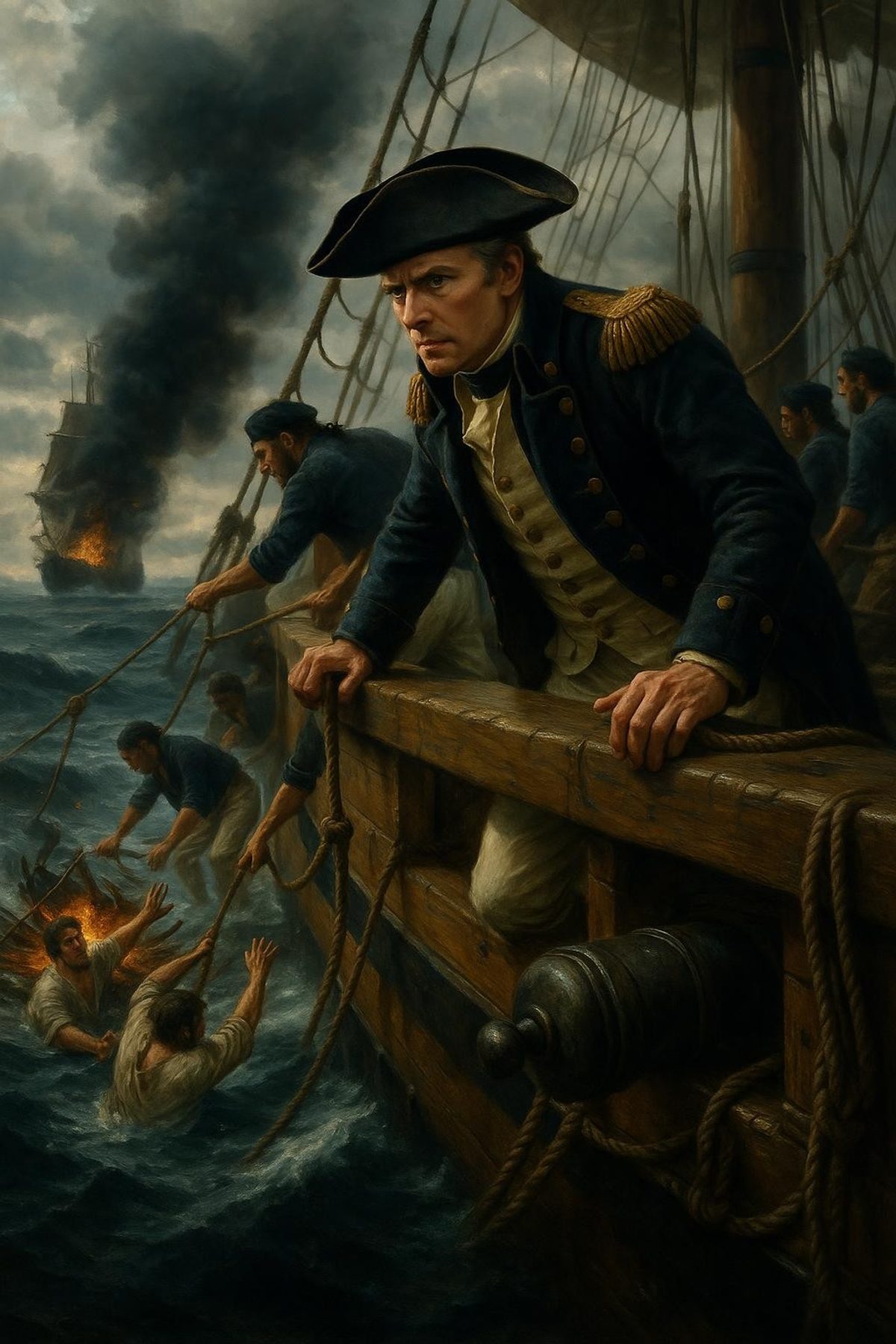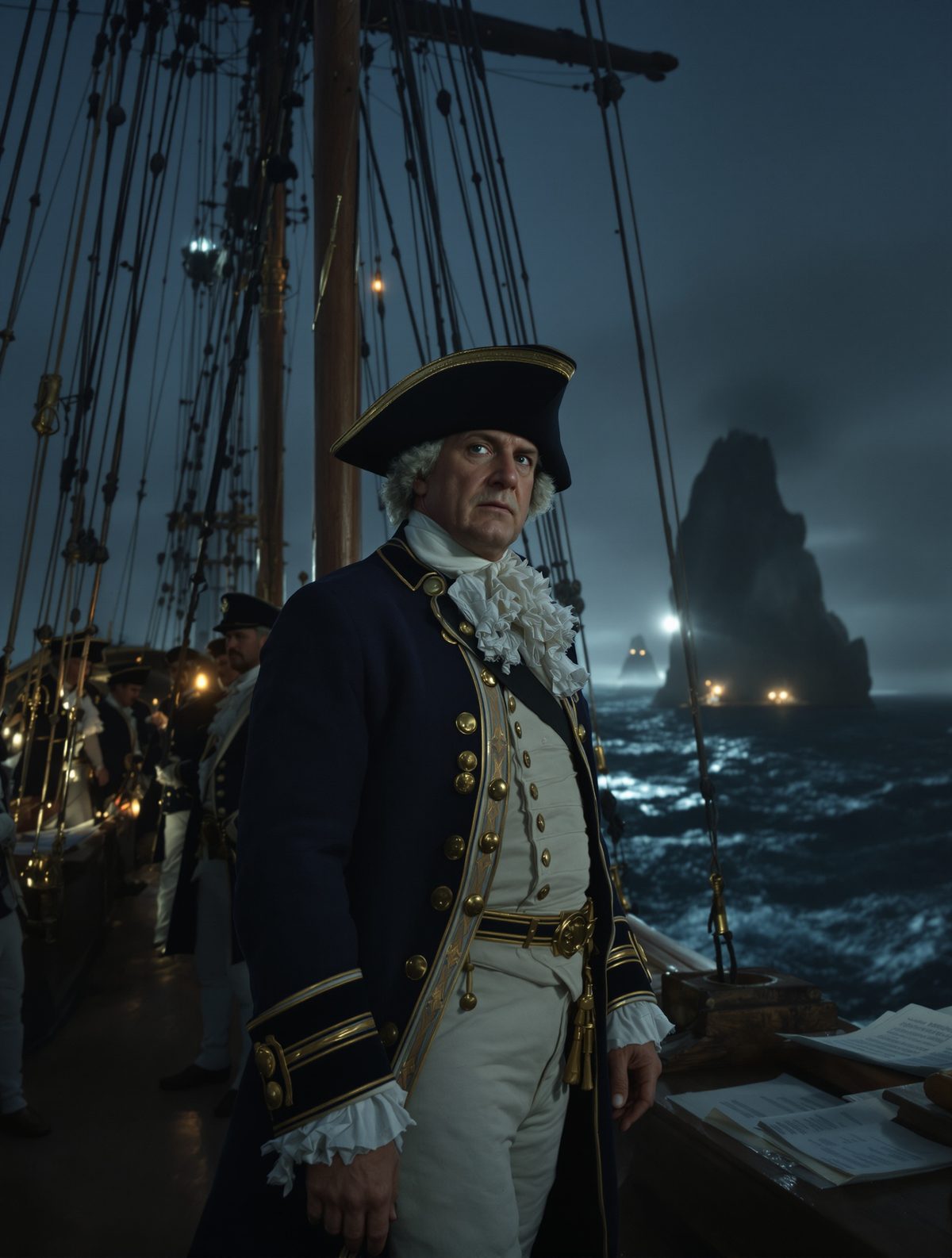
In the black waters off the Scilly Isles on the night of October 22nd, 1707, Admiral Sir Cloudesley Shovell stood on the quarterdeck of HMS Association, watching fog swirl around his 21-ship fleet like ghostly fingers. His navigators assured him they were safely threading the English Channel, homeward bound from a glorious victory at Toulon. They were catastrophically wrong. Within minutes, Britain's most experienced admiral and nearly 2,000 sailors would be dead, victims of the worst peacetime naval disaster in British history—a tragedy that would literally change how humans navigate the world's oceans.
The Hero Admiral's Triumphant Return
Sir Cloudesley Shovell was no ordinary naval commander. Born into modest circumstances in Norfolk, he had clawed his way up through the ranks to become one of Queen Anne's most trusted admirals. His very name—Cloudesley—seemed destined for maritime legend, though few could have predicted how tragically prophetic that would prove.
By 1707, Shovell commanded the respect of every sailor in the Royal Navy. He had survived the brutal Anglo-Dutch Wars, helped destroy the French fleet at La Hogue, and earned a knighthood for his courage under fire. His latest triumph at Toulon had been particularly sweet—a successful siege that demonstrated British naval supremacy in the Mediterranean during the War of Spanish Succession.
But it was precisely this success that set the stage for disaster. Flush with victory and eager to return home before winter storms made the Atlantic crossing treacherous, Shovell's fleet departed Gibraltar on October 9th, 1707. The 21 warships represented the cream of the Royal Navy: his flagship HMS Association carried 90 guns and 800 men, while HMS St. George, HMS Firebrand, and HMS Romney bristled with cannon and seasoned crews.
Read next: The Day Napoleon Surrendered to the Ship That Shot at Him
What none of them realized was that they were sailing toward a navigational nightmare that would expose the deadly inadequacy of 18th-century seamanship.
Lost in a Mathematical Maze
In 1707, determining your position at sea was more art than science—and a dark, dangerous art at that. Sailors could measure latitude reasonably well using the sun and stars, but longitude remained navigation's unsolved riddle. Without accurate clocks or reliable methods to calculate east-west position, even the most experienced navigators were essentially making educated guesses when sailing out of sight of land.
Shovell's fleet had been at sea for nearly two weeks, battling contrary winds and thick fog that prevented celestial observations. His navigators used a technique called "dead reckoning"—estimating position based on speed, direction, and time traveled. It was like trying to find your way through a maze while blindfolded, relying only on counting your steps.
The Admiral's sailing masters believed they were safely west of Ushant, the treacherous rocky outcrop off France's Brittany coast, and well into the English Channel. Charts of the era were notoriously inaccurate, often based on centuries-old observations and riddled with errors. Even worse, magnetic compass variation—the difference between magnetic and true north—was poorly understood, adding another layer of potential miscalculation.
What makes this story particularly haunting is that one common sailor allegedly approached Admiral Shovell during the voyage, claiming that by his own reckoning, the fleet was dangerously off course and heading straight for the Scilly Isles. According to naval law, such presumption by a lower-ranking sailor was mutinous—the man was reportedly hanged from the yardarm for his insubordination. Whether this account is legend or fact remains debated, but it perfectly captures the rigid hierarchy that prevented potentially life-saving information from reaching command decisions.
A Night of Unthinkable Horror
October 22nd, 1707, brought the kind of weather that turns experienced sailors' blood cold. Thick fog shrouded the fleet as evening approached, reducing visibility to mere yards. The wind was picking up from the southwest, driving the ships forward through increasingly confused seas. Still convinced they were safely in open water, Shovell maintained course and speed.
At approximately 8 PM, lookouts on HMS Association glimpsed something that transformed routine sailing into living nightmare: white water breaking over rocks, directly ahead. There was no time to turn, no space to maneuver, no hope of avoiding catastrophe.
The flagship struck the Outer Gilstone Rock with tremendous force, her hull ripping open like paper. The 90-gun ship-of-the-line—one of the most powerful warships in the world—began sinking immediately. In the darkness and confusion, her 800-man crew had virtually no chance of survival. The shock of hitting submerged granite at full sail would have thrown men across the decks like rag dolls, while the incoming flood of icy Atlantic water turned the lower gun decks into death traps.
HMS Romney struck the rocks moments later, her 50 guns and 400 crew disappearing into the churning darkness. HMS Firebrand followed, then HMS St. George—four major warships destroyed in less than an hour, their combined crews of nearly 2,000 men swallowed by the unforgiving sea.
The remaining 17 ships, alerted by the sounds of destruction echoing through the fog, managed to claw their way clear of the rocks, but the damage was done. In terms of lives lost, it was as if an entire city had been wiped from the map in a single evening.
The Admiral's Final Moments
What happened to Sir Cloudesley Shovell in his final moments remains one of history's most intriguing mysteries. Three days after the disaster, his body washed ashore on Porth Hellick Beach on St. Mary's, the largest of the Scilly Isles. Remarkably, he appeared to have survived the initial shipwreck—local accounts suggest he made it to shore alive, only to be murdered by islanders who stripped him of his valuable rings and clothing.
The most persistent legend claims that an island woman confessed on her deathbed, decades later, to smothering the unconscious admiral for his emerald ring. Whether true or not, this story reflects the harsh reality of 18th-century coastal communities, where shipwrecks were often seen as providential sources of valuable cargo rather than human tragedies requiring rescue efforts.
Shovell's body was initially buried in the sand dunes of St. Mary's, but his importance to the realm ensured eventual reinterment in Westminster Abbey. His ornate tomb there depicts him rising from the waves—a poignant reminder that even the mightiest naval commanders remained at the mercy of the sea's unforgiving mathematics.
Legacy Written in Clockwork and Law
The Scilly naval disaster sent shockwaves through British society that extended far beyond maritime circles. The loss of so many experienced sailors and officers seriously weakened the Royal Navy at a crucial moment in the War of Spanish Succession. But more importantly, it highlighted the deadly inadequacy of existing navigation methods in an age when Britain's growing empire depended absolutely on safe ocean travel.
In 1714, Parliament passed the Longitude Act, offering the extraordinary prize of £20,000 (equivalent to millions today) for a practical method of determining longitude at sea. This legislative response directly stemmed from the Scilly disaster and other navigation-related catastrophes. The prize eventually went to John Harrison, whose revolutionary marine chronometer finally solved the longitude problem after decades of painstaking work.
The disaster also prompted improvements in charting and surveying. The Scilly Isles themselves became subject to much more accurate mapping, while the Admiralty began investing seriously in better navigational training for its officers. In a very real sense, the blood spilled on those October rocks in 1707 helped pave the way for the precise global navigation we take for granted today.
When GPS Fails: Lessons from the Deep
More than three centuries later, the tragedy of Sir Cloudesley Shovell's fleet speaks to our modern world with surprising relevance. In an age when satellite navigation guides everything from ocean-crossing container ships to weekend sailors, it's easy to forget that technology can fail, signals can be jammed or spoofed, and human judgment remains the final arbiter of maritime safety.
Recent years have seen multiple incidents where over-reliance on electronic navigation led to groundings, collisions, and near-disasters. The fundamental challenge that killed Admiral Shovell—knowing precisely where you are in a vast, featureless ocean—remains as critical today as it was in 1707. The tools have evolved dramatically, but the consequences of getting it wrong can still be measured in human lives.
Perhaps most poignantly, the story reminds us that expertise and experience, while invaluable, can become dangerous when they breed overconfidence. Shovell was arguably the most skilled naval commander of his generation, yet his certainty in flawed navigation methods led directly to catastrophe. In our interconnected world, where complex systems can fail in unpredictable ways, the admiral's fate serves as a sobering reminder that disaster often strikes not the unprepared, but those who believe themselves most secure.
The fog-shrouded rocks off Scilly claimed more than ships and sailors that October night—they claimed the illusion that human mastery over the sea could ever be complete. Even today, that lesson remains worth remembering.