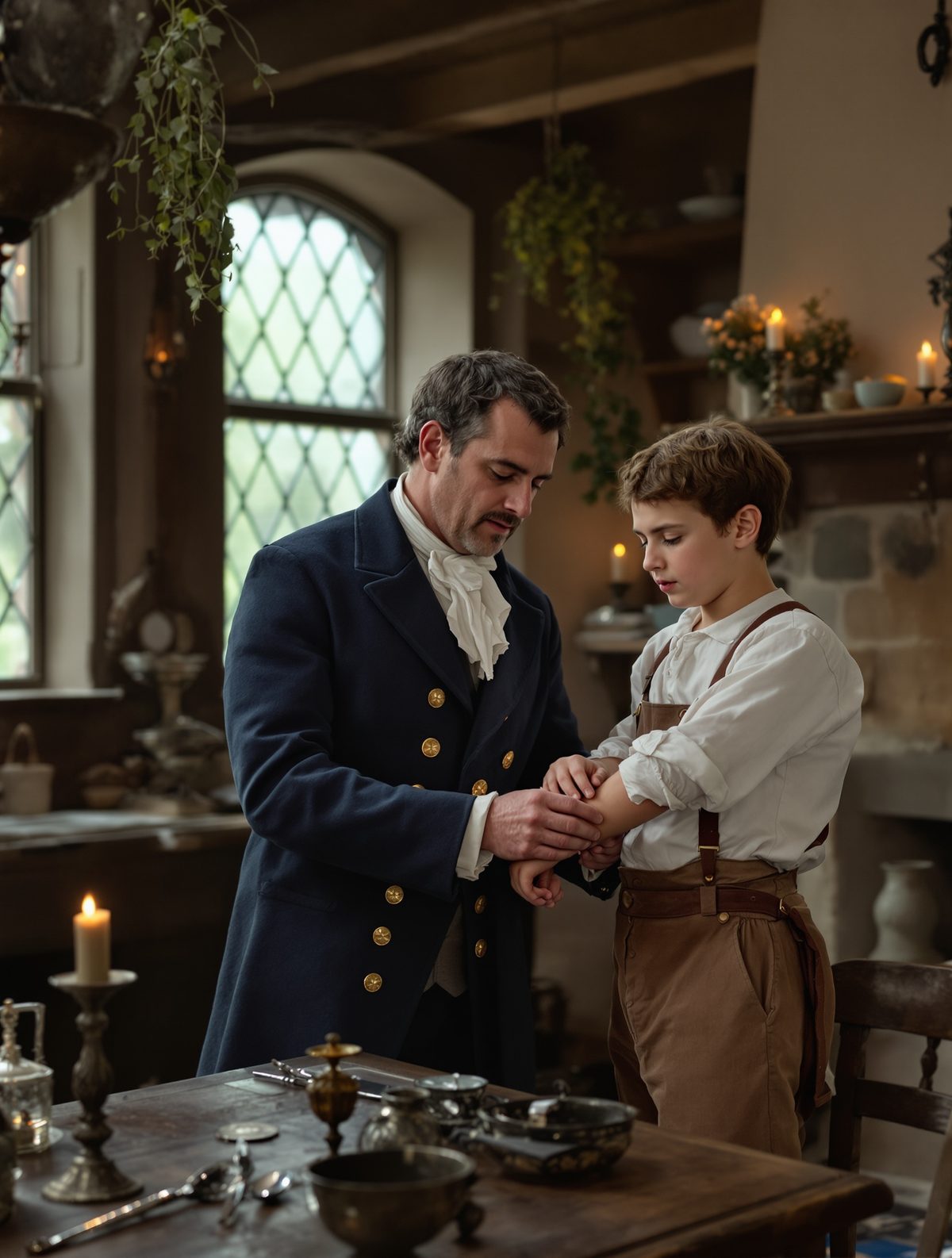
On a crisp May morning in 1796, in the rolling countryside of Gloucestershire, a country doctor prepared to conduct an experiment that would either make him a saviour of humanity or a child killer. Dr. Edward Jenner stood in his modest cottage surgery, studying the pustules on the hand of Sarah Nelmes, a young milkmaid whose cheerful demeanour belied the significance of what was about to unfold. Nearby, eight-year-old James Phipps fidgeted nervously, unaware that he was about to become the first person in history to be deliberately vaccinated—a word that didn't even exist yet.
What Jenner was proposing flew in the face of everything the medical establishment believed. He wanted to take pus from an infected cow disease and inject it into a healthy child. To his contemporaries, it sounded like madness. To us, it was the moment that changed everything.
The Pox That Terrorised a Nation
In Georgian England, smallpox wasn't just a disease—it was a death sentence hanging over every household. The variola virus showed no mercy, cutting down princes and paupers alike with horrifying efficiency. By some estimates, smallpox killed 400,000 Europeans every year in the late 18th century, and left survivors permanently disfigured with deep, pitted scars that marked them for life.
The disease was so feared that parents wouldn't name their children until they'd survived their first bout of smallpox. Queen Mary II died of it in 1694. The Habsburg line nearly ended when it killed Emperor Joseph I in 1711. Even the great and terrible had no defence against this microscopic killer that turned the skin into a landscape of pustules and filled graveyards across the continent.
Read next: The Day a Surgeon Walked Into a Prison and Freed a Madman
The only protection available was variolation—a risky procedure imported from the Ottoman Empire where healthy people were deliberately infected with mild smallpox through a scratch on the skin. Lady Mary Wortley Montagu had famously introduced the practice to England after witnessing it in Constantinople, but it was a dangerous gamble. While most survived variolation, roughly one in fifty died from the procedure itself, and survivors could still spread the disease to others.
A Country Doctor's Curious Observation
Edward Jenner was hardly the sort of man you'd expect to revolutionise medicine. Born in 1749 in the market town of Berkeley, he was the son of a vicar and had trained as a country physician—respected locally but unknown beyond the Cotswolds. What set Jenner apart wasn't genius so much as an almost childlike curiosity about the natural world around him.
As he made his rounds through the dairy farms of Gloucestershire, Jenner began to notice something remarkable. The milkmaids—those rosy-cheeked young women who spent their days coaxing milk from temperamental cows—seemed to possess an almost supernatural immunity to smallpox. While their neighbours fell victim to the disease in epidemic waves, the milkmaids remained untouched, their skin unmarked by the telltale scars.
The local folklore had an explanation: if you caught cowpox—a relatively mild disease that cows occasionally passed to humans—you would never catch smallpox. The milkmaids themselves believed it completely. "I shall never have smallpox for I have had cowpox," they would say with quiet confidence. But folk wisdom and medical science were different beasts entirely.
Jenner spent years investigating this rural legend, meticulously documenting case after case. He found milkmaid after milkmaid who had contracted the blistering sores of cowpox on their hands and arms, only to remain mysteriously protected when smallpox swept through their communities. The correlation was undeniable, but correlation wasn't causation—and the medical establishment of London remained deeply sceptical of theories that emerged from the farmyards of Gloucestershire.
The Boy Who Would Change History
James Phipps was the son of Jenner's gardener—a healthy, robust eight-year-old with his whole life ahead of him. On May 14, 1796, Jenner made two small incisions on the boy's arm and carefully inserted matter from the cowpox pustules on Sarah Nelmes' hand. It was, by any measure, an extraordinary act of faith—or folly.
What happened next unfolded with agonising slowness. Young James developed a mild fever and some discomfort at the incision site, exactly as Jenner had hoped. The cowpox took hold gently, running its benign course through the boy's system. But the real test was yet to come.
Six weeks later, on July 1, Jenner took the ultimate gamble. He variolated James with actual smallpox matter—the same procedure that killed one in fifty patients. If his theory was wrong, he had just murdered a child. If he was right, he had just saved not only James Phipps, but potentially millions of future lives.
The hours that followed must have been torture for Jenner. He watched and waited as James showed no signs of infection. The smallpox simply couldn't take hold. The boy remained healthy, active, and blissfully unaware that he had just proved one of the most important medical theories in human history.
From Heresy to History
When Jenner published his findings in 1798 in "An Inquiry into the Causes and Effects of the Variolae Vaccinae"—a title only an 18th-century gentleman could love—the reaction was explosive. The Royal Society initially rejected his work, finding it too revolutionary and insufficiently supported. Critics emerged from every corner, armed with religious objections, medical scepticism, and social prejudice.
The idea that a disease from cows could protect humans struck many as blasphemous. Political cartoonist James Gillray produced a famous satirical print showing people sprouting cow parts after vaccination. Clergymen denounced it from pulpits as interfering with divine will. The medical establishment, heavily invested in the profitable practice of variolation, fought back with fierce opposition.
But Jenner had something his critics lacked: results. As more physicians tried his technique—which he generously shared freely rather than patent for profit—the evidence became overwhelming. Children vaccinated with cowpox remained healthy when exposed to smallpox. The procedure was safer, more effective, and didn't require the dangerous use of actual smallpox matter.
Within a few years, vaccination was spreading across Europe and beyond. Napoleon, despite being at war with Britain, had his entire army vaccinated and struck a medal in Jenner's honour. Thomas Jefferson called vaccination "the most remarkable medical discovery of our time." Even the word itself came from Jenner's work—"vacca," Latin for cow.
The Milkmaid's Legacy
What happened to the key players in this historical drama tells us something profound about how scientific breakthroughs actually occur. James Phipps lived a long and healthy life, dying in 1853 at the age of 65—outliving Jenner himself by 30 years. Sarah Nelmes, the milkmaid whose infected hand provided the crucial cowpox matter, disappeared back into history, her contribution largely forgotten despite being essential to the discovery.
Jenner, meanwhile, became one of the most celebrated men of his age, receiving honours from governments across Europe and a substantial reward from the British Parliament. Yet he remained a country doctor at heart, continuing to practice in Berkeley until his death in 1823. He once remarked that he had spent more time studying the behaviour of cuckoo birds than developing vaccination—a reminder that scientific breakthroughs often come from the most unexpected directions.
The impact of Jenner's work cannot be overstated. Smallpox, which had terrorised humanity for millennia, became the first disease ever completely eradicated through human intervention. The last natural case occurred in Somalia in 1977. Today, the virus exists only in two secure laboratories, a testament to the power of the technique born from a milkmaid's secret in Georgian Gloucestershire.
The Courage to Question Everything
As we face new global health challenges in our interconnected world, the story of Edward Jenner and James Phipps offers both inspiration and warning. It reminds us that medical breakthroughs often come from unexpected sources—not from prestigious institutions but from curious minds willing to observe, question, and test the world around them.
Yet it also highlights the eternal tension between scientific innovation and public acceptance. The same social media that today spreads vaccine misinformation would have loved Jenner's critics, with their cow-sprouting cartoons and religious objections. The miracle is not just that Jenner discovered vaccination, but that enough people were willing to trust science over superstition to let it succeed.
In that Gloucestershire cottage in 1796, three lives converged to change the course of human history: a curious doctor, a brave child, and a milkmaid whose name we barely remember. Their story reminds us that the greatest advances in human knowledge often begin not in grand laboratories but in quiet moments of observation, courage, and trust. Sometimes, the legends they leave out of the textbooks are the ones that matter most.