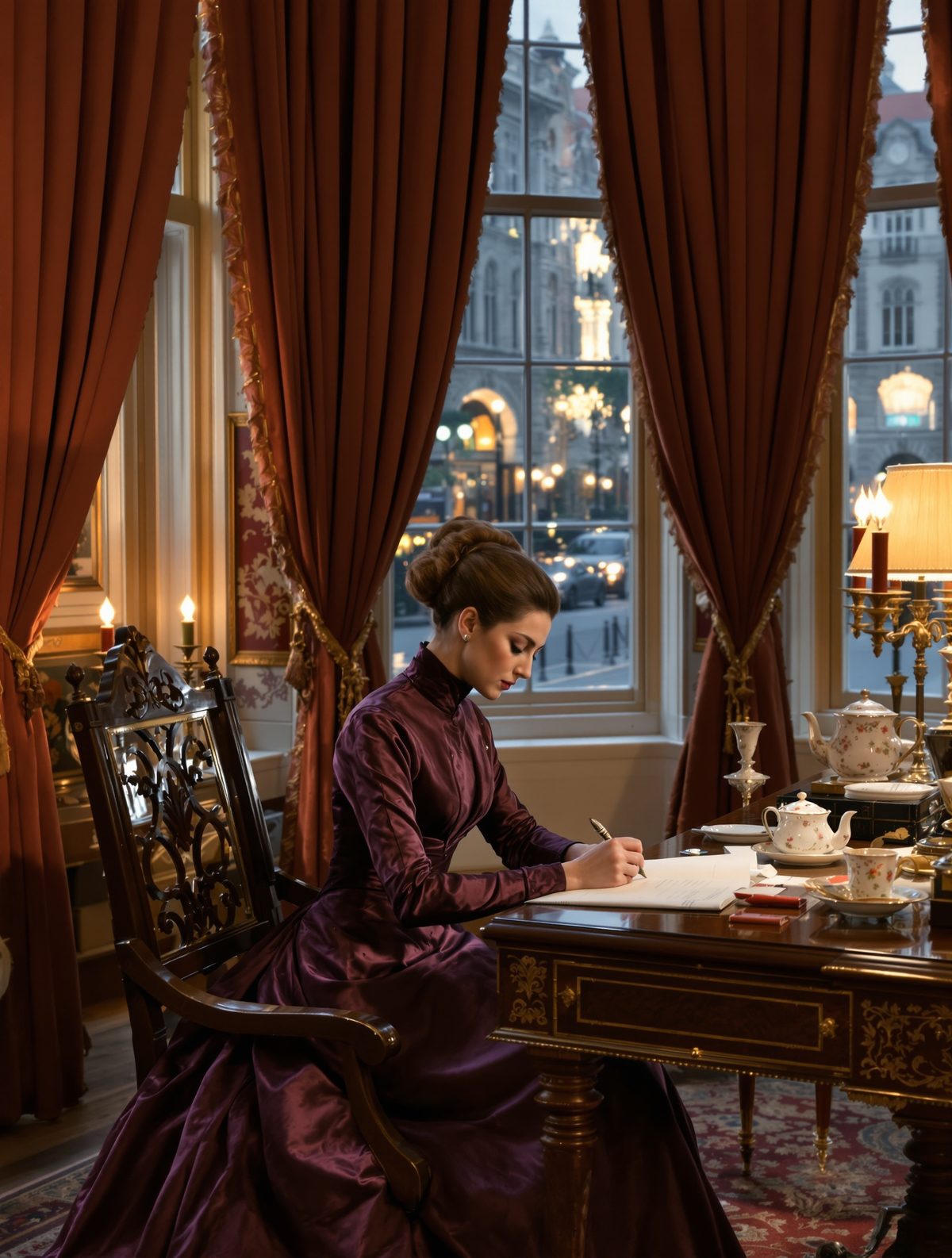
The morning sun streamed through the lace curtains of a comfortable Didsbury drawing room as Emily Williamson set down her teacup with trembling hands. Outside her window, Manchester's well-to-do ladies promenaded past in their finest millinery — each hat a grotesque monument to slaughter. Entire hummingbirds, their iridescent feathers still gleaming, perched frozen on velvet brims. Kingfisher wings spread in permanent flight. The severed heads of exotic terns gazed with glassy eyes from beneath silk ribbons.
It was February 1889, and Emily had reached her breaking point. What happened next in that quietly rebellious drawing room would transform her from a typical Victorian housewife into the founder of what would become one of the world's most powerful conservation organizations. But on this particular morning, all she had was rage, a pen, and an unshakeable belief that something had to be done.
The Feathered Carnage of Fashion
To understand Emily's horror, you must first grasp the sheer scale of the Victorian feather trade. This wasn't a few delicate plumes tucked into a hatband — entire birds were skinned, stuffed, and mounted on women's heads. The fashion magazines of 1889 gleefully recommended hats adorned with "the wings and breast of a jay, seven bluebirds, and a nest with three eggs."
The numbers were staggering. In a single year, London's feather merchants imported the plumes of 67,000 birds of paradise. The famous Regent Street millinery houses displayed windows full of what one contemporary observer called "avian cemeteries." Ospreys were driven to near-extinction in Britain, while across the Atlantic, entire colonies of egrets and herons were wiped out by plume hunters who knew that breeding birds produced the most spectacular feathers.
Read next: The Day a London Printer Stood Trial and Freed the Press
But perhaps most shocking of all was society's complete indifference. These weren't hidden atrocities — they were worn proudly to church, to the opera, to tea parties. The more exotic and elaborate the feathered creation, the higher your social standing. Emily watched her Manchester neighbors parade past like walking mausoleums, and something inside her snapped.
A Revolutionary Tea Party
Emily Williamson was, by all accounts, an unlikely revolutionary. The wife of a successful lawyer, mother to young children, she embodied Victorian respectability. But she possessed something dangerous: a moral imagination that could see beyond the conventions of her time. When she looked at those feathered hats, she didn't see fashion — she saw suffering.
On February 17, 1889, Emily did what well-bred Victorian ladies did best: she organized a tea party. But this was no ordinary social gathering. She had spent weeks writing carefully worded letters to like-minded women across Manchester, inviting them to her Didsbury home to discuss "a matter of urgent moral concern."
That afternoon, as delicate china clinked and cucumber sandwiches were passed around, Emily stood before her guests and delivered what amounted to a declaration of war against the fashion industry. She proposed something radical: a society of women who would pledge never to wear the feathers of wild birds. They would be called the Society for the Protection of Birds, and they would fight with the only weapons Victorian ladies possessed — social pressure and moral authority.
The response was immediate and electric. Within hours, Emily had her founding members. Within weeks, word had spread across Manchester's middle-class neighborhoods like wildfire. The revolution had begun in a drawing room, armed with nothing but conscience and cucumber sandwiches.
The Power of the Pledge
Emily's stroke of genius lay in understanding her audience. She didn't lecture about ornithology or ecology — concepts barely understood in 1889. Instead, she appealed to something deeper: the Victorian obsession with moral duty. The Society's pledge was deceptively simple: "We, the undersigned, discourage the wanton destruction of birds by refusing to wear their feathers as ornaments."
What made this pledge revolutionary wasn't its words, but its target audience. Emily recognized that women — specifically, fashionable, influential women — held the key to ending the feather trade. If they stopped buying, the killing would stop. It was economics disguised as ethics, and it was brilliant.
The society grew with astonishing speed. By the end of 1889, Emily had recruited over 5,000 members across Britain. These weren't radical feminists or social outcasts — they were the wives of judges, the daughters of bishops, the cream of Victorian society. They signed Emily's pledge and then did something even more powerful: they made feathered hats socially unacceptable.
Suddenly, wearing exotic plumes became a mark of moral bankruptcy rather than social status. Society magazines that had once praised elaborate feathered creations began publishing articles about the "cruel millinery trade." Church sermons condemned the "vanity that demanded avian sacrifice." Emily had weaponized Victorian morality, and the feather trade began to crumble under the weight of social disapproval.
From Drawing Room to Royal Charter
By 1891, Emily's little society had become a national phenomenon. Membership had swelled to over 20,000, including some of the most influential women in Britain. The Duchess of Portland became a patron. The Countess of Carlisle hosted fundraising events. What had begun as a Manchester tea party was now attracting aristocratic attention.
But Emily was already thinking bigger. She began collaborating with similar groups, including one founded by Etta Lemon in London. These women understood that real change required more than moral pressure — it needed legal teeth. They began lobbying for legislation to protect wild birds, funding the first bird reserves, and hiring the first wardens to guard threatened species.
The transformation was remarkable. In 1904, just fifteen years after Emily's drawing room revolution, the society received its Royal Charter and became the Royal Society for the Protection of Birds. King Edward VII himself became patron, lending royal authority to what had begun as a housewife's moral crusade.
Perhaps most satisfying of all, the fashion industry capitulated completely. By the early 1900s, the elaborate feathered hats that had once symbolized Victorian excess looked hopelessly outdated. A new aesthetic emerged — one that prized simplicity over extravagance, and conscience over mere display. Emily had literally changed what it meant to be fashionable.
The Gentle Revolutionary's Legacy
Emily Williamson died in 1936, having lived to see her drawing room rebellion grow into an organization with over 100,000 members. But her true legacy wasn't measured in membership numbers — it was in the fundamental shift she had catalyzed in how society thought about its relationship with the natural world.
Before Emily, conservation was largely the concern of male naturalists and scientists. She democratized environmentalism, proving that ordinary people — particularly women — could be powerful agents of change. She showed that consumer choices were moral choices, that fashion was political, and that revolution could begin with something as simple as refusing to buy a hat.
Today, the RSPB boasts over one million members, making it one of Europe's largest conservation charities. It protects more than 200 nature reserves and has played crucial roles in saving species from the bittern to the red kite. Every recovered bird population, every protected habitat, every successful conservation campaign can trace its lineage back to that February afternoon in 1889 when a Manchester housewife decided that enough was enough.
As we face our own environmental crises — climate change, mass extinction, habitat destruction — Emily Williamson's story offers both inspiration and instruction. She reminds us that world-changing movements don't require superhuman heroes or vast resources. Sometimes all they need is one person with enough moral clarity to see what's wrong, enough courage to act, and enough determination to convince others that change is not just possible, but necessary.
In our age of fast fashion and throwaway culture, Emily's century-old lesson remains startlingly relevant: every purchase is a vote, every choice is a statement, and sometimes the most radical thing you can do is simply refuse to participate in what everyone else considers normal. Revolution, it turns out, can be as simple as leaving the feathers where they belong — on the birds.