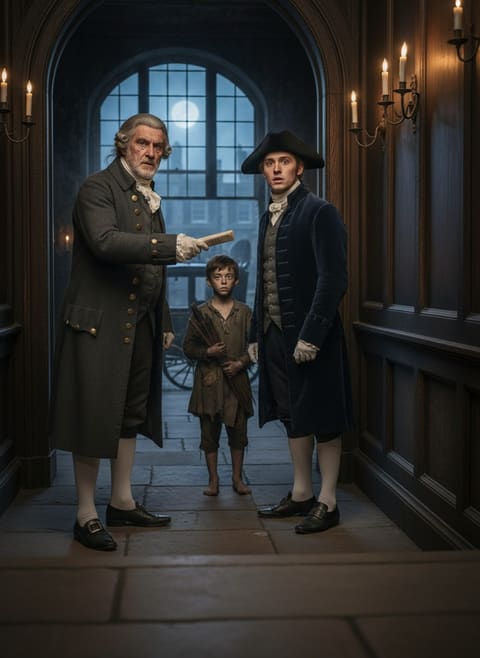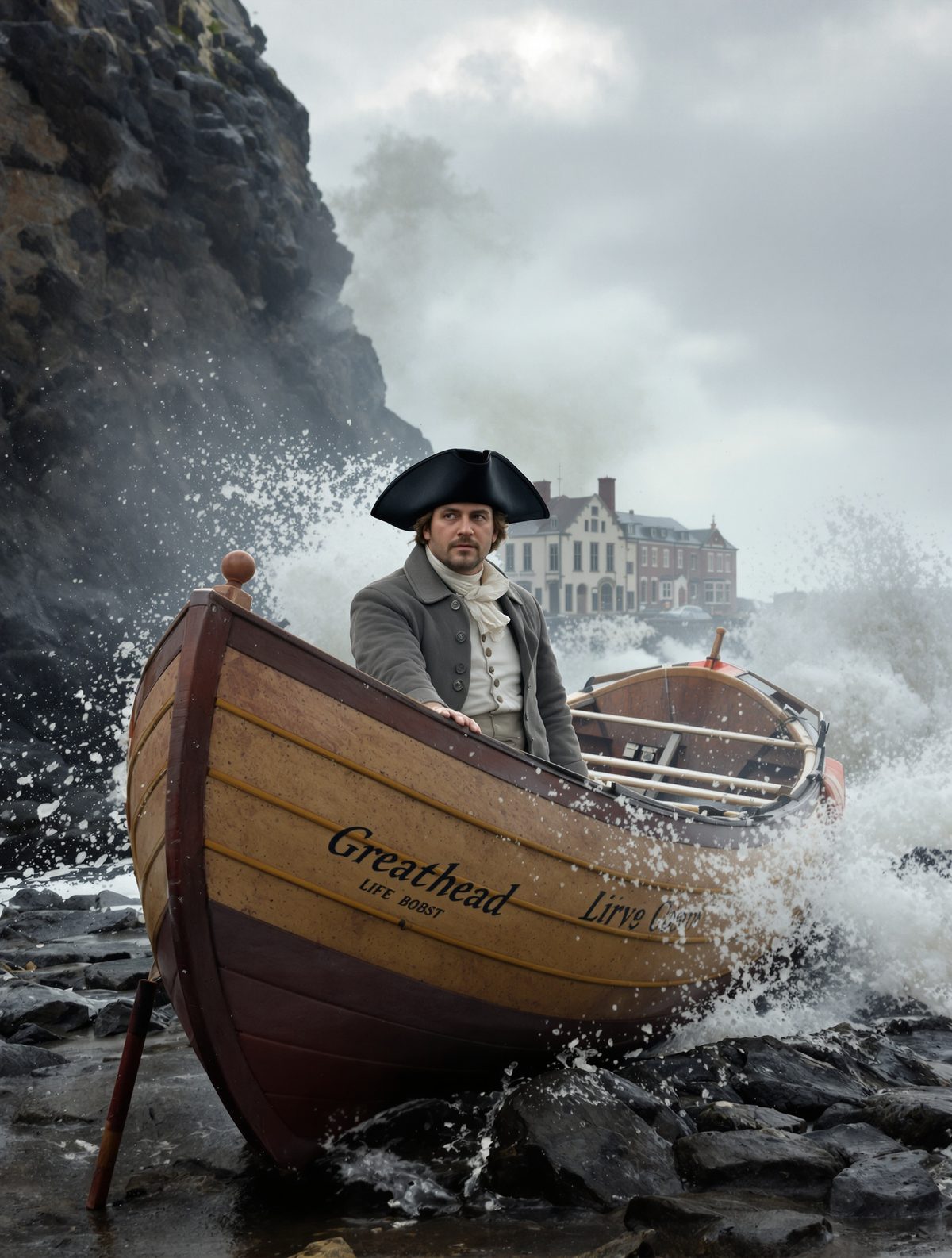
The winter of 1789 had already claimed too many lives on the Tyne. Henry Greathead stood on the wind-lashed shore at South Shields, watching another ship break apart on the merciless rocks just yards from safety. The Adventure groaned and twisted in the churning waters, her crew clinging to the rigging as waves tall as houses crashed over her deck. Local fishermen shook their heads and turned away—they'd seen this tragedy unfold countless times before. But today would be different. Today, Greathead's revolutionary creation, a boat designed to dance with death itself, would face its baptism by fury.
What happened next would transform maritime rescue forever, yet most history books barely mention the moment when one man's desperate gamble launched the modern age of sea rescue. This is the untold story of how Britain's first true lifeboat proved itself in the crucible of a North Sea storm.
The Killing Coast
The mouth of the River Tyne was a ship-eater. Despite being the gateway to Newcastle's booming coal trade, the treacherous Herd Sand and the jagged Black Middens rocks had claimed over 50 vessels in the previous two decades alone. Local records grimly noted that rescue attempts often claimed more lives than the original disasters—conventional boats simply couldn't survive the violent waters that surrounded a wreck.
The tragedy that sparked everything happened on 5th March 1789, when the ship Adventure foundered in a winter gale. Helpless townspeople watched from the shore as all hands were lost within sight of safety. The local newspaper, the Newcastle Courant, captured the community's anguish: "To see fellow creatures perishing before our eyes, without the possibility of assisting them, is perhaps one of the most painful sensations the human mind can experience."
Read next: The Day a Black Sailor Walked Into Court and Freed Himself
But from this despair came innovation. The gentlemen of South Shields, led by Nicholas Fairles and backed by the Duke of Northumberland, offered a prize of two guineas for the best lifeboat design. They had no idea they were about to commission a revolution.
The Boat Builder's Gamble
Henry Greathead was no gentleman inventor. Born around 1757, he was a working boat builder whose hands were as familiar with timber and tar as a surgeon's with bone and blood. His workshop on the South Shields waterfront had produced countless fishing boats and pleasure craft, but nothing like what he was about to attempt.
The competition drew multiple entries, including designs from celebrated naval architects. Yet it was Greathead who understood something the others missed: a rescue boat didn't just need to stay afloat—it needed to survive being turned upside down, sideways, and inside out by waves that could crush a normal vessel like an eggshell.
His solution was radical for its time. The Original, as he named her, stretched 30 feet long but drew only 3 feet of water. Her secret lay in her extraordinary design: a self-righting hull filled with cork for buoyancy, sealed air chambers that made her unsinkable, and a keel weighted with 700 pounds of iron. Most revolutionary of all were her upturned ends, curved like crescent moons, which allowed waves to sweep over her without swamping the crew.
The gentlemen's committee hedged their bets, combining elements from multiple designs, but Greathead built what he believed would work. By December 1789, his Original sat ready on the beach, untested in real conditions but embodying principles that would define lifeboat design for the next century.
Into the Maelstrom
The test came sooner than anyone expected. On 20th January 1790, barely a month after completion, another vessel found herself in mortal peril off the Tyne. Contemporary accounts don't name the ship, but they vividly describe the conditions: a north-easterly gale that turned the sea white with foam, waves breaking clean over the pier heads, and a vessel being driven inexorably toward the rocks.
This was the moment Greathead had prepared for, yet as he looked at his creation, doubt must have gnawed at him. No amount of theory could predict how the Original would behave when nature unleashed its full fury. The boat's crew—handpicked volunteers who understood they were risking everything on an untested design—waited for his signal.
What happened next defied the expectations of everyone watching from shore. As the Original met the first massive wave, she didn't fight it—she rode over it like a cork, her curved ends cutting through the water as Greathead had envisioned. When a second wave caught her beam-on and rolled her completely over, gasps went up from the crowd. But within seconds, the weighted keel pulled her upright again, her crew still aboard, still rowing.
The rescue itself took nearly four hours. Time and again, mountainous waves buried the Original completely, only for her to emerge like a sea creature, shaking off tons of water through her ingenious drainage system. By the time Greathead's crew reached the distressed vessel and brought her people safely to shore, they had proven something extraordinary: death at sea was no longer inevitable.
The Innovation That Changed Everything
What made the Original so revolutionary wasn't any single feature, but how Greathead combined multiple innovations into one vessel. Her cork-filled hull provided buoyancy that made her literally unsinkable—a concept so novel that many contemporaries couldn't believe it would work. The curved stems weren't just decorative; they allowed the boat to shed water instantly rather than taking it aboard.
Perhaps most ingenious was her self-righting capability. Greathead had calculated the precise weight and positioning of the iron keel so that no matter how violently the boat was thrown about, physics would always pull her upright. Tests conducted later showed she could right herself in less than five seconds—faster than a man could drown.
The boat's construction revealed Greathead's intimate understanding of his materials. He used English oak throughout, but varied the thickness strategically: thicker planking below the waterline for strength, lighter construction above for buoyancy. Iron bands reinforced stress points, while copper fastenings resisted corrosion. Every detail served the singular purpose of keeping the crew alive in conditions that would destroy conventional boats.
But Greathead's masterstroke was recognizing that a lifeboat crew couldn't just survive—they had to be able to work. The Original's design kept her relatively stable even in extreme conditions, allowing the crew to row effectively and maneuver alongside vessels in distress. This wasn't just a survival pod; it was a working rescue platform.
Read next: The Day a London Clerk Walked Into Court for a Dying Slave
The Ripple Effect
Word of the Original's success spread along Britain's coast like wildfire. Within a year, orders poured into Greathead's workshop from ports across the kingdom. The Admiralty took notice, commissioning detailed studies of the design. Trinity House, the ancient institution responsible for maritime safety, endorsed the concept.
By 1803, Greathead had built over 30 lifeboats based on his original design, saving hundreds of lives in the process. The Original herself served for 40 years, credited with rescuing over 400 souls from the hungry sea. Her success inspired the formation of the National Institution for the Preservation of Life from Shipwreck in 1824—later renamed the Royal National Lifeboat Institution (RNLI).
The design principles Greathead pioneered—self-righting capability, unsinkable construction, and sea-keeping ability in extreme conditions—remain fundamental to lifeboat design today. Modern RNLI vessels still use weighted keels and sealed compartments, direct descendants of innovations first tested in that winter storm of 1790.
Yet perhaps the most profound change wasn't technical but philosophical. Before Greathead, shipwreck was accepted as an inevitable tragedy. After the Original, maritime communities began to believe that rescue was possible, that human ingenuity could cheat the sea of its victims. This shift in mindset drove decades of innovation in maritime safety.
The Legacy Written in Saved Lives
Today, as GPS and satellite communication make sea rescue seem routine, it's easy to forget how revolutionary Greathead's achievement was. In an age when steam power was still experimental and Napoleon was just beginning his rise to power, a working boat builder from South Shields solved one of humanity's oldest problems: how to snatch life from the jaws of the sea.
The Original survived until 1830, when she was finally retired after four decades of service. By then, she had become legendary, her design copied and adapted across the maritime world. Greathead himself lived to see his innovation transform sea rescue from a desperate gamble into a science, though he never achieved the wealth his contribution merited.
Perhaps most remarkably, the fundamental challenge Greathead faced—designing a vessel that could operate safely in conditions that would destroy conventional boats—mirrors modern rescue operations from space missions to disaster response. His solution—understanding the environment completely and designing with nature rather than against it—remains as relevant today as it was in 1790. In our age of technological marvels, there's something profoundly inspiring about a craftsman whose greatest innovation was simply refusing to accept that courage wasn't enough, that there had to be a better way to save lives at sea.