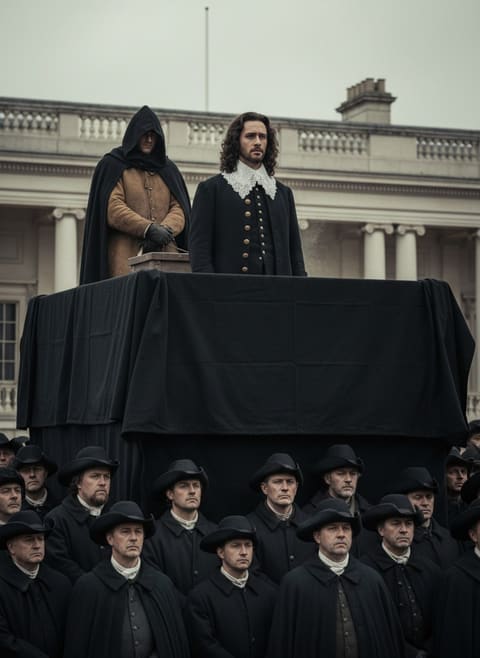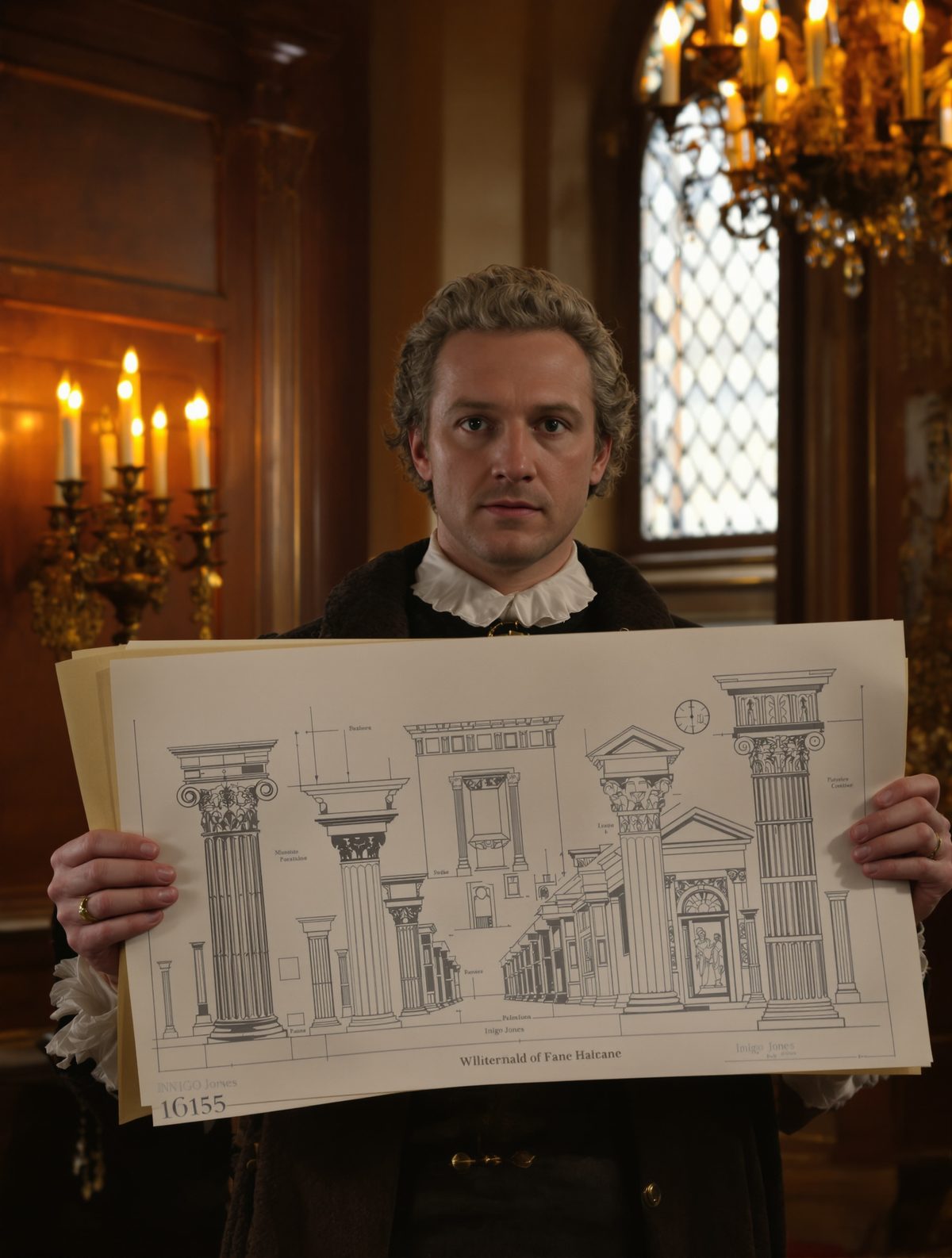
Picture this: a Welsh carpenter's son stands in the opulent chambers of Whitehall Palace, his weathered hands trembling slightly as he unrolls a collection of architectural drawings before King James I. The year is 1615, and what the monarch sees spread across the polished oak table will make him gasp. Gone are the familiar pointed arches, the soaring buttresses, the ornate stonework that has defined English buildings for centuries. Instead, these sketches show something utterly foreign yet breathtakingly elegant—clean lines, perfect proportions, and columns that seem to dance with mathematical precision.
The man's name is Inigo Jones, and he's about to commit what some might call architectural treason. He's smuggling the Renaissance into England, one building at a time.
The Revolutionary Returns Home
Jones had just returned from his second transformative journey to Italy, where he'd spent months studying the works of Andrea Palladio, the master architect whose buildings had redefined what it meant to create beauty in stone and mortar. But this wasn't just academic tourism—Jones was on a mission of architectural espionage.
In the narrow streets of Vicenza, Jones had sketched obsessively, measuring doorways and counting columns with the intensity of a man possessed. He filled notebook after notebook with precise drawings of Villa Rotonda, annotating Palladio's mathematical ratios and classical proportions. When Italian authorities questioned this foreign visitor spending so much time documenting their architectural treasures, Jones claimed he was merely a curious traveler. In reality, he was preparing to revolutionize an entire nation's building tradition.
Read next: The Day a Tudor Chancellor Chose Death Over a Royal Lie
What made Jones's mission so audacious wasn't just what he was bringing into England—it was what he planned to sweep away. For over 400 years, English architecture had been dominated by the Gothic tradition: soaring spires reaching toward heaven, elaborate stone tracery, and buildings that seemed to grow organically from the landscape. It was architecture born of faith, mystery, and medieval craftsmanship. Jones wanted to replace all of that with something radically different: the cool, rational perfection of classical antiquity.
A King Enchanted by Foreign Dreams
James I was the perfect patron for such a revolution. Unlike his predecessors who had been content with England's architectural insularity, James harbored grand continental ambitions. He'd already commissioned Jones to design masques—elaborate court entertainments that showcased the latest European theatrical innovations. Now the king was ready to let Jones work the same magic with stone and timber.
The first test came with the Queen's House in Greenwich, begun in 1616 for James's queen, Anne of Denmark. When construction commenced, local craftsmen stared in bewilderment at Jones's plans. Where were the familiar pointed windows? The decorative battlements? The comfortable chaos of Tudor timber framing?
Instead, Jones demanded something that had never been seen in England: a perfectly symmetrical cube of a building, its facade dominated by a double-height loggia supported by slender Ionic columns. The proportions followed Palladio's mathematical ratios religiously—every window, every door, every decorative element calculated according to classical formulas that hadn't been seen in Britain since the Romans left over a thousand years earlier.
The Queen's House was, quite literally, foreign architecture dropped onto English soil. Local builders struggled with the unfamiliar techniques. How do you construct a flat Italian roof in England's wet climate? How do you source the precise types of stone needed for classical columns when English quarries had been supplying Gothic projects for centuries?
The Banqueting House: Palladio Meets Whitehall
But Jones's true masterstroke came in 1619 when fire destroyed the old Banqueting House at Whitehall Palace. Here was his chance to plant a piece of Renaissance Italy right in the heart of English royal power. The building he designed was nothing short of revolutionary—a perfect double cube internally, its exterior facade a rigorous exercise in classical proportion that wouldn't have looked out of place in Renaissance Venice.
The new Banqueting House featured something England had never seen: a facade organized by a giant order of classical columns that rose through two full stories. Jones imported the finest Portland stone and employed Italian craftsmen to execute details that local masons simply didn't know how to carve. The building's seven bays were organized according to a complex mathematical rhythm: 3-1-3, with the central bay slightly emphasized but never overwhelming the perfect balance of the whole.
Contemporary observers were stunned. The Venetian ambassador wrote back to the Doge describing "a building of such classical perfection that it might have been transported entire from the Veneto." English courtiers, meanwhile, weren't sure whether to admire or deplore this foreign intrusion into their familiar architectural landscape.
The interior was even more radical. Jones created a vast ceremonial space with a flat ceiling—no Gothic vaulting, no medieval timber work, just pure geometric perfection topped by Peter Paul Rubens's magnificent painted panels celebrating the divine right of kings. This was architecture as political statement: orderly, hierarchical, and absolutely controlled.
The Resistance and the Revolution
Not everyone welcomed Jones's architectural revolution. Master masons who had spent decades perfecting Gothic stonework found themselves obsolete overnight. The medieval guild system, which had governed English building for centuries, suddenly seemed hopelessly old-fashioned. Traditionalists grumbled that Jones was corrupting honest English craftsmanship with foreign fripperies.
Religious conservatives were even more alarmed. Gothic architecture had been explicitly Christian—its pointed arches lifting the eye toward heaven, its elaborate decoration celebrating divine creation. Jones's classical architecture, by contrast, was pagan in origin, celebrating human reason and mathematical perfection rather than spiritual transcendence. Some clergy denounced the new style as "heathen temples" unfit for Christian worship.
But Jones pressed on, training a new generation of craftsmen in classical techniques and gradually building a network of supporters who understood his vision. When he was appointed Surveyor of the King's Works in 1615—essentially England's chief royal architect—he gained the institutional power to implement change on a massive scale.
His influence extended far beyond individual buildings. Jones reformed building regulations, standardized classical proportions, and even designed the first planned urban development in London: Covent Garden, laid out around a perfect Italian piazza with uniform facades that wouldn't have looked out of place in Renaissance Rome.
Read next: The Day a Tudor Bishop Refused to Crown a Usurper
The Architect as Cultural Smuggler
What makes Jones's achievement so remarkable isn't just the beauty of his individual buildings—it's the sheer audacity of cultural transplantation he accomplished. He essentially convinced an entire nation to abandon its architectural DNA and adopt a completely foreign building tradition.
Consider the scale of this transformation. In 1610, virtually every significant building in England was Gothic or Tudor in style. By 1650, classical architecture was spreading across the country like wildfire. Country gentlemen who had never been closer to Italy than Dover were commissioning houses with pediments and pilasters. Church architects were tentatively introducing classical details into their designs. Even humble parish churches began sprouting Renaissance doorways and symmetrical facades.
Jones had done more than import a new architectural style—he'd fundamentally altered how the English thought about space, proportion, and beauty. The organic, intuitive approach of medieval building was being replaced by something systematic, mathematical, and consciously sophisticated.
Perhaps most surprisingly, this foreign architecture gradually became thoroughly English. By the 18th century, the classical tradition that Jones had smuggled from Italy was considered the natural expression of English taste and values. Georgian London, with its perfectly proportioned squares and terraces, was built on foundations that Jones had laid two centuries earlier.
The Legacy of Architectural Rebellion
Today, as we walk past the Banqueting House on Whitehall or admire the elegant proportions of a Georgian terrace, we're seeing the long-term consequences of Jones's quiet revolution. He didn't just change how buildings looked—he transformed how an entire culture understood the relationship between beauty, order, and power.
In our age of global architecture, when buildings designed in one continent routinely appear on another, Jones's story feels remarkably contemporary. He was perhaps history's first truly international architect, synthesizing Italian theory with English pragmatism to create something entirely new. His career reminds us that the most profound cultural changes often begin with a single individual willing to challenge everything their society takes for granted.
The Welsh carpenter's son who stood before James I in 1615 with his subversive drawings couldn't have imagined that his architectural rebellion would still be shaping cityscapes four centuries later. But perhaps that's the real measure of revolutionary vision—it creates a future so thoroughly that we can hardly imagine the world that existed before it.