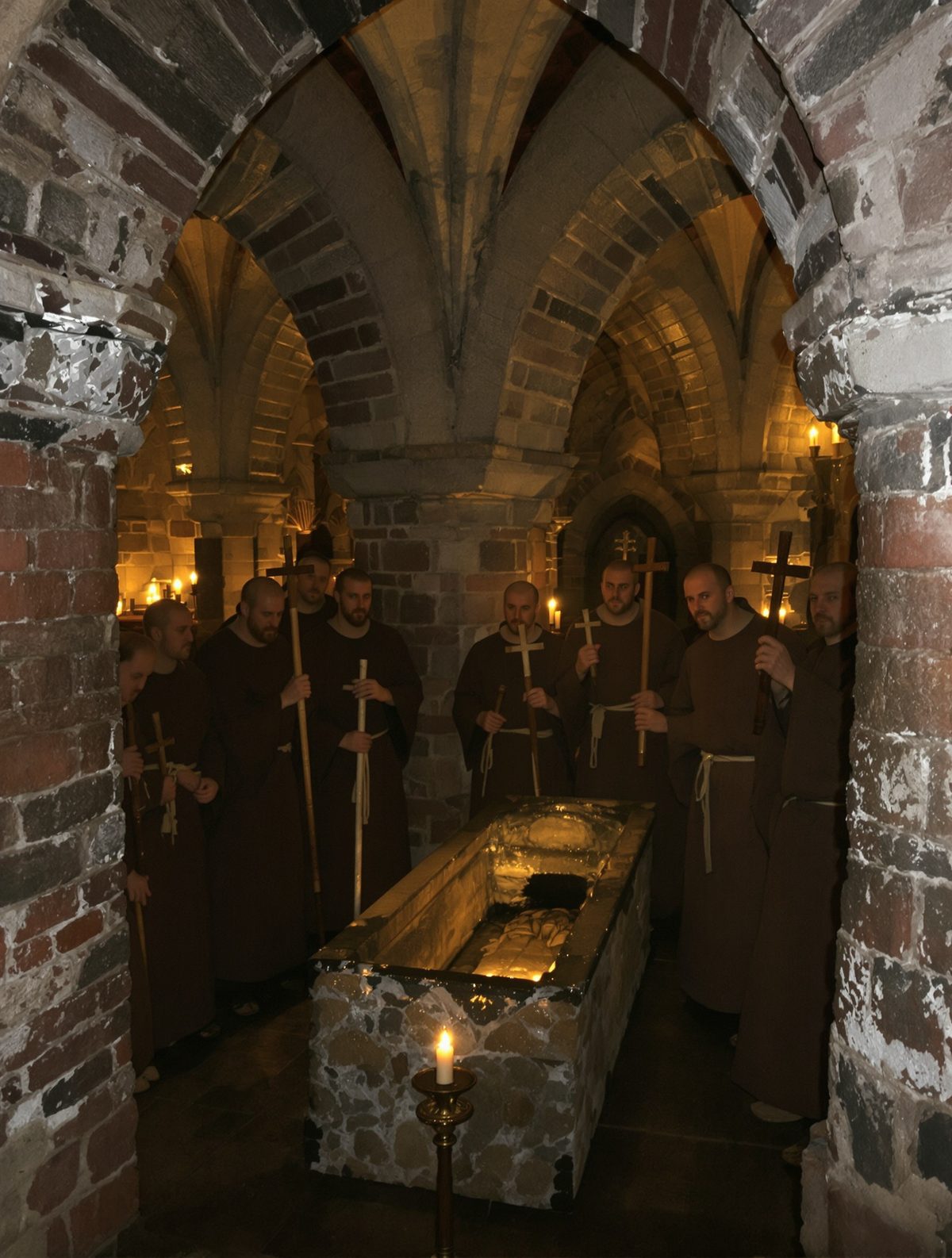
The chisel bit into the ancient stone with a sharp crack that echoed through Westminster Abbey's hallowed halls. It was October 13th, 1102, and Abbot Gilbert Crispin watched nervously as his monks worked to open a tomb that had remained sealed for thirty-six long years. Inside lay Edward the Confessor, the last Anglo-Saxon king of England, and what they were about to discover would change the course of English history forever.
As the heavy stone lid shifted and torchlight pierced the darkness within, the monks gasped in unison. Where they expected to find crumbling bones and the musty smell of decay, they saw something that defied every natural law they understood. King Edward lay before them as if he had died only yesterday—his flesh intact, his royal robes unmarred by time, his face serene and uncorrupted. In that moment, England had witnessed what would be declared its first royal miracle.
The Saintly King Who Never Wanted the Crown
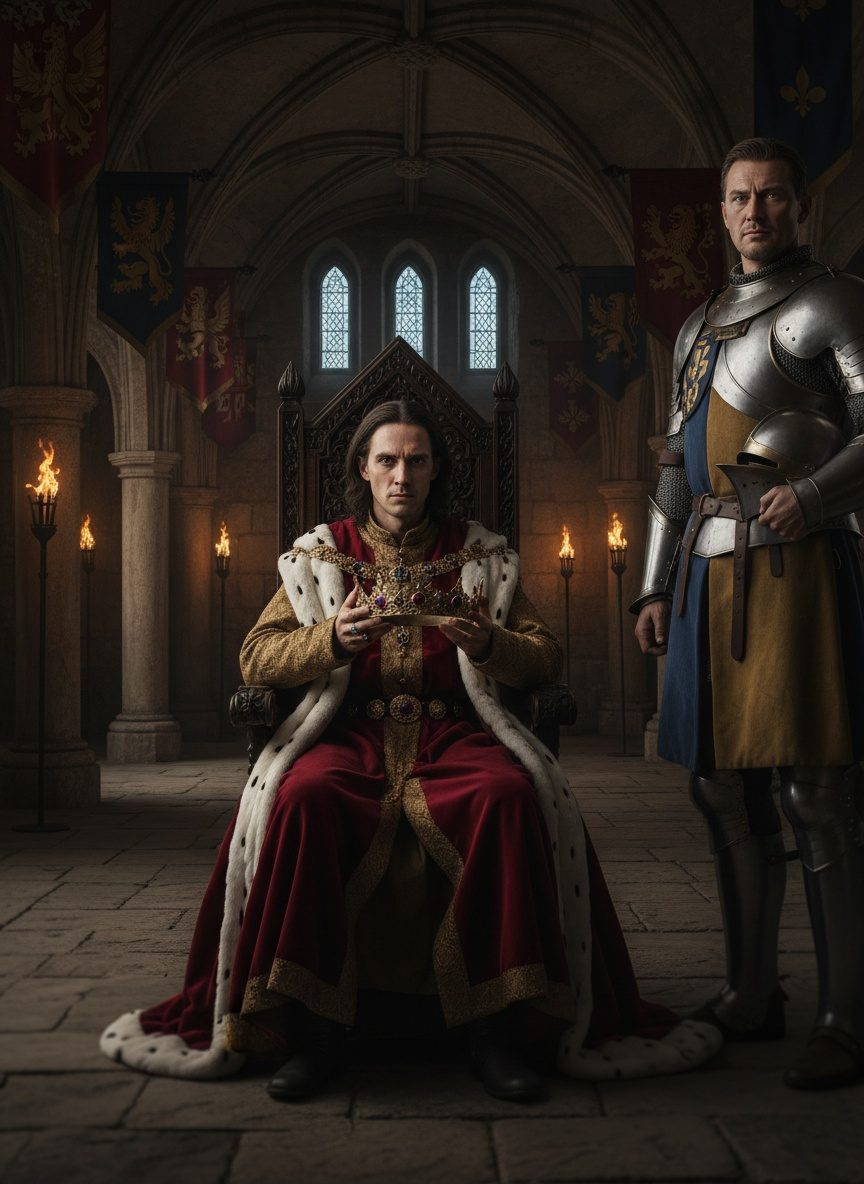
To understand the magnitude of what the Norman monks discovered, we must first journey back to Edward himself—a reluctant king whose path to sainthood began long before his death. Born around 1003, Edward spent twenty-five years in exile in Normandy while Viking kings ruled his homeland. When he finally claimed the English throne in 1042, he was already forty years old and more monk than monarch in temperament.
Edward's contemporaries described him as a man who seemed to belong more in a monastery than a palace. He attended mass daily, sometimes twice, and was known to give away so much of the royal treasury to the poor that his advisors despaired. The Vita Ædwardi Regis, written shortly after his death, tells us that Edward would personally wash the feet of pilgrims and was so generous that "he scattered his wealth like seed upon fertile ground."
Read next: The Day a Defeated King Sailed Away and Never Looked Back
Perhaps most remarkably for a medieval king, Edward and his wife Edith lived in what many historians believe was a celibate marriage. Whether this was due to political calculation, personal piety, or both, it meant that when Edward died on January 5th, 1066, he left no heir—a fact that would trigger the Norman Conquest and forever change the trajectory of English history.
Death of a King, Birth of a Legend
Edward's final days were marked by visions that his followers would later cite as evidence of his prophetic powers. According to the Anglo-Saxon Chronicle, the dying king predicted great tribulations would befall England—a prophecy that seemed to come true when Harold fell at Hastings and William the Conqueror swept across the land.
On that cold January morning in 1066, as Edward drew his last breath in his palace at Westminster, something extraordinary allegedly occurred. Witnesses reported that a sweet fragrance filled the room, and the king's face took on an otherworldly peace. His body was interred the very next day in his greatest achievement—Westminster Abbey, which he had spent the last years of his life rebuilding in the grand Norman style.
But here's what most people don't know: Edward's tomb wasn't originally meant to be permanent. Medieval practice often involved moving royal remains to more elaborate resting places once proper monuments could be constructed. The Norman kings who succeeded Edward had every political reason to honor their predecessor—after all, William the Conqueror claimed his right to the English throne partly through Edward's supposed promise.
The Miracle That Shook Westminster
When Abbot Gilbert Crispin ordered Edward's tomb opened that October day in 1102, he was likely planning a routine translation of the remains to a more fitting shrine. What he found instead was so shocking that word spread throughout Christendom within weeks.
The detailed account recorded by the monks describes Edward's body as "whole and uncorrupted, as if he had been buried that very day." His royal vestments showed no signs of decay, his skin remained supple to the touch, and most astonishing of all, his beard and hair appeared to have continued growing after death. The chronicler Osbert of Clare, who interviewed eyewitnesses, wrote that "the king's face shone with such beauty that all who saw it were filled with wonder and joy."
But the miracle went beyond mere preservation. According to multiple accounts, when the monks carefully lifted Edward's hand to examine a ring, the limb moved freely at the joints as if the king were merely sleeping. One particularly bold monk reportedly trimmed a piece of the royal beard as a relic—and claimed the hair felt as soft and fresh as that of a living man.
Word of the discovery reached King Henry I within days. The Norman king, perhaps sensing the political value of a saintly predecessor, ordered that Edward's body be examined by bishops and learned men. Their unanimous verdict: this was indeed a divine miracle, proof of Edward's sanctity.
The Science Behind the Sacred
Modern historians and forensic experts have proposed various theories to explain Edward's remarkable preservation. The cold, dry conditions within Westminster Abbey's stone tomb might have created a natural mummification process. Some scholars suggest that Edward's reportedly austere lifestyle—eating little meat and drinking minimal wine—could have affected his body's chemistry in ways that inhibited decay.
There's also the intriguing possibility of adipocere formation—a waxy substance that can preserve corpses under specific conditions of moisture and temperature. This process, unknown to medieval minds, can create the appearance of almost perfect preservation decades after death.
Yet even accounting for these natural explanations, the sheer completeness of Edward's preservation remains remarkable. Medieval chronicles are filled with exaggerated claims, but the consistency of multiple independent accounts suggests something genuinely extraordinary occurred in that tomb.
Perhaps most tellingly, when Edward's tomb was opened again in 1163 for his official canonization ceremony, witnesses reported the same perfect preservation after ninety-seven years. Even allowing for medieval embellishment, this suggests preservation far beyond normal expectations.
From King to Saint: The Political Miracle
The discovery of Edward's uncorrupted body couldn't have come at a better time for Norman political interests. Henry I was consolidating his rule and needed to legitimize Norman claims to divine approval. A miracle-working Anglo-Saxon king who had welcomed Norman customs and allegedly promised the throne to William the Conqueror was perfect propaganda.
The campaign for Edward's canonization began almost immediately. Petitions flooded Rome with accounts of miracles attributed to the dead king's intercession. Pilgrims reported healings after visiting his tomb, and Westminster Abbey began to rival Canterbury as a destination for the faithful.
In 1161, Pope Alexander III officially canonized Edward the Confessor, making him England's first royal saint. The timing was significant—it came during the turbulent reign of Henry II, who needed all the divine legitimacy he could muster during his conflicts with Thomas Becket and the Church.
On October 13th, 1163—exactly sixty-one years after the first opening—Edward's body was ceremonially moved to a magnificent new shrine behind the high altar of Westminster Abbey. Contemporary accounts suggest his preservation remained as perfect as ever, even after nearly a century in the grave.
The Eternal King's Lasting Legacy
Today, as visitors walk through Westminster Abbey past the shrine of Edward the Confessor, few realize they're witnessing the culmination of one of history's most extraordinary preservation mysteries. The original shrine was destroyed during the Reformation, but Edward's remains still rest there, having survived nearly a millennium since that shocking discovery in 1102.
The story of Edward's incorruptible body reminds us that history often lies at the intersection of the miraculous and the mundane, the sacred and the political. Whether divine intervention, natural preservation, or medieval embellishment—or perhaps all three—the discovery in 1102 shaped English identity for generations.
In our age of scientific skepticism, it's easy to dismiss such accounts as medieval superstition. Yet the human need to find meaning in the inexplicable remains as powerful today as it was nine centuries ago. Edward the Confessor's perfectly preserved body offered a divided nation proof that England itself was blessed, that continuity could survive conquest, and that some things—whether kingdoms, faith, or human dignity—truly are incorruptible.
The monks who opened that tomb expecting dust and bones instead found a mystery that still challenges our understanding of history, faith, and the thin line between legend and truth. In the end, perhaps that's the most remarkable preservation of all—not of flesh and bone, but of wonder itself.