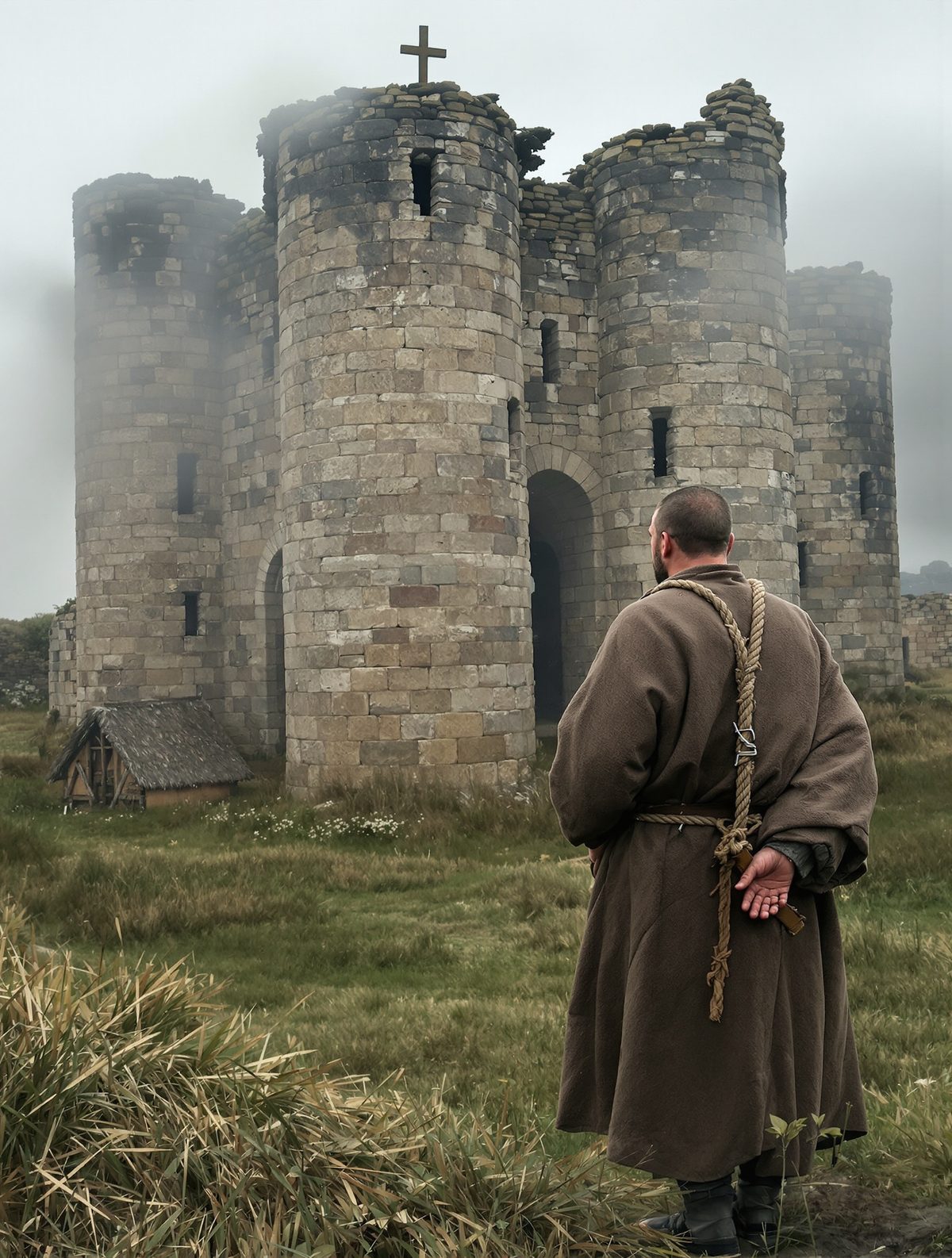
The salt wind howled across the Essex marshes as Brother Cedd stepped through the crumbling gatehouse of Bradwell fort. Ravens scattered from the broken walls, their cries echoing off stones that had stood since Rome's legions first marched into Britain. Beneath his feet lay scattered bones—whether Roman, Saxon, or Viking, none could say. The locals called this place forbiddan grund—forbidden ground. They whispered that demons danced among the ruins when darkness fell.
But on this grey morning in 654 AD, the Irish-trained monk saw something else entirely. Where others saw desolation, Cedd glimpsed destiny. In this blood-soaked wasteland at the edge of the world, he would build something extraordinary: England's first stone church, rising like a phoenix from the ashes of empire.
Where Eagles Once Flew
Bradwell-on-Sea had been magnificent once. The Romans called it Othona, one of nine great forts guarding the Saxon Shore against barbarian raiders. For three centuries, its walls had sheltered the last flicker of Roman civilization as the empire crumbled around it. Legionnaires from Syria and Spain had walked these ramparts, watching for Saxon longships cutting through the morning mist.
But by 410 AD, the eagles had flown home forever. The fort's massive walls—built from Kentish ragstone and local septaria—became a hollow shell. Nature began its slow reclamation, ivy creeping through the mortar, wild flowers pushing up between the cobblestones where centurions once marched.
Read next: The Day a Saxon King Knelt and Washed a Leper's Feet
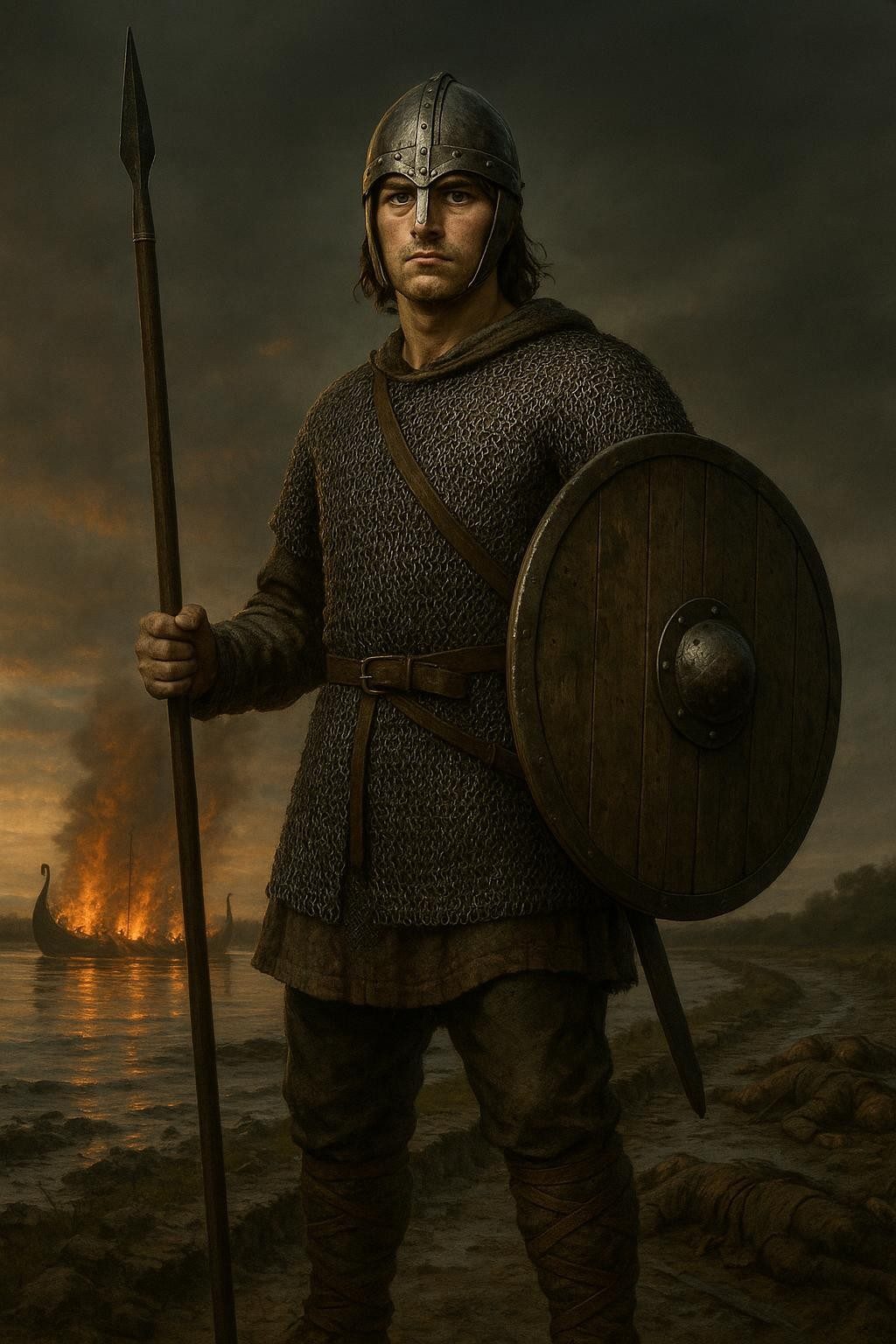
Then came the Vikings. Sometime in the early 640s, a Danish war-band had made Bradwell their temporary base, using its walls as protection while they raided up the Thames. Local chronicles speak darkly of Christian priests murdered on these very stones, their blood seeping into ground already soaked with centuries of violence. Little wonder the Saxons gave the place a wide berth, crossing themselves as they sailed past its brooding silhouette.
The Saint from the Edge of the World
Cedd was no ordinary missionary. Born in Northumbria around 620 AD, he belonged to that remarkable generation of Celtic saints who would transform Anglo-Saxon England. Along with his three brothers—Chad, Cynibil, and Caelin—he had trained at the great monastery of Lindisfarne, where Irish monks had preserved classical learning through the darkest centuries.
At Lindisfarne, Cedd learned to read Greek and Latin, to illuminate manuscripts, and to work stone. But most importantly, he absorbed the Celtic church's fearless approach to evangelization. While Roman missionaries preferred to work through kings and nobles, the Irish tradition sent saints into the wilderness—the more hostile and remote, the better.
When Sigeberht, King of the East Saxons, requested missionaries to convert his people, Cedd answered the call. He had already proven himself in the wild frontier of Mercia, where he'd founded monasteries at Repton and Lastingham. But Essex presented a different challenge entirely. This was the homeland of the East Saxons, among the most stubbornly pagan of all the Germanic tribes. Their king might have converted, but his people still poured ale on ancient standing stones and whispered prayers to Woden in the darkness.
Seeing God's Plan in Desolation
Why did Cedd choose Bradwell? The decision seems almost perverse—a missionary selecting the one place guaranteed to terrify potential converts. Local Saxons avoided the ruins so completely that fishermen would rather brave dangerous tides than beach their boats nearby. The very stones seemed to reek of violence and pagan magic.
But Cedd's choice revealed profound spiritual insight. In the Celtic Christian tradition, such places held special power. Where pagans saw curses, Christians could demonstrate God's sovereignty by claiming the darkness for the light. The more feared the location, the more spectacular the victory when Christ's presence transformed it.
There were practical considerations too. The fort's position was strategically brilliant—perched on a low hill overlooking the Blackwater estuary, visible to ships sailing the Thames approaches. Its Roman-built harbor could accommodate vessels from across the North Sea. Most importantly, the massive walls provided ready-made quarry stone of exceptional quality, already cut and seasoned by three centuries of weathering.
As Cedd walked through the ruins, his architect's eye catalogued possibilities. The fort's west wall contained enough dressed stone to build his entire church. The foundations were solid, the drainage excellent. What the Romans had built for war, God would reclaim for peace.
Raising the Stones
Construction began in early spring 654, just weeks after Cedd's arrival. The saint had brought a small community of monks from Lindisfarne, men skilled in the arts of building and manuscript copying. But the real workforce came from an unexpected source: Sigeberht's court, including nobles doing penance for past sins.
Medieval chronicles record that King Sigeberht himself worked alongside common laborers, carrying stones and mixing mortar as an act of humility. This royal participation sent a powerful message to local Saxons: even their king wasn't afraid of Bradwell's supposed curse.
The church they built was revolutionary. While every other Christian building in England used wood, Cedd's vision demanded permanence. Working within the fort's west wall, his builders created something unprecedented: a stone basilica 55 feet long and 22 feet wide, with walls three feet thick. The design blended Roman engineering with Celtic symbolism—a perfect metaphor for Christianity's conquest of pagan Britain.
The builders incorporated Roman architectural elements with stunning confidence. Columns from the fort's headquarters became the church's arcade supports. Roman roof tiles were carefully reset to keep out the North Sea gales. Most remarkably, they created England's first stone baptistery, fed by a spring that bubbled up through the Roman foundations—water flowing from pagan ruins into Christian salvation.
Where Miracles Walked
As the church rose, something extraordinary happened. The curse that had kept Saxons away began to lift, replaced by growing wonder at Cedd's boldness. Fishermen reported strange lights moving through the ruins at night—not the demonic fires they'd feared, but something altogether more benevolent. The saint's fearless presence seemed to cleanse the very air.
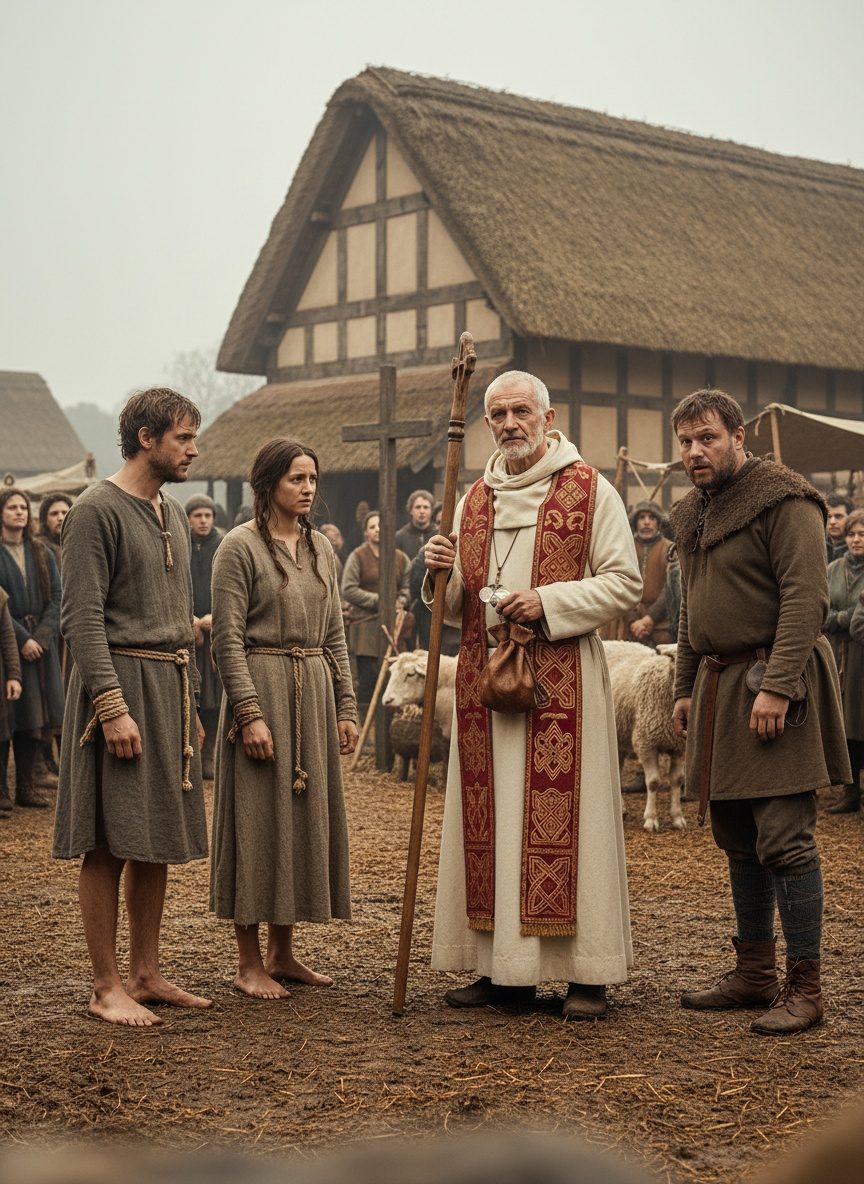
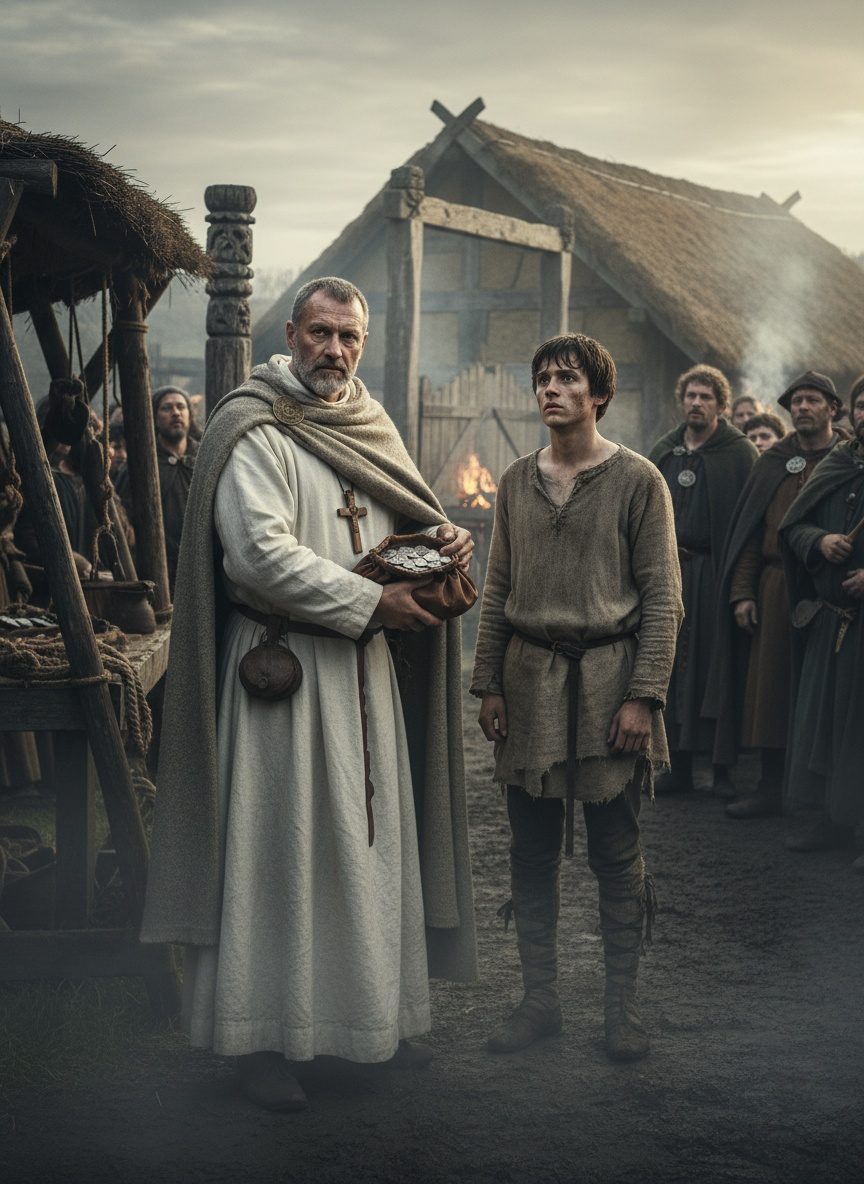
Cedd established his monastic rule based on the Irish model: prayer eight times daily, manuscript copying, and agricultural work to feed the growing community. But Bradwell's real transformation came through its role as a missionary center. From here, Cedd and his monks fanned out across Essex, preaching in Saxon halls and village markets.
The monastery became a beacon of learning in an age of darkness. Its library contained Greek and Latin texts preserved nowhere else in England. Visiting nobles came to marvel at the illuminated gospels, their intricate Celtic designs incorporating Saxon artistic traditions. For the first time since the Roman withdrawal, classical civilization was taking root in British soil again.
By 660 AD, just six years after its founding, Bradwell had become one of England's most important religious centers. Kings and bishops made pilgrimages to see the church that defied both nature and superstition. The "cursed" ruins had become a symbol of Christianity's triumph over fear itself.
Echoes Across the Centuries
Today, St. Peter's Chapel at Bradwell-on-Sea stands as England's oldest church, its Roman stones still defying the North Sea winds after nearly fourteen centuries. Visitors can trace Cedd's vision in every weathered block—Roman expertise wedded to Christian hope, classical engineering serving medieval faith.
The chapel survived Viking raids, Norman conquest, and Protestant reformation precisely because of Cedd's bold choice of location and materials. While wooden churches rotted and burned, his stone sanctuary endured, a testament to the power of permanence in an age of chaos.
But perhaps Cedd's greatest legacy lies not in stones but in attitude. In choosing the most feared place in Essex for his greatest work, the saint demonstrated that no location lies beyond redemption's reach. Where others saw only curses and failure, he glimpsed possibility. In the ruins of the past, he built foundations for the future.
In our own age of uncertainty, when ancient divisions and modern fears seem to dominate the headlines, Cedd's story offers profound hope. Sometimes the most transformative work happens precisely in those places others have written off as lost causes—if we have the courage to see past the surface to the deeper possibilities beneath.