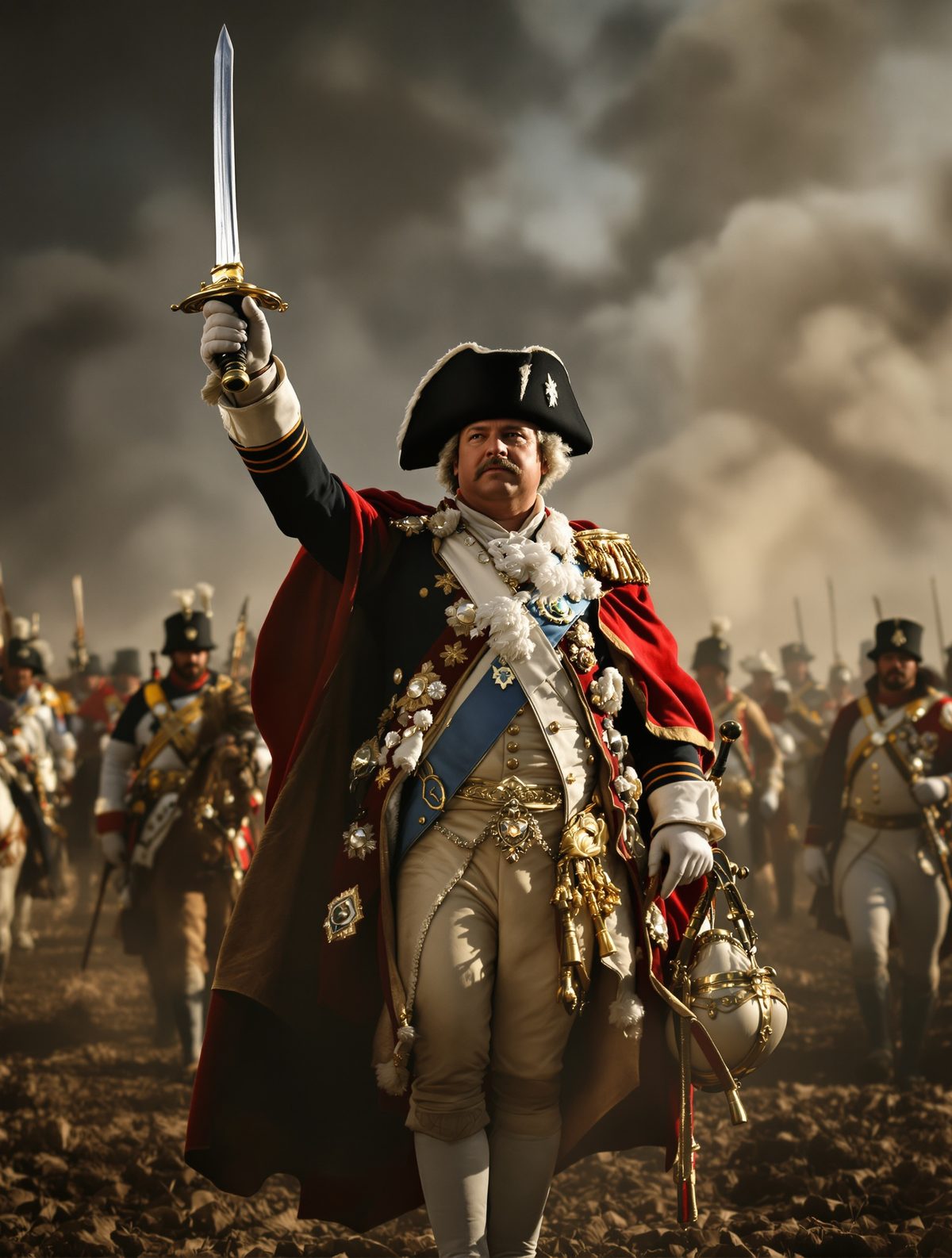
Picture this: a sixty-year-old king, his elaborate wig askew, standing ankle-deep in German mud with a sword in his hand as French cannonballs whistle overhead. His terrified horse has just bolted toward enemy lines, leaving His Majesty stranded between two armies locked in mortal combat. Any sensible monarch would retreat to safety. But King George II was about to prove he was cut from different cloth entirely.
On June 27, 1743, at the Battle of Dettingen, the Hanoverian king would earn his place in history as Britain's last warrior monarch—not through careful strategy from a distant command tent, but by grabbing his sword and charging into the fray like a medieval knight. What happened that day would echo through the corridors of royal history, marking the end of an era when kings led from the front rather than the palace.
A King Shaped by War
George Augustus had war in his blood long before he inherited the British throne in 1727. Born in Hanover in 1683, he'd grown up watching his father, the future George I, navigate the treacherous politics of continental Europe. By his twenties, young George was already a veteran of the War of Spanish Succession, having fought with distinction at the Battle of Oudenarde in 1708. He understood viscerally what his later successor monarchs would only know from reports: the acrid smell of gunpowder, the chaos of cavalry charges, and the weight of steel in your hand when lives hung in the balance.
This wasn't merely royal posturing. The House of Hanover ruled territories that sat squarely in Europe's most contested region. George II's domains stretched from Britain across the North Sea to the German states, making him a target for ambitious neighbors and requiring the kind of hands-on leadership that modern constitutional monarchs would find unthinkable. When the War of Austrian Succession erupted in 1740, dragging Britain into another continental conflict, George II saw an opportunity to prove that the fighting spirit that had brought his dynasty to power still burned bright.
Read next: The Day a Young Prince Knelt and Refused a Crown
March to Dettingen
The road to Dettingen began with grand ambitions and questionable intelligence. In spring 1743, George II assembled the "Pragmatic Army"—a coalition force of 40,000 British, Hanoverian, Austrian, and Hessian troops intended to support Austria's Maria Theresa against French expansion. The king insisted on personal command, despite the protests of his ministers who feared for both his safety and Britain's stability should anything happen to him.
The army's objective was straightforward: advance down the Main River valley and threaten French positions in Germany. What could go wrong? As it turned out, quite a lot. French Marshal Adrien Maurice de Noailles had positioned his forces brilliantly, using the terrain near the small Bavarian village of Dettingen to create what military historians call a "tactical mousetrap." The allies found themselves squeezed between the Main River and French artillery positions, with their supply lines cut and retreat routes blocked.
By the morning of June 27, George II faced every commander's nightmare: his army was trapped, outnumbered, and running low on supplies. The French held the high ground and controlled the roads. It was precisely the sort of predicament that separates competent leaders from legends—and George II was about to find out which category he belonged in.
When Majesty Met Musket Fire
The battle began at dawn with French artillery opening fire on the packed allied columns. What happened next reveals something remarkable about eighteenth-century warfare: despite the growing sophistication of military technology, battles could still be decided by personal courage and split-second decisions by individual leaders.
George II had positioned himself with the front lines—not safely in the rear as modern protocol would dictate, but close enough to see the whites of French eyes. Contemporary accounts describe him as remarkably calm, even as cannon shot churned up earth around his position. The king wore his full military dress uniform, complete with the elaborate powdered wig that marked his royal status, making him an unmistakable target for French sharpshooters.
Then disaster struck in the most peculiar way imaginable. George's horse, a magnificent charger that had carried him safely through countless reviews and ceremonies, chose this moment to succumb to battle panic. Spooked by the thunder of artillery and the screams of wounded men, the animal bolted directly toward the French lines, carrying the King of England on what appeared to be a suicidal charge into enemy territory.
Here's where the story takes on an almost mythical quality. Rather than desperately trying to regain control of his mount, George II calmly dismounted while still under fire, drew his sword, and began walking back toward his own lines. But he didn't retreat to safety. Instead, he gathered the nearest troops around him and prepared to lead a counterattack on foot.
The Foot-Slogging King
The image of a British monarch advancing on foot, sword in hand, leading a charge against French positions must have seemed like something from a romanticized painting rather than eighteenth-century reality. Yet multiple eyewitness accounts confirm that's exactly what happened. Captain Robert Kirke of the 3rd Foot Guards wrote to his wife: "His Majesty was in the thickest of it, encouraging the men with words I dare not repeat in polite company, but which had the desired effect upon their spirits."
What were those unrepeatable words? According to several sources, George II had reverted to his native German in the heat of battle, shouting at his retreating troops: "Nun, nun, meine Kinder, nun hauen wir die Franzosen über den Haufen!" ("Now, now, my children, now we'll knock the French on their heads!") The sight of their king cursing in German while waving a sword apparently struck the British soldiers as either inspiring or amusing enough to rally their spirits.
The counterattack succeeded brilliantly. French forces, perhaps as surprised as anyone to find themselves facing a charging monarch, began to waver. The battle turned into a rout, with French casualties mounting rapidly as allied forces pressed their advantage. By evening, the field belonged to George II, though at considerable cost—allied casualties numbered over 2,500 men.
The Last of His Kind
George II's victory at Dettingen resonated far beyond the immediate military consequences. In an age when monarchs were increasingly becoming symbolic figureheads, here was a king who had literally bled for his cause. The battle made George II a celebrity across Europe, with even his enemies grudgingly admitting respect for his personal courage.
Read next: The Day a Queen Rode Alone Into a Mutinous Army
But Dettingen also marked the end of an era. No British monarch would ever again personally command troops in battle. George II's own grandson, the future George III, would preside over the American Revolution and Napoleonic Wars from the safety of London. The age of warrior kings was giving way to the modern constitutional monarchy, where sovereigns reign but do not rule—and certainly do not charge enemy positions with drawn swords.
The reasons for this shift were practical as much as constitutional. As military technology advanced and battlefields became more lethal, the presence of irreplaceable heads of state near the front lines became an unacceptable risk. Moreover, the growing complexity of governance meant that kings were too valuable as administrators and symbols to risk losing to a stray musket ball.
Legacy of the Warrior King
Today, as we watch modern monarchs conduct carefully choreographed visits to military units, it's worth remembering that there was once a time when royal leadership meant something entirely different. George II's charge at Dettingen represents the last gasp of medieval kingship—the idea that a monarch's legitimacy derived not just from bloodline or constitutional law, but from personal valor in defense of the realm.
The battle had lasting consequences beyond its symbolic value. George II's victory strengthened Britain's position in the War of Austrian Succession and demonstrated to European powers that the Hanoverian dynasty was no mere accident of succession politics. The king had proven his worth in the most definitive way possible: with steel in his hand and mud on his boots.
Perhaps most remarkably, George II's example reminds us how much the nature of leadership has changed. In our age of remote warfare and risk-averse governance, the image of a head of state personally facing enemy fire seems almost fantastical. Yet that willingness to share the ultimate risks with his subjects may have been precisely what made George II's leadership authentic in a way that modern political theater, however well-intentioned, struggles to match.
The warrior king is extinct, vanished as surely as the cavalry charge and the musket volley. Whether that represents progress or loss remains a question each generation must answer for itself.