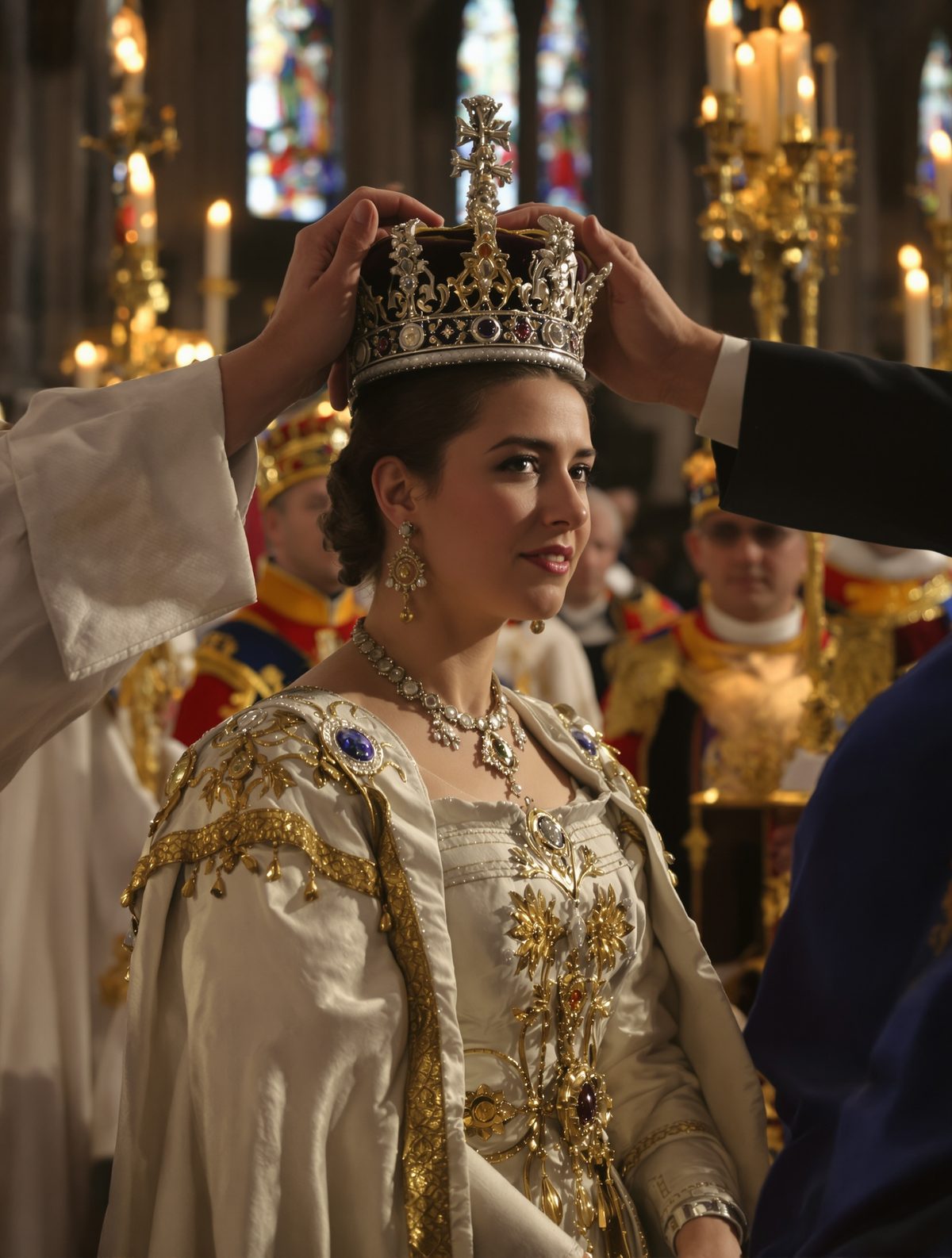
At 4 AM on June 28th, 1838, a pale, frightened teenager awoke in Buckingham Palace knowing that by sunset, she would either emerge as the crowned Queen of the British Empire—or collapse in front of 8,000 witnesses in Westminster Abbey. What Victoria couldn't have imagined was that her coronation would become the most spectacular disaster in royal history, a five-hour ordeal so chaotic that she would later write in her diary: "I really do not know how I got through it."
The girl who had become queen at just 18 was about to face her ultimate test. But as the first rays of dawn crept across London, nobody—not the Archbishop of Canterbury, not the government officials, not even Victoria herself—realized they were about to orchestrate a ceremony so bungled it would nearly kill Britain's future Empress.
The Weight of Gold and Glory
Victoria's ordeal began before she even left Buckingham Palace. The Imperial State Crown, hastily resized for her small head, still weighed nearly five pounds—equivalent to carrying a brick on your skull for five hours. The crimson velvet Robe of State stretched eighteen feet behind her, so heavy it required eight trainbearers to manage. At barely five feet tall and weighing less than eight stone, Victoria was dwarfed by the regalia that symbolized her power over a quarter of the world's population.
The procession to Westminster Abbey should have been a triumphant parade. Instead, it became the first sign of impending disaster. The golden state coach, built in 1762, lacked any form of suspension. Every cobblestone sent shockwaves through Victoria's already aching body. Spectators later reported seeing the young queen's face grow visibly paler as the carriage lurched through the streets of London, her knuckles white as she gripped the sides to avoid being thrown about like a rag doll.
Read next: The Day a Young Prince Knelt and Refused a Crown
What the cheering crowds couldn't see was that Victoria had barely eaten breakfast, terrified that any food might make her sick during the ceremony. This decision—understandable but catastrophic—would nearly prove her undoing as the day wore on.
When Everything Goes Wrong at Once
Westminster Abbey at 11 AM was a scene of barely controlled chaos masquerading as solemn ceremony. The Archbishop of Canterbury, William Howley, was 72 years old and, according to several witnesses, "appeared confused from the very beginning." The ceremonial program, hastily printed and distributed just days before, contained multiple errors. Worse still, key participants had received different versions, ensuring that nobody was quite sure what should happen when.
The problems began immediately. The Archbishop stumbled over the opening prayers, pausing awkwardly as he searched for his place in the text. Lord John Thynne, the Sub-Dean, whispered frantically in Howley's ear, but their hushed consultations were audible throughout the abbey's front rows. Victoria, standing rigidly in her heavy robes, felt the first waves of dizziness wash over her just twenty minutes into the ceremony.
Then came the moment that would be remembered as the coronation's most painful blunder—literally. The Archbishop, either through nerves or poor preparation, attempted to force the coronation ring onto Victoria's fourth finger. There was just one problem: the ring had been sized for her fifth finger. As Howley pushed and twisted the golden band, Victoria's face contorted in agony. She later wrote that the pain was "excruciating," but protocol demanded she remain silent and still as the Archbishop essentially tortured her in front of 8,000 witnesses.
The Fainting Queen
By the ceremony's third hour, Victoria was fighting a losing battle against exhaustion and hunger. The combination of the crushing weight of her crown, the stifling heat generated by thousands of bodies in the abbey, and her empty stomach created a perfect storm of physical distress. Witnesses in the front rows reported seeing her sway during the lengthy biblical readings, catching herself at the last moment.
The first near-collapse came during the homage ceremony, when dozens of peers approached the throne to swear their loyalty. Each noble was required to touch the crown and kiss Victoria's hand—a process that took nearly an hour. As the seemingly endless line of dukes, earls, and barons processed past her, Victoria's vision began to blur. Only her iron grip on the throne's armrests kept her upright.
The second crisis occurred during what should have been the ceremony's most triumphant moment: the presentation of the orb and scepter. As Victoria attempted to hold both symbols of royal power while maintaining her composure, the combined weight proved too much. She began to tilt forward, and for a terrifying moment, it appeared Britain's new queen would topple from her throne. Quick thinking from the Bishop of Bath and Wells, who steadied her elbow while pretending to adjust his ceremonial robes, prevented a catastrophe that would have been remembered for centuries.
The Archbishop's Disappearing Act
Perhaps the most surreal moment in this catalog of disasters came when the Archbishop of Canterbury simply vanished. During a complex portion of the service involving multiple biblical readings, Howley apparently became so confused by the conflicting programs that he declared the ceremony complete—despite having skipped several crucial elements, including the presentation of the Bible and the blessing of the communion elements.
Victoria, despite her physical distress, realized something was wrong when she found herself alone at the altar. The Archbishop had retreated to the vestry, apparently convinced his duties were finished. Courtiers scrambled to locate him while 8,000 guests sat in bewildered silence, watching their new queen stand abandoned at the heart of Westminster Abbey.
When Howley finally returned—looking, according to one witness, "as if he had seen a ghost"—the ceremony resumed with the missing elements hastily inserted wherever they might fit. The biblical readings were delivered out of order, prayers were repeated or skipped entirely, and the communion service became a masterclass in improvisation as church officials desperately tried to salvage some dignity from the proceedings.
Read next: The Day a Queen Rode Alone Into a Mutinous Army
Survival and Scandal
When the ordeal finally ended after five grueling hours, Victoria's first act was to rip off the painful coronation ring, taking skin with it. Her ladies-in-waiting reported that her finger had swollen so badly that the ring had to be soaked off with ice water—a process that took nearly an hour and left her hand bloodied and bruised.
The immediate aftermath was chaos. Victoria, exhausted and in pain, could barely walk from the abbey to her carriage. Courtiers formed a protective circle around her, desperately trying to conceal from the public that their new queen was on the verge of complete collapse. The return journey to Buckingham Palace became a race against time as Victoria fought to remain conscious in the swaying state coach.
News of the ceremony's disasters spread quickly through London's social circles, though newspapers of the era were far too deferential to report the full extent of the chaos. However, foreign observers were less diplomatic. The French ambassador wrote to Paris describing "a ceremony more suited to a country fair than the coronation of a great monarch," while the Prussian envoy reported that "the English have managed to make their ancient rituals appear ridiculous through sheer incompetence."
The Crown That Changed Everything
Victoria's coronation disaster became a turning point that shaped both her reign and the future of royal ceremony. Traumatized by the experience, she became obsessively involved in planning every subsequent royal event, from her own wedding to the coronations of future monarchs. Her meticulous attention to detail—born from the chaos of June 28th, 1838—established protocols that royal ceremonies follow to this day.
The young woman who nearly collapsed under the weight of tradition would go on to rule for 63 years, transforming Britain into the world's dominant empire. But perhaps more importantly, her coronation ordeal revealed something crucial about leadership: sometimes our greatest strengths emerge not from our triumphs, but from our ability to endure when everything goes wrong.
In an age when we expect perfection from our leaders and institutions, Victoria's coronation reminds us that even the most significant moments in history are shaped by human frailty, confusion, and the sheer determination to carry on despite chaos. The teenager who survived five hours of disaster at Westminster Abbey would become the woman who defined an era—not because her coronation was perfect, but because she refused to let its imperfections defeat her.