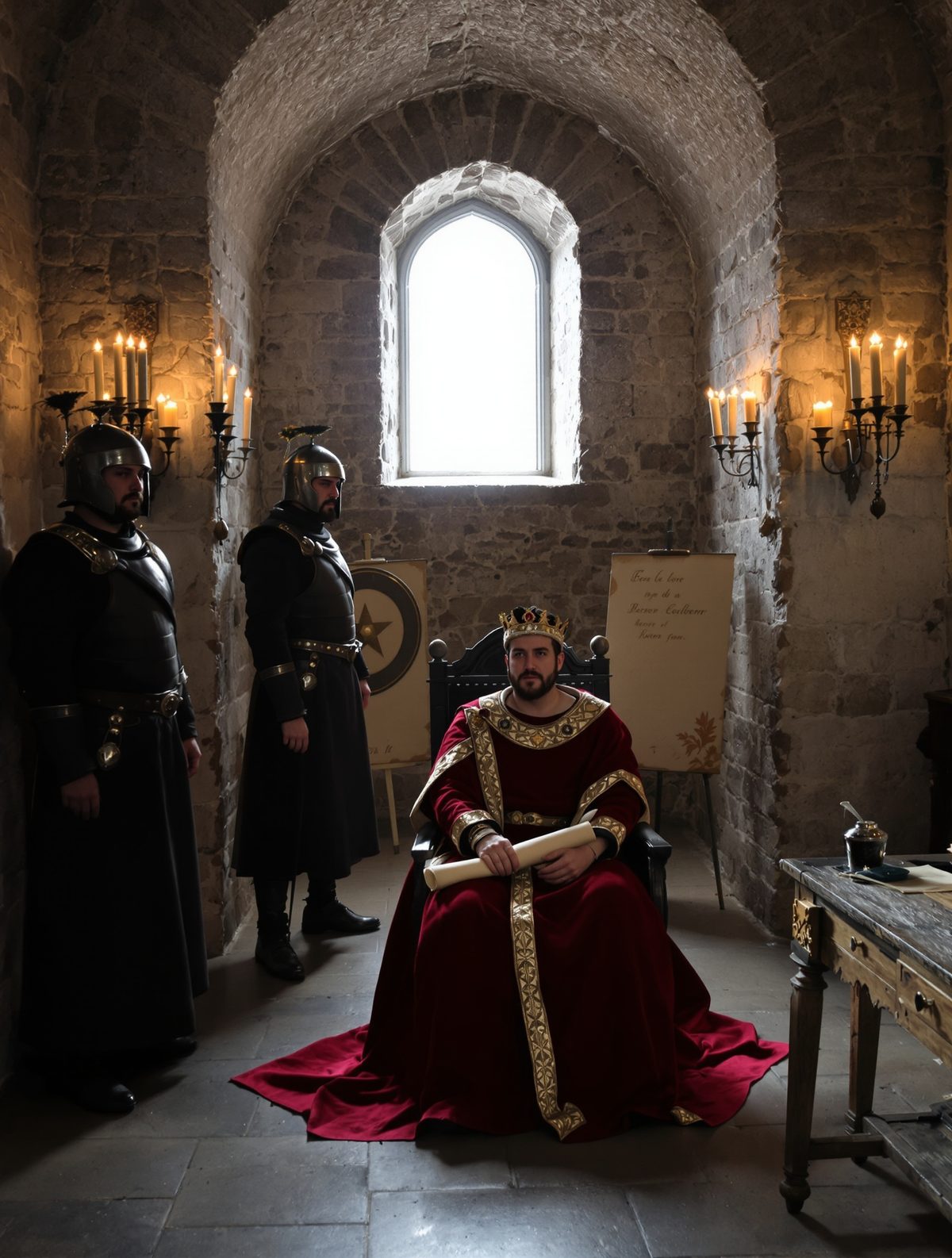
On a somber September day in 1399, Richard II, the once-magnificent monarch of England, sat secluded in the austere confines of the Tower of London. Having ascended the throne as a mere boy of ten and reigned for over two decades, he now faced the unthinkable. Before a sparse gathering, Richard read aloud the document that would not only strip him of his crown but unravel the fabric of a kingdom. This was a day unlike any other, a quiet act in a turbulent time where the whisper of parchment was louder than any war cry.
The Child King Confronts a Storm
Richard was thrust into regal responsibility in 1377 after the death of his grandfather, Edward III. At just ten years old, he inherited a kingdom not fully healed from the calamities of the Black Death and financially drained by the Hundred Years' War. Still, Richard exhibited sparks of diplomacy and courage. At fourteen, during the Peasants' Revolt of 1381, young Richard rode out to confront a throng of thousands at Smithfield, fearing neither blade nor betrayal. "I am your king," he declared, quelling tempers with promises of reform—pledges that would prove impossible to keep in full.
As tensions simmered beneath the surface, Richard's early triumph seemed a harbinger of strong leadership. Yet beneath the veneer of princely charisma, there lingered a propensity for authoritarian rule—a legacy that would eventually be his undoing.
The Nobles' Fury: Lords Appellant vs. The King
The 1380s unveiled the stark adage confronting all medieval monarchs: power was rarely secure. As Richard’s authority grew, so did his willingness to sidestep traditional advisors in favor of flatterers and favorites, a decision causing fissures within the realm. It was this inclination that stoked the fury of the Lords Appellant—a group of mighty nobles who, in 1387, challenged Richard's authority in a thinly-veiled coup.
Read next: The Day a Queen Walked Into a Rebel Camp Alone
Led by the staunch Henry of Bolingbroke (later Henry IV) and Thomas of Woodstock, Duke of Gloucester, they apprehended and executed several of Richard's closest confidants, citing treasonous conduct and mismanagement of the treasury. They effectively neutered the king’s powers, pressing him into submission. Richard's throne trembled, yet he remained—biding his time, waiting for retribution.
The King's Revenge and the Tides of Tyranny
By 1397, an older, weathered Richard II sought vengeance. He executed or exiled key members of the Lords Appellant, including his cousin Henry Bolingbroke. In a series of draconian acts, Richard appeared omnipotent, as if Atlas himself, holding the kingdom on his shoulders. Yet, his reforms, cloaked as stabilizing efforts, bore the seeds of tyranny—undermining the very structures of advisory and nobility that kept monarchs honest and their subjects protected.
Ironically, these actions facilitated Bolingbroke's return in July 1399. Leveraging discontent, Bolingbroke landed at Ravenspur and mustered significant support, including from exiled nobles and Richard’s disgruntled former allies. By August, Richard had gone from dominating a realm to becoming a fugitive within it.
The Unmaking of a Monarch
By September, the king—once feared, now captured—was ensconced in the Tower of London, isolated and defenseless. Here lay the crux of medieval sovereignty. Richard still believed in the divine right to rule—a celestial endorsement that was supposed to make a king inviolable, untouchable. Now, under duress, he confronted the ultimate indignity of his crown being stripped through legal rather than martial means.
It was on September 29, 1399, within the dim chamber of Westminster Hall, that Richard read aloud his own abdication. "I resign the crown and the royal dignity," his voice echoed, a surrender not to swords, but to ink and parchment. His hands trembled, not from fear, but the realization that his divine right was nullified by human hand. Richard’s words were spoken not just to the audience present but to history itself. A recorded performance, destined to ripple through centuries.
The Ripple of Richard's Fall
As Richard II vacated his throne, the Plantagenet line flickered uncertainly, its permanence shattered. Henry Bolingbroke assumed the throne as Henry IV, inaugurating the Lancastrian dynasty. But the legacy of Richard's deposition reverberated through history. Shakespeare immortalized the episode in his plays, shaping public consciousness of the event as a dramatic fulcrum of fate and foible.
Richard's fall was not merely the dethronement of a king but a paradigm shift. It illuminated the stark realization that crowns and the divine rights that accompanied them were human constructs—susceptible to the whims and enterprises of people. A king could indeed be unmade by the stroke of a quill.
From Shadows, Lessons Beyond the Crown
Today, Richard's abdication is a poignant reminder of leadership, legacy, and the delicate equilibrium between power and governance. It highlights the fallibility of rulers who prioritize absolute control over counsel and consensus. As modern civilizations grapple with questions of authority, civil rights, and justice, Richard’s tale continues to resonate—a testament to the intricate dance between destiny and decision.
The story of Richard II's surrender serves as a mirror reflecting both the perils of autocracy and the enduring insight that no ruler, whatever their divine mandate, stands outside the reach of history. His legacy, fractured yet profound, informs a dialogue as relevant today as it was over six centuries ago—a sobering truth wrapped in the pages of "Britain Untold."