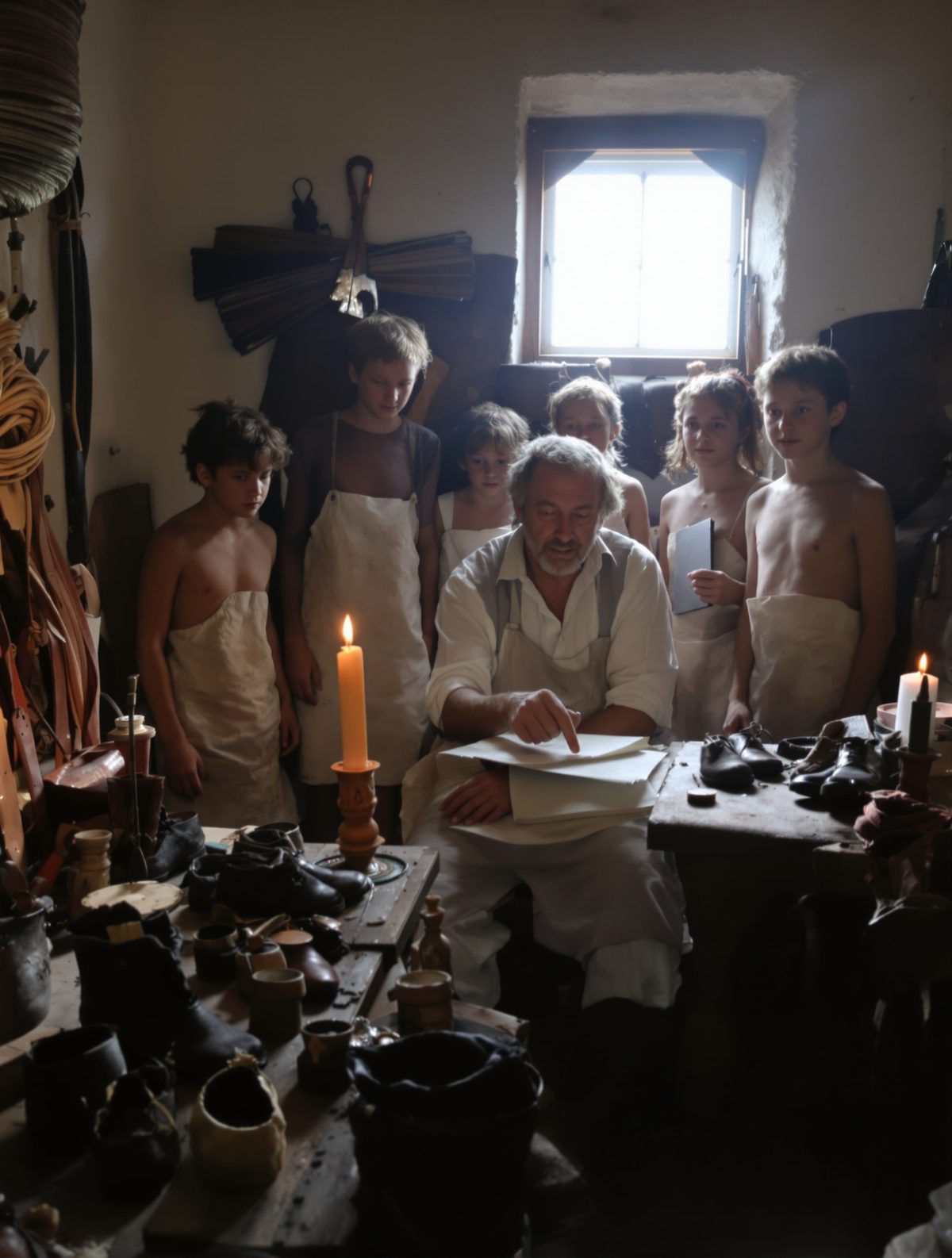
The fog of the English Channel hung low over Portsmouth on a crisp January morning in 1818. Amidst the bustle of sailors, traders, and the ever-present salty breeze, the cobbled streets echoed with the chatter of children — children who had no homes, no schools, and seemingly, no future. Yet, tucked away in a modest workshop, a crippled cobbler named John Pounds was about to quietly revolutionize an entire nation's approach to education. With the click of his latch and the creak of the door, he welcomed in these street urchins, offering them not just the warmth of his hearth, but a spark of hope.
The Humble Cobbler
Born on June 17, 1766, John Pounds grew up in the vibrant coastal town of Portsmouth. John was destined to follow in the footsteps of his family, who were skilled tradesmen, until a tragic incident at the age of 15 changed his life forever. A fall from the rigging of a ship in the Royal Dockyard left him severely injured, with a permanently damaged back and legs. Despite his challenges, John pursued the shoemaker’s trade, a path that suited his new, sedentary reality.
His workshop on St. Mary Street became his haven and the community’s heart. While many saw him as just a simple cobbler, John had a heart full of compassion and an astute mind swarming with ideas. He taught himself to read and write, for formal education was out of reach during his childhood, especially for the physically challenged. This self-taught skill sowed the seeds of a lifelong mission: to grant today's children a brighter tomorrow.
The Birth of a School
It began with a single ragged child — malnourished, neglected, and alone. Pounds took the boy in, teaching him to read and write as he mended shoes and stitched leather. Before long, news of this goodwill spread like wildfire amongst Portsmouth’s poor, leading to a remarkable sight: a cobbler’s small bench crowded with eager, unwashed faces, eyes wide with curiosity.
Read next: The Day a London Printer Stood Trial and Freed the Press
What started as an act of kindness became an endeavor of epic proportions. By 1818, John Pounds was teaching over 40 children in his workshop, a feat achieved in an astonishingly small space of less than 200 square feet. As the years progressed, he took in orphaned girls, runaway boys, and any child in need of care, discipline, and knowledge.
These children, often dismissed as the "ragged and unteachable," soaked up his lessons. With lessons interwoven into daily tasks, the children learned by example, watching John's hands deftly repair a sole while explaining the alphabet. This was more than just a school of letters — it was a school of life.
An Education Revolution
John’s school was a bastion of egalitarianism and opportunity, principles distant from the institutional rigidity of the Regency era’s traditional education system. His teaching was free, and he sought no recognition, only the satisfaction of seeing a child’s eyes light up with newfound knowledge. It was, in essence, a one-room, philanthropic haven demonstrating the power of empathy and human spirit.
The influence of John Pounds was profound, laying the foundation for the Ragged Schools Movement. His approach inspired contemporaries like Thomas Guthrie, who would later establish more formalized institutions based on John’s methods. By addressing the roots of destitution and ignorance, the Ragged Schools empowered a generation of disadvantaged children with the tools to change their lives. Notably, Charles Dickens extolled the virtues of these efforts, helping to bring this educational cause to national prominence.
The Cobbler's Legacy
John Pounds passed away on January 1, 1839, but by then, his echo resonated far beyond the walls of his humble shop. Britain, and indeed the world, began to recognize the importance of providing basic education to all. The momentum gathered from Pounds’ initiative contributed directly to the Education Act of 1870, which laid the groundwork for compulsory schooling.
Visitors to Portsmouth can still find John Pounds' legacy, immortalized at the site of his workshop and commemorated with schools and institutions bearing his name. His life story stands as testimony to the extraordinary change an ordinary person can invoke.
Why John Pounds Matters Today
In an age where educational disparity still lingers both in Britain and across the globe, John Pounds' tale is a poignant reminder of the profound impact of grassroots action. His willingness to open his heart and workshop to those society forgot urges us to reconsider how we approach problems of access and equity in education.
Today, as we encounter myriad technological advances and policy debates regarding education, the Cobbler of Portsmouth stands as a guiding light. His belief in no child's limitation of potential challenges us to continue his legacy — to empower and educate, no matter the odds, nurturing the seeds of knowledge in every willing child. It compels us to consider: in our modern world, who might be the John Pounds of our community?
As we face our future challenges, John Pounds’ story beckons us to open our hearts and perhaps, metaphorically, our own doors, so that the lights of curiosity, education, and opportunity might shine even brighter for the children yet to come.