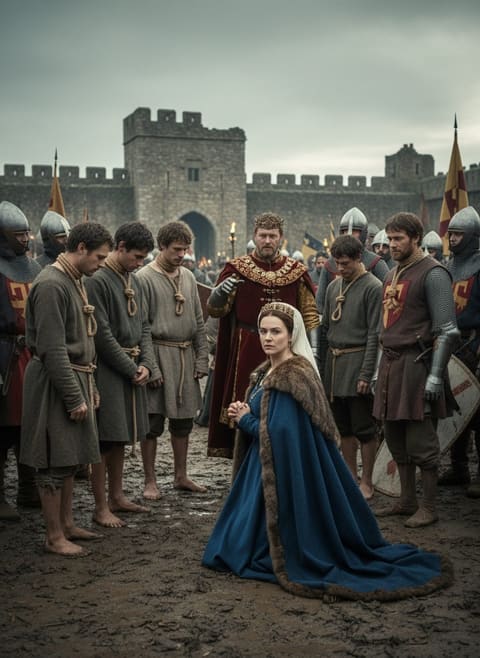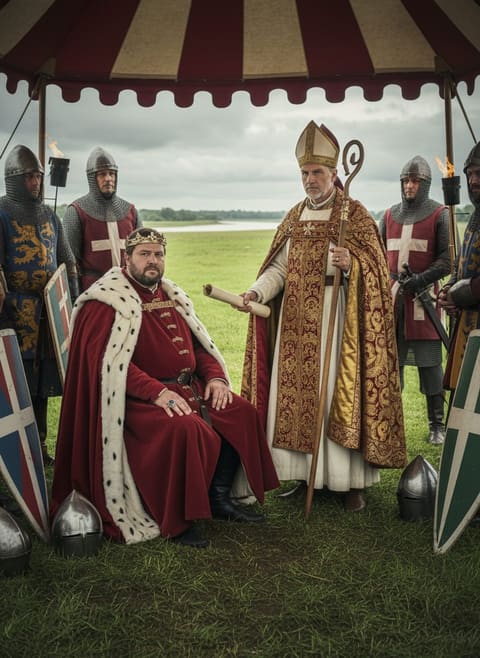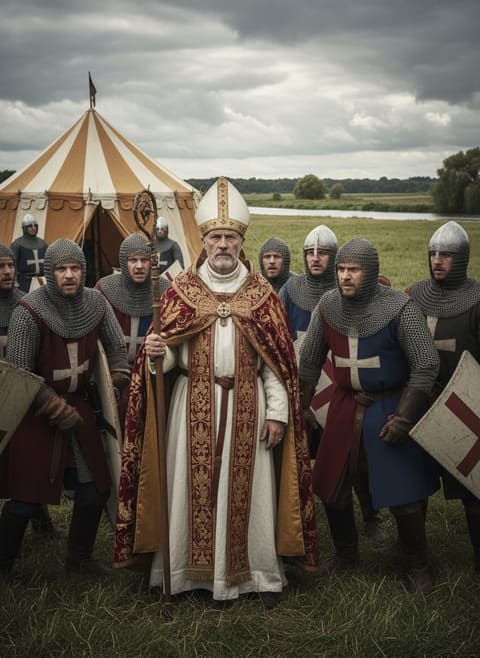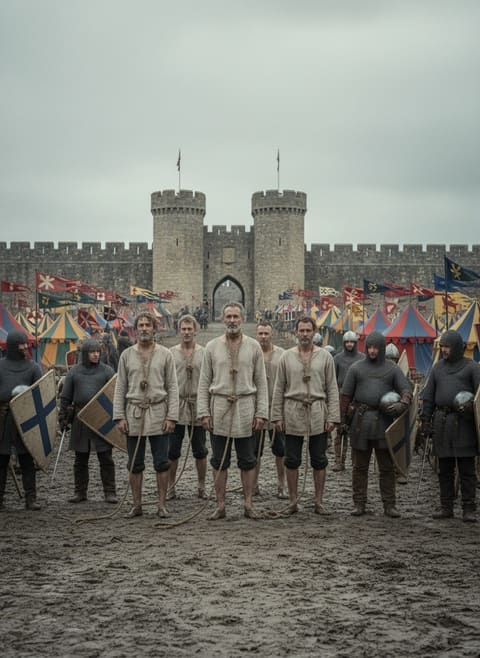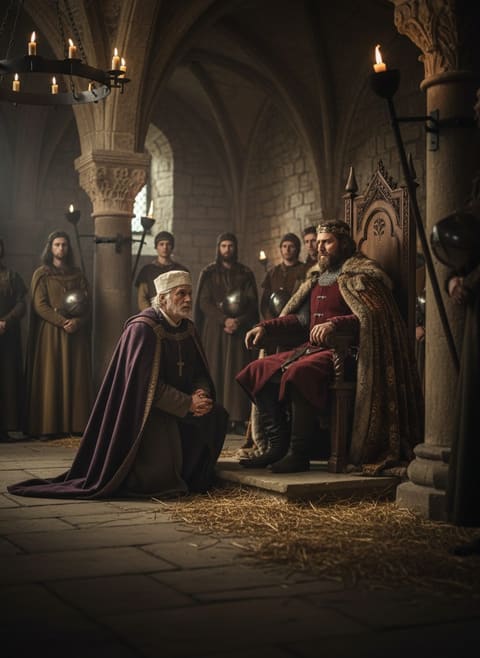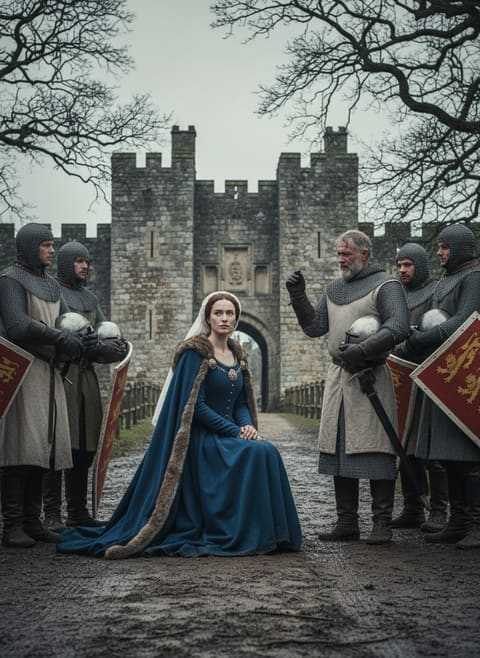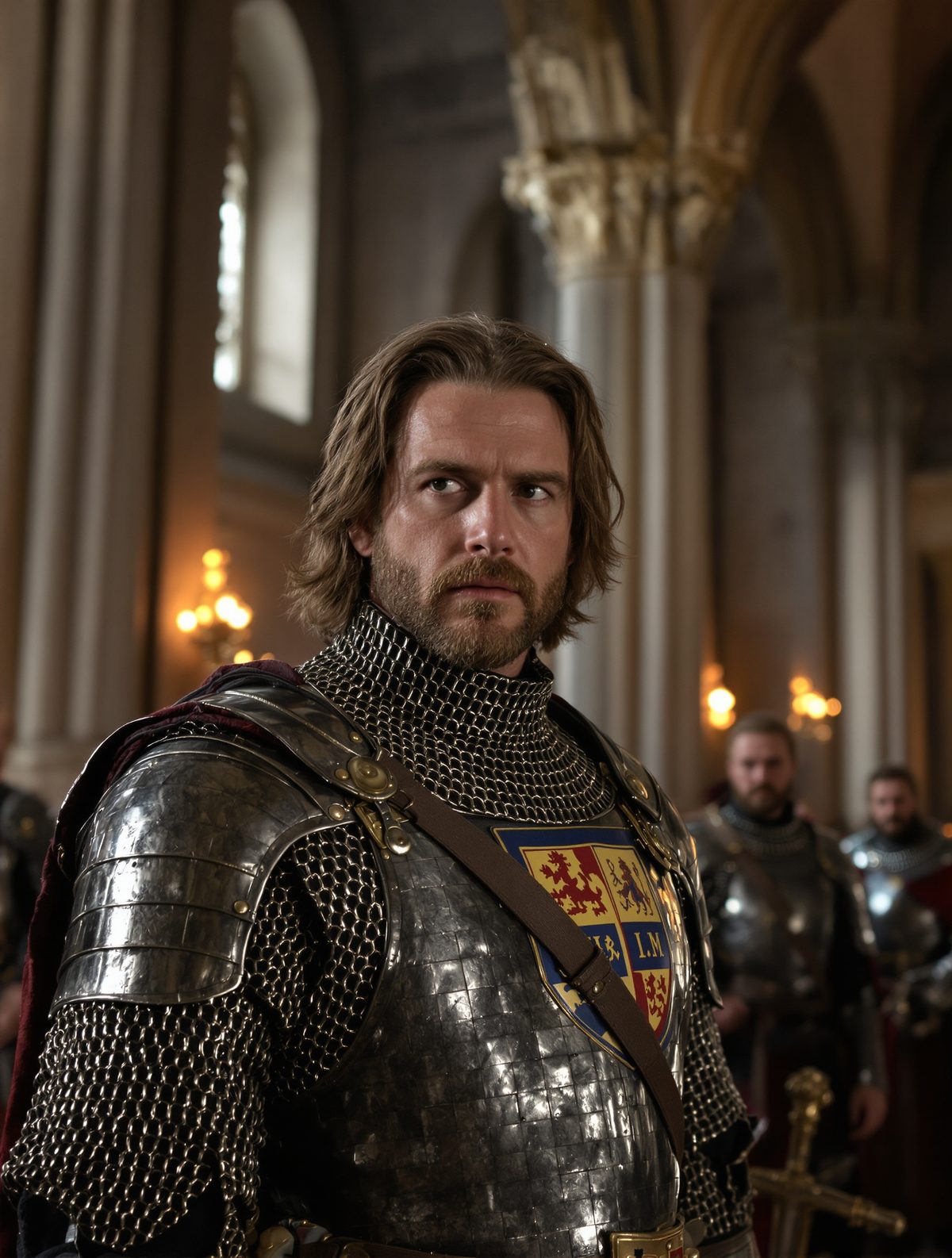
The mud at Runnymede squelched beneath heavy boots as two armies faced each other across a meadow that would change the course of world history. On one side stood King John Plantagenet—the man who had murdered his nephew, starved nobles to death in his dungeons, and ruled England through terror for seventeen blood-soaked years. On the other, a group of twenty-five barons led by a man whose name has been largely forgotten by history: Robert FitzWalter, Marshal of the Army of God and Holy Church.
It was June 15th, 1215, and the most hated king in English history was about to be forced to his knees by a baron who had dared to raise his sword against tyranny itself.
The Baron Who Refused to Bow
Robert FitzWalter was no ordinary nobleman. As Lord of Dunmow Castle in Essex and holder of vast estates across England and Normandy, he commanded wealth and influence that rivaled the king himself. But what set FitzWalter apart wasn't his riches—it was his spine. In an age when most barons cowered before John's reputation for savage revenge, FitzWalter had already proven he would rather lose everything than submit to tyranny.
The roots of their conflict stretched back over a decade. Some whispered it began when King John cast his lecherous eye upon FitzWalter's beautiful daughter, Matilda. When the baron refused to hand her over to satisfy the king's appetites, John's fury was swift and merciless. In 1208, he ordered FitzWalter's magnificent Baynard Castle in London to be torn down, stone by stone. Not content with this humiliation, John declared FitzWalter an enemy of the realm and seized all his English lands.
Read next: The Day a Welsh Girl Barred the Door on a King's Army
Most men would have begged forgiveness. FitzWalter chose exile instead, fleeing to France where he began plotting the downfall of the Plantagenet king. For five years, he gathered allies, resources, and—most dangerously of all—legitimacy for his cause.
A Kingdom Bleeding Under the Tyrant's Fist
While FitzWalter nursed his fury in French exile, King John was busy earning his reputation as England's most despised monarch. The younger brother of the legendary Richard the Lionheart, John combined paranoia, cruelty, and incompetence in equal measure. His reign read like a catalog of horrors that would make even medieval nobles—hardly squeamish about violence—recoil in disgust.
John had almost certainly murdered his own nephew, Arthur of Brittany, in 1203, likely strangling the boy with his own hands in a drunken rage. He starved Maud de Braose and her son to death in the dungeons of Corfe Castle simply because Maud had spoken too freely about Arthur's fate. When William de Briouze couldn't pay the crushing debt John had imposed on him, the king didn't just seize his lands—he destroyed his entire family line.
But it wasn't just the nobility who suffered. John taxed his subjects into destitution to fund his disastrous military campaigns, losing Normandy and most of England's continental empire to Philip Augustus of France. He quarreled so bitterly with the Pope that England was placed under interdict for six years—meaning no church services, no weddings, no Christian burials. The kingdom festered under his rule like an untreated wound.
The Marshal of the Army of God
In 1213, Robert FitzWalter returned to England under the terms of John's reconciliation with the Church. But the baron who came back was not the same man who had fled five years earlier. He had transformed himself from a wronged nobleman into something far more dangerous: a revolutionary with a cause.
FitzWalter adopted the grandiose title "Marshal of the Army of God and Holy Church," positioning himself not as a mere rebel, but as an instrument of divine justice. This wasn't just clever propaganda—it was a masterstroke of medieval politics. By framing his rebellion in religious terms, FitzWalter gave every baron, knight, and freeman a moral justification to oppose their anointed king.
The spark that ignited open rebellion came in 1214, when John's latest continental adventure ended in humiliating defeat at the Battle of Bouvines. The king returned to England desperately needing money and began squeezing his barons with increasingly outrageous demands. When the northern barons refused to pay scutage for a campaign they considered both illegal and pointless, John's response was typically vicious: he would crush them completely.
It was exactly the moment FitzWalter had been waiting for. In early 1215, he issued a call that would echo through the centuries: it was time to force King John to govern according to law, not whim.
The Army of God Rises
What happened next was unprecedented in medieval Europe. Instead of the usual baronial uprising—a few disgruntled nobles making regional trouble—FitzWalter assembled something approaching a national revolution. Twenty-five of England's most powerful barons joined his cause, along with the Mayor and citizens of London, who opened their gates to the rebels in May 1215.
The sight of FitzWalter's army must have been magnificent and terrifying in equal measure. Banners bearing the arms of England's greatest families—Clare, Bigod, de Vesci, Mowbray—fluttered in the wind above columns of armed knights. These weren't desperate men fighting for survival, but the flower of English nobility united in righteous anger.
More importantly, they came prepared not just for war, but for governance. The rebels had spent months crafting a detailed charter of demands that would fundamentally reshape the relationship between king and subject. They called it the Articles of the Barons, and it would become the foundation of Magna Carta.
John found himself caught in an impossible position. He couldn't defeat the rebels militarily—they controlled London and commanded forces equal to his own. He couldn't simply wait them out, as more nobles joined their cause every week. For perhaps the first time in his life, the king who had terrorized England with his arbitrary will was forced to negotiate as an equal.
Read next: The Day a Medieval Mayor Knelt and Saved Six Condemned Men
The Meadow That Changed the World
The meeting place chosen for negotiations revealed the careful thought behind FitzWalter's rebellion. Runnymede was no accident—this ancient meadow beside the Thames sat exactly on the boundary between the royal castle at Windsor and the rebel stronghold of London. Neither side could claim the advantage of home ground.
For three days, from June 15th to 17th, 1215, the fate of English liberty hung in the balance. John arrived with his mercenary captains and foreign advisors, men who had helped him squeeze England dry. FitzWalter came with the greatest names in the land, representing not just their own interests but the broader principle that even kings must answer to law.
The document they hammered out together was revolutionary beyond anything the medieval world had seen. Magna Carta didn't just limit royal power—it established the radical principle that government must operate according to established legal procedures. No freeman could be imprisoned, outlawed, or punished except by the lawful judgment of his peers or the law of the land. The king could not impose taxes without consent. Justice could not be sold, denied, or delayed.
When John finally pressed his seal into the wax, he was doing more than ending a rebellion. He was acknowledging that his will was not absolute—that there existed a power higher than the crown: the law itself.
The Legacy of a Forgotten Hero
Robert FitzWalter's triumph at Runnymede was short-lived. Within months, John had persuaded the Pope to annul Magna Carta, and England plunged into a devastating civil war that lasted until the king's death in 1216. FitzWalter himself died in 1235, his name already fading from popular memory as the new regime of Henry III sought to downplay the revolutionary origins of their constitutional settlement.
But the principle FitzWalter fought for—that government must operate under law rather than arbitrary will—proved impossible to kill. Magna Carta was reissued, revised, and embedded so deeply in English legal tradition that it survived the Middle Ages to inspire later generations of freedom fighters. The American revolutionaries quoted it in their Declaration of Independence. Nelson Mandela kept a copy in his prison cell.
Today, as democracies around the world face new challenges from authoritarian leaders who claim to be above the law, FitzWalter's example feels startlingly relevant. He understood that liberty requires more than good intentions—it demands the courage to stand up to power when power oversteps its bounds. In a muddy meadow beside the Thames, one baron's refusal to bow helped establish a principle that still protects us today: that no one, not even kings, is above the law.