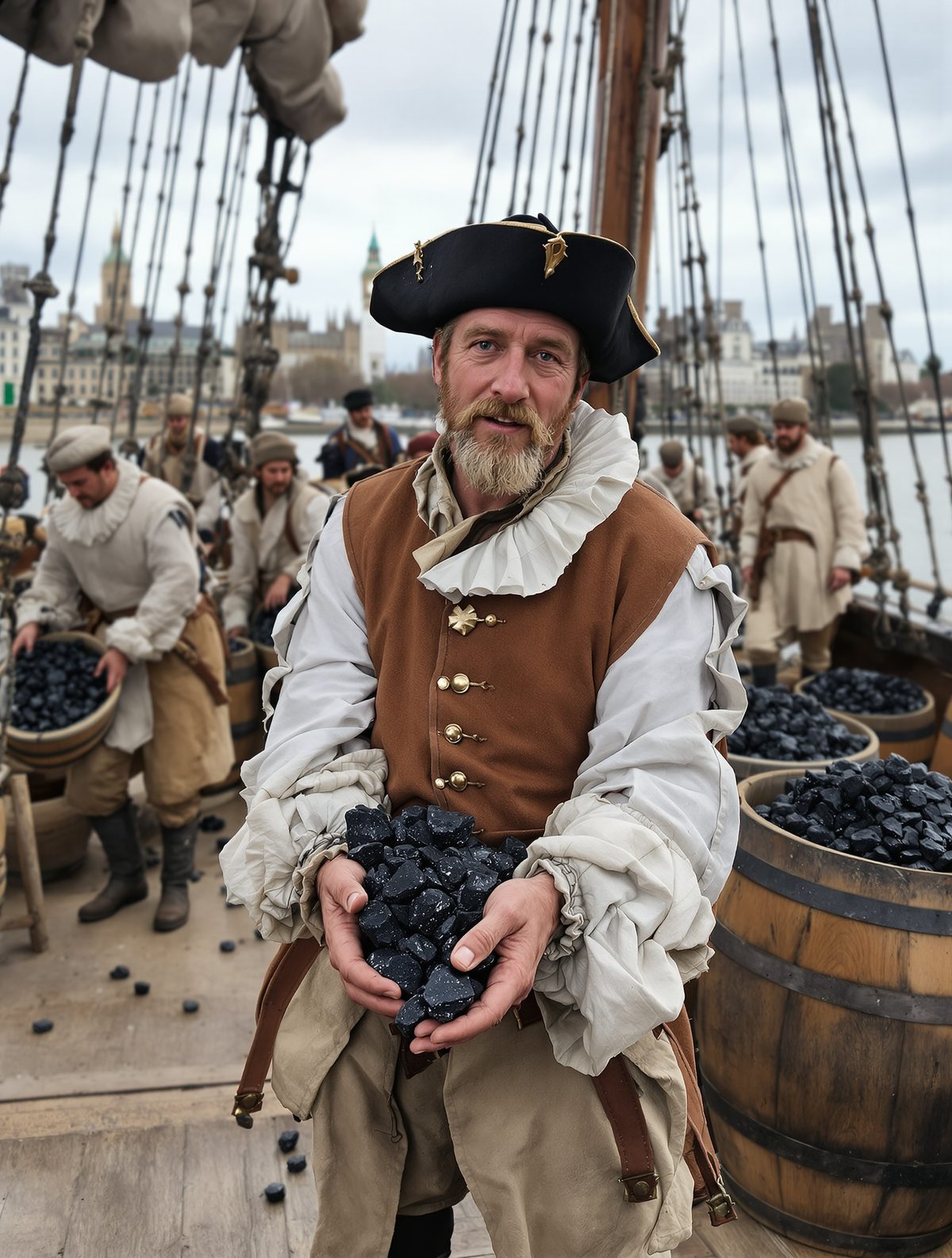
Picture this: a summer day in 1577, and the Thames is alive with whispers. Three weather-beaten ships creep up the murky river toward London, their hulls riding dangerously low in the water. Word spreads like wildfire through the crowds gathering on the banks—Captain Martin Frobisher has returned from the uttermost ends of the earth, and his ships are groaning under the weight of treasure. But this isn't Spanish silver or exotic spices. Frobisher has brought something far more precious: 200 tons of glittering black rock that promises to make England the richest nation on earth.
What happened next would become one of the most spectacular financial disasters in Tudor history—a cautionary tale of greed, wishful thinking, and the dangerous allure of fool's gold that would echo through the centuries.
The Captain Who Chased Dreams Through Ice
Martin Frobisher wasn't your typical Elizabethan gentleman. Born around 1535 in Yorkshire, he'd spent his youth as something barely distinguishable from a pirate, prowling the seas and making enough enemies that the Spanish had a price on his head. But by the 1570s, this rough-edged sea dog had grander ambitions than mere theft on the high seas.
Like so many of his generation, Frobisher was obsessed with finding the Northwest Passage—that mythical sea route through the Arctic that would open up the riches of Asia to English ships. In 1576, he convinced a group of London merchants to back his first expedition with £875, a modest sum that reflected their skepticism about his chances of survival, let alone success.
Read next: The Day a Devon Captain Charted the Pacific and Changed the World
Frobisher's first voyage that year was a disaster by most measures. Of his three ships, one turned back, another disappeared entirely, and five of his men were captured by Inuit hunters in what we now know as Baffin Island. But Frobisher returned to England with something unexpected: a fist-sized chunk of black rock that would change everything.
The story goes that an Inuit man had thrown the stone at Frobisher's crew. Whether in anger or friendship, we'll never know—but that single thrown rock would soon launch a thousand ships.
When Black Rock Became Black Gold
Back in London, Frobisher initially struggled to generate interest in his peculiar souvenir. The first assayers he consulted dismissed the black rock as worthless. A second pronounced it interesting but hardly valuable. But Frobisher was nothing if not persistent, and the third assayer he approached—an Italian named Giovanni Battista Agnello—delivered the verdict that would make history.
The rock, Agnello declared with the confidence of a man who clearly understood his audience's desires, was rich in gold.
The news hit Elizabethan London like a thunderbolt. Here was proof that the frozen wasteland of the Arctic—safely beyond the reach of Spanish interference—contained riches that could rival the mines of Peru. Suddenly, everyone wanted a piece of Frobisher's next expedition.
The Cathay Company was hastily formed to exploit this miraculous discovery, with investors ranging from Queen Elizabeth herself to prominent courtiers who should have known better. Even the cautious William Cecil, Elizabeth's chief advisor, bought shares. The Queen invested £1,000—roughly £300,000 in today's money—and provided the use of two royal ships.
But here's a detail that reveals just how thoroughly gold fever had gripped the English imagination: when Frobisher set sail for his second voyage in May 1577, his official instructions were to spend no more than ten days actually looking for the Northwest Passage. The rest of his time was to be devoted entirely to mining operations.
Arctic Mining Madness
Frobisher's second voyage was a masterclass in misguided priorities. Leading a fleet of three ships and 120 men, he reached his "gold mine"—really just scattered deposits of black rock on barren Baffin Island—in July 1577. What followed was perhaps the most absurd mining operation in history.
Working in the teeth of Arctic storms, Frobisher's men spent weeks filling their ships with over 200 tons of black ore. They worked with a desperate intensity, as if the Spanish Armada might arrive at any moment to claim their prize. The sailors, many of whom had signed up for exploration and adventure, found themselves wielding pickaxes in temperatures that could freeze a man's breath in his lungs.
The physical challenges were enormous. The permafrost made digging nearly impossible. Supply lines stretched across thousands of miles of hostile ocean. And winter was always lurking just around the calendar's corner, ready to trap unwary ships in ice that wouldn't break until the following summer—if ever.
Yet somehow, Frobisher pulled it off. By August, his ships were loaded with enough ore to make every investor rich beyond their wildest dreams. The return voyage to England must have felt like a victory lap, with every man aboard calculating his share of the fortune resting in their holds.
The Reckoning in the Royal Laboratory
The scene at the Tower of London in the late summer of 1577 must have been extraordinary. Elizabeth's assayers worked in a frenzy of excitement and secrecy, testing and retesting Frobisher's precious cargo. Courtiers lingered in the corridors, hoping for scraps of news. The Queen herself reportedly visited the laboratories, eager to see her investment validated.
And for a brief, glorious moment, it seemed their faith had been justified. Initial tests appeared to confirm the presence of gold in the black ore. Plans were already underway for a third, even grander expedition—this time with fifteen ships and a permanent settlement to support year-round mining operations.
But as the weeks passed and more rigorous testing continued, a horrifying truth began to emerge. The black rock wasn't gold ore at all. It was iron pyrite—fool's gold—mixed with worthless mica and hornblende. Every backbreaking hour in the Arctic, every penny invested, every grand dream of English prosperity had been built on a foundation of glittering lies.
Read next: The Day a Devon Sailor Mapped the Roof of the World Alone
The moment when this reality finally sank in must have been devastating. Imagine the silence in Elizabeth's court when the final assay results were delivered. Two hundred tons of Arctic rock, extracted at enormous cost and risk, were worth less than the nails holding Frobisher's ships together.
From Hero to Cautionary Tale
The collapse of the Cathay Company was swift and total. Investors who had dreamed of riches found themselves holding worthless shares in a venture that had literally built its foundations on fool's gold. The 200 tons of ore ended up being used as road surfacing and wall repair around London—perhaps the most expensive road maintenance project in Tudor history.
Frobisher himself somehow survived the disaster with his reputation largely intact—a testament to both his personal charm and the recognition that he had been as deceived as anyone else. He went on to serve with distinction in the defeat of the Spanish Armada in 1588, proving that his maritime skills far exceeded his geological expertise.
But the third expedition to the Arctic, launched in 1578 before the full extent of the deception became clear, was a final monument to the power of wishful thinking. Fifteen ships and 400 men spent another summer collecting more worthless rock, while the planned permanent settlement was wisely abandoned when the scale of the fraud became undeniable.
The Gold Rush That Never Was
Frobisher's fool's gold expedition offers a fascinating glimpse into the mind of Elizabethan England—a nation hungry for wealth, desperate to compete with Spanish treasure fleets, and perhaps too eager to believe in easy answers to complex problems. The episode reveals how even the most sophisticated investors of the age could be swept away by the promise of instant riches.
In many ways, Frobisher's Arctic misadventure was England's first great speculative bubble—a precursor to the South Sea Bubble, the railway mania, and even today's cryptocurrency frenzies. The same psychological forces that drove Tudor courtiers to invest in imaginary Arctic gold mines continue to drive modern investors toward the latest "sure thing."
Perhaps most remarkably, those 200 tons of worthless rock may have inadvertently changed the course of English exploration. The failure of Frobisher's venture helped convince future investors to look elsewhere for profitable opportunities—toward the spice trades of the East Indies, the tobacco plantations of Virginia, and the genuine treasures that would eventually build the British Empire. Sometimes, it seems, the most important discoveries are learning what not to pursue.