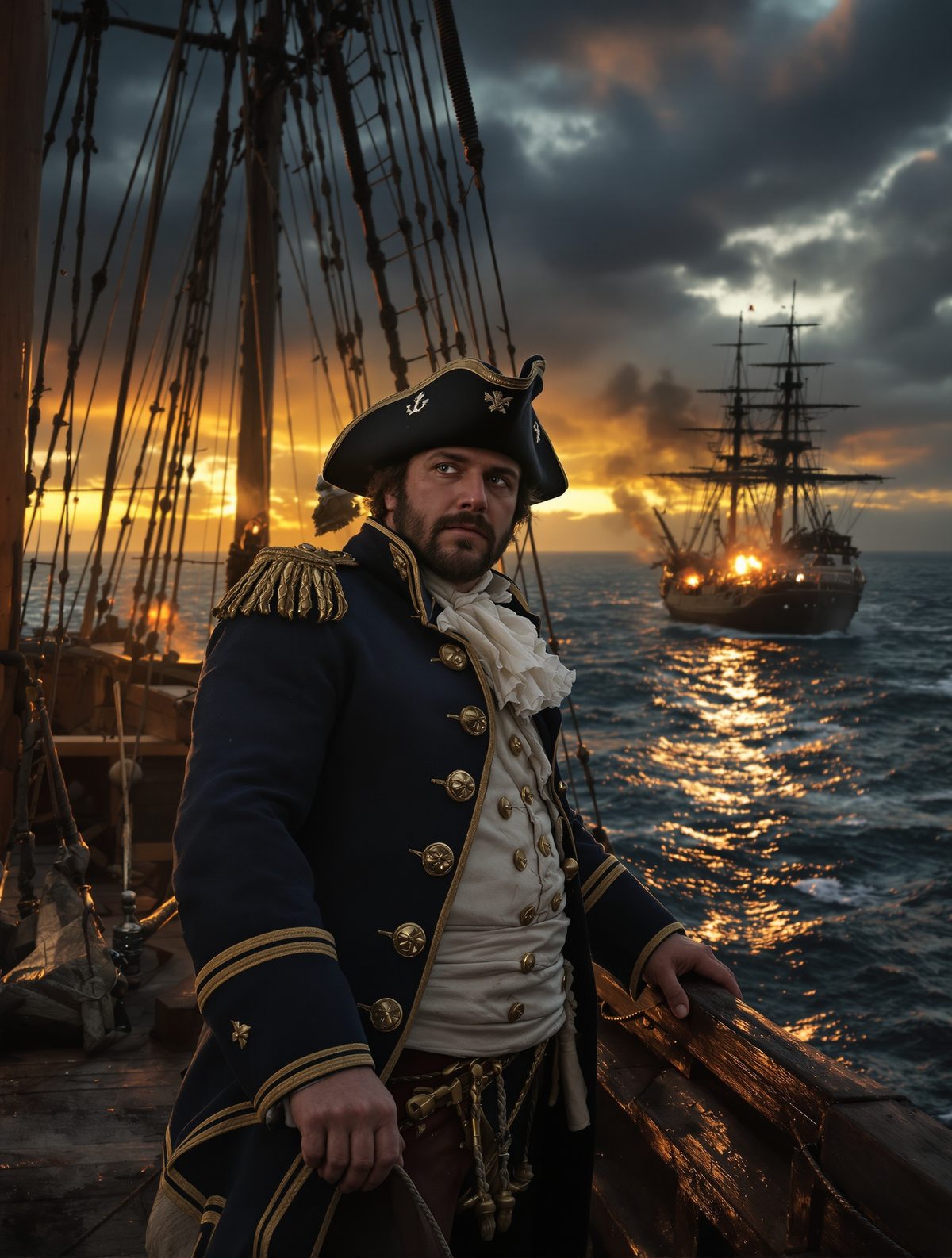
The North Sea waves crashed over the splintered deck of the Bonhomme Richard as cannon fire lit up the September darkness. Water poured through gaping holes in her hull, and the ship's own guns had begun falling through the shattered deck into the ocean below. Any reasonable naval captain would have struck his colors and surrendered. But John Paul Jones wasn't reasonable—he was Scottish.
When HMS Serapis demanded his surrender that fateful night off England's Yorkshire coast, Jones bellowed back words that would echo through naval history: "I have not yet begun to fight!" What happened next defied every rule of naval warfare and turned a sinking defeat into America's most legendary naval victory.
The Gardener's Son Who Terrorized the Royal Navy
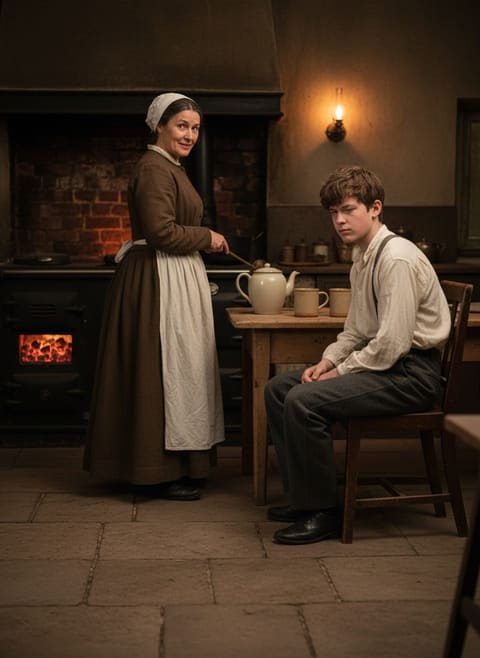
John Paul Jones began life as simply John Paul, born in 1747 in a humble cottage on the Arbigland estate in Kirkcudbrightshire, Scotland. His father was the estate's gardener, his mother a housekeeper. Nothing in young John's background suggested he would one day become Britain's most feared naval nemesis.
By age thirteen, he was apprenticed to a merchant in nearby Whitehaven—ironically, the very English port he would later raid during the Revolution. The sea called to him with an irresistible voice, and by his early twenties, he had already commanded merchant vessels in the Caribbean slave trade. But a mysterious killing in Tobago in 1773 forced him to flee to America, where he added "Jones" to his name and disappeared into colonial Virginia.
Read next: The Day a Scots Weaver's Son Freed the Kirk From a King
When revolution erupted, the Continental Navy desperately needed experienced captains. John Paul Jones emerged from obscurity, offering his services to a cause that would let him strike at the empire that had forced him into exile. Congress handed him a ship and essentially gave him a license for revenge.
Terror Raids on the Scottish Coast
By 1779, Jones had already earned his reputation as a master of audacious raids. He had done something no foreign enemy had managed in over a century—he had landed on British soil and struck at the heart of the empire's sense of security.
In April 1778, commanding the Ranger, Jones sailed boldly into Belfast Lough and attempted to kidnap the Earl of Selkirk from his castle on St. Mary's Isle. Though the Earl wasn't home, Jones's men ransacked the family silver. More shocking still, they had landed, conducted their raid, and escaped—all within sight of the Scottish coast that should have been absolutely secure.
Jones followed this with an even more brazen assault on Whitehaven, the very port where he had learned seamanship. Under cover of darkness, his crew spiked the guns of the harbor fortresses and set fire to the shipping in the harbor. The psychological impact was enormous: if Whitehaven wasn't safe, nowhere in Britain was.
These raids sent shockwaves through the British establishment. Suddenly, the American rebellion wasn't just happening in distant colonies—it was literally at Britain's doorstep, conducted by one of their own.
The Unlikely Alliance and a Ship Named for a Philosopher
By September 1779, Jones found himself commanding a curious vessel with an even more curious name: Bonhomme Richard, French for "Poor Richard"—a tribute to Benjamin Franklin's almanac. The ship was a converted French merchant vessel, hardly ideal for naval combat, but it was what the French allies could spare for Jones's ambitious plan to raid British shipping in the North Sea.
His squadron included the French frigate Alliance, whose captain, Pierre Landais, harbored a dangerous jealousy toward Jones. This internal conflict would prove nearly as perilous as any British warship. The Alliance sailed under the American flag but followed French orders, creating a command structure that was diplomatically delicate and tactically nightmarish.
Jones's plan was characteristically bold: he would sail around the British Isles, capturing merchant vessels and drawing Royal Navy ships away from American waters. It was commerce raiding elevated to strategic warfare, and it was working. By September, Lloyd's of London was reporting insurance rates skyrocketing as Jones's squadron prowled British home waters with impunity.
"I Have Not Yet Begun to Fight!"
On September 23, 1779, Jones spotted a prize that would make his reputation forever: a Baltic merchant convoy protected by HMS Serapis, a brand-new 44-gun frigate under Captain Richard Pearson. The Serapis was everything the Bonhomme Richard was not—purpose-built for war, heavily gunned, and commanded by an experienced Royal Navy officer.
The battle began at sunset off Flamborough Head, with crowds of spectators gathering on the Yorkshire cliffs to watch what they assumed would be a quick British victory. The Serapis opened fire first, and within minutes it became clear that Jones was catastrophically outgunned. His ancient 18-pounder cannons began exploding from the stress, killing more of his own men than enemy shots.
By nine o'clock, the Bonhomme Richard was a floating wreck. Water poured through holes "big enough to drive a coach through," and the ship was settling visibly lower in the water. It was then that Captain Pearson called across the darkness: "Do you ask for quarter?"
Jones's response became the stuff of legend: "I have not yet begun to fight!" But what he did next was even more extraordinary than his defiant words.
Victory from the Jaws of Defeat
Realizing that conventional gunnery would only hasten his defeat, Jones made a desperate gamble. He maneuvered the sinking Bonhomme Richard alongside the Serapis and ordered his crew to lash the ships together with grappling hooks and anchor chains. If he was going down, he would take the British frigate with him.
What followed was naval warfare at its most primitive and terrifying. Sailors fought hand-to-hand across the decks while cannons fired point-blank into each other's hulls. The Bonhomme Richard's mizzen mast crashed down, creating a bridge between the ships across which men charged with cutlasses and boarding axes.
Read next: The Day a Highland Clan Turned a Massacre Into a Legend
The turning point came when a Scottish sailor in Jones's crew, William Hamilton, climbed into the rigging with a bucket of grenades. From his precarious perch above the Serapis, Hamilton began dropping explosives onto the British ship's deck. One grenade fell through an open hatch and exploded in the gun deck, igniting loose powder cartridges and killing twenty men instantly.
Meanwhile, the treacherous Captain Landais chose this moment to sail the Alliance into range—but instead of attacking the Serapis, he opened fire on both ships, apparently hoping to sink Jones and claim credit for any victory himself. Jones found himself fighting both the Royal Navy and his own supposed ally simultaneously.
After three hours of this floating hell, with both ships ablaze and the Bonhomme Richard settling ever deeper, something extraordinary happened: Captain Pearson struck his colors and surrendered the Serapis. He had decided that discretion was the better part of valor, and that losing his ship was preferable to taking it to the bottom along with Jones's floating wreck.
The Legend That Outlived the Ship
Jones barely had time to savor his impossible victory. The Bonhomme Richard was beyond saving, and thirty-six hours later, she slipped beneath the North Sea waves. Jones transferred his flag to his captured prize, the Serapis, and sailed her triumphantly into a Dutch port—where he faced another diplomatic crisis as the British demanded the Netherlands surrender him as a pirate.
The battle's impact extended far beyond the tactical victory. Jones had proven that the fledgling American navy could meet the Royal Navy's finest ships in single combat and prevail. More importantly, he had demonstrated that the American cause possessed something the British had perhaps underestimated: leaders willing to fight beyond all reasonable hope of victory.
King George III personally ordered Jones's capture, and the British press struggled to explain how a Scottish gardener's son had humiliated the world's greatest navy. Jones became a celebrity throughout Europe, feted in French salons and Dutch drawing rooms as the man who had brought the British lion to heel.
Today, John Paul Jones is remembered as the father of the American navy, but his story resonates beyond national mythology. In an age when we often wonder whether individual courage can still change the course of events, Jones's defiant cry off Flamborough Head reminds us that sometimes the most powerful force in history is simply the refusal to accept defeat. On that September night in 1779, a sinking ship became unsinkable not because of its construction, but because of the indomitable will of the man who commanded her.