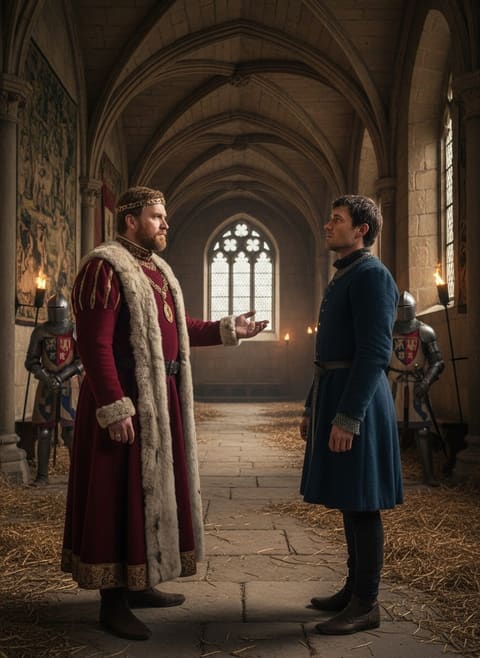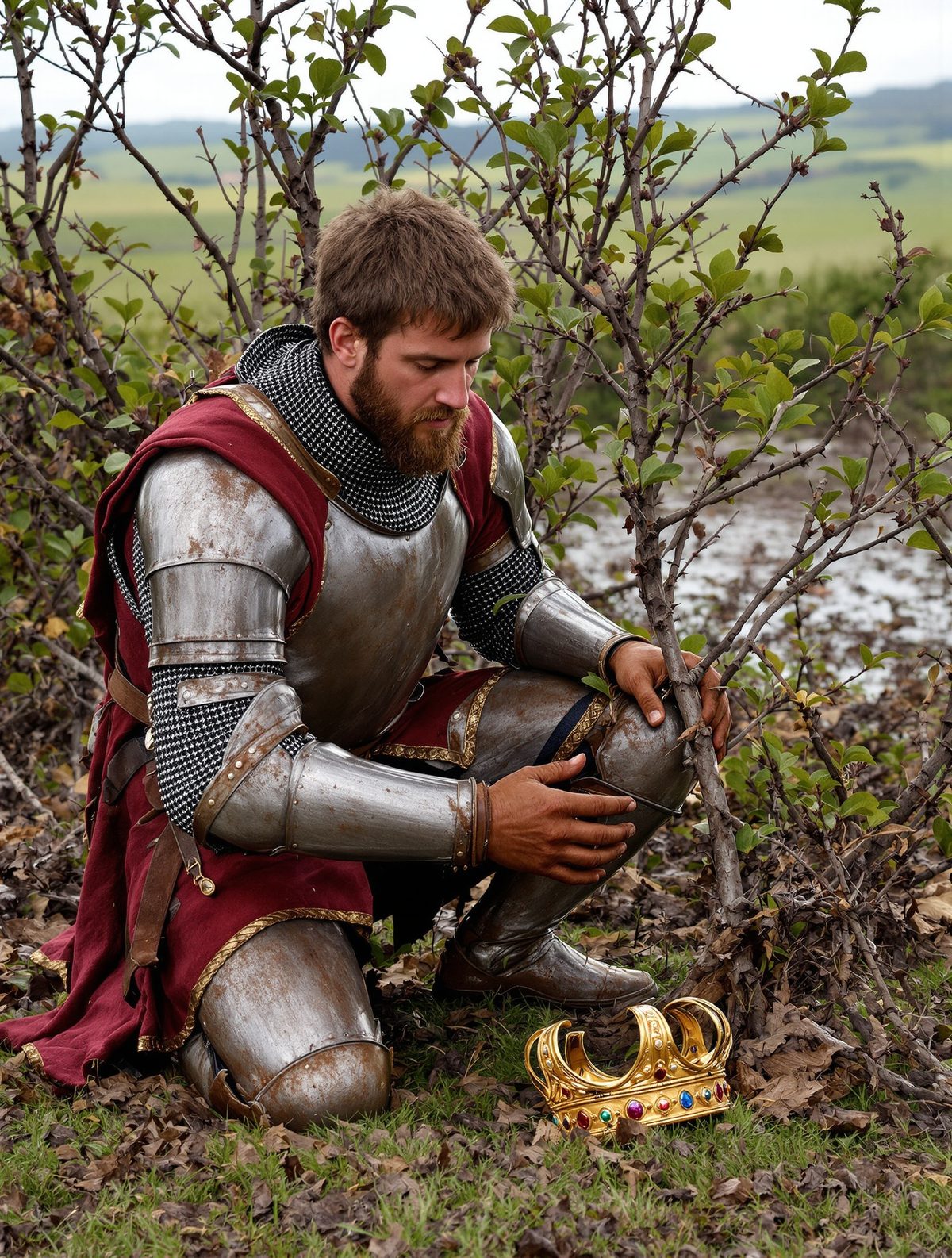
Picture this: the last Plantagenet king of England lies dead in the mud, his naked body slung across a horse like a slaughtered deer. Yet somewhere in the chaos of Bosworth Field, among the trampled grass and abandoned weapons, sits the most precious object in the realm—England's golden crown, caught in the thorny embrace of a humble hawthorn bush. It's August 22nd, 1485, and the symbol of divine kingship has literally fallen from grace, waiting for whoever dares claim it.
This isn't just any crown lost in any battle. This is the moment that ended three centuries of Plantagenet rule and launched the Tudor dynasty that would give us Henry VIII and Elizabeth I. And it all hinged on a piece of metal jewelry tangled in some thorns.
The Last Charge of the Last Plantagenet
Richard III woke up on August 22nd knowing this would be the day that decided everything. The night before, according to Shakespeare and several contemporary sources, he'd been plagued by nightmares—though whether these were literary invention or genuine historical record remains hotly debated. What we do know is that Richard, despite having the larger army, was in serious trouble.
The problem wasn't just Henry Tudor's invading force of French mercenaries and Welsh supporters. Richard's real nightmare was standing right beside him in his own ranks: the Stanley brothers, Thomas and William, commanded around 6,000 men between them. They'd promised to fight for Richard, but their loyalty was about as reliable as a chocolate teapot. Thomas Stanley's stepson was none other than Henry Tudor himself.
Read next: The Day a Young Prince Knelt and Refused a Crown
When battle commenced near the village of Sutton Cheney in Leicestershire, Richard initially held his ground on Ambion Hill. His army numbered around 10,000 men—significantly larger than Henry's force of roughly 5,000. But medieval battles weren't won by numbers alone; they were won by loyalty, and Richard's was paper-thin.
As the fighting raged, Richard spotted Henry Tudor's banner across the field. In a moment that defined him as either gloriously brave or spectacularly reckless, the king made a decision that would echo through history. Rather than directing the battle from safety, Richard lowered his lance, spurred his destrier, and charged directly at his rival claimant with his household knights.
When Kings Fall From Heaven
What happened next was both magnificent and catastrophic. Richard, by all accounts an accomplished warrior, smashed through Henry's bodyguard like a battering ram. He killed Henry's standard-bearer, Sir William Brandon, with his own hand and came within sword's length of Henry Tudor himself. For a few heart-stopping moments, it looked like Richard might actually pull off this audacious gamble.
But then Sir William Stanley—who had been watching the battle with calculating eyes—made his choice. Stanley's forces crashed into Richard's flank just as the king was most exposed. The royal charge, which had begun as a stroke of genius, became a death trap.
Here's where the story gets interesting in ways the textbooks rarely mention. Richard wasn't just wearing any old crown—he was wearing what historians believe was a crown of battle, a lighter circlet designed to fit over a helmet. This wasn't the heavy, jewel-encrusted Crown of England safely stored in the Tower of London, but a battlefield symbol that declared "here rides your king" to every soldier who could see it.
As Richard fell—struck down by multiple blows that archaeological analysis of his skull centuries later would reveal in gruesome detail—that crown became a projectile. Whether knocked from his helmet by a weapon blow or simply flung off as he tumbled from his horse, the symbol of English kingship went flying through the air to land in the most undignified place imaginable: a thorny bush.
The Stanley Gamble Pays Off
Lord Thomas Stanley wasn't called "the Fox" for nothing. The man who found Richard's crown amid the hawthorn thorns was the same noble who'd spent the entire battle calculating which way the wind was blowing. Stanley had played perhaps the most dangerous political game in English history—and won.
Think about the audacity of this moment. Stanley literally picked the crown out of a bush and, without consulting Parliament, without any formal ceremony, without even cleaning the mud off it, placed it on Henry Tudor's head right there on the battlefield. It was the most informal coronation in English history, conducted by a man who'd just betrayed his previous king.
But here's the detail that makes this story even more extraordinary: the hawthorn bush wasn't random. In Welsh tradition, the hawthorn was considered sacred, a tree that marked the boundary between the mortal world and the realm of the spirits. Henry Tudor, remember, was Welsh—his grandfather Owen Tudor had been a Welsh courtier who'd secretly married Henry V's widow. The symbolism couldn't have been more perfect if a Hollywood screenwriter had invented it.
Stanley's gamble was breathtaking in its boldness. If Henry had lost, or if Richard had survived, Stanley would have faced certain execution for treason. Instead, he became the kingmaker who literally crowned a new dynasty with his own hands.
The Crown That Changed History
That crown retrieved from the thornbush carried more than symbolic weight—it carried the legitimacy of centuries. Medieval people believed deeply in the concept of divine right; kings ruled because God willed it, and the crown was the physical manifestation of that divine approval. When Stanley placed it on Henry's head, he wasn't just making a political statement—he was declaring that God Himself had chosen sides.
The new King Henry VII was smart enough to understand this symbolism completely. He immediately ordered that the hawthorn bush become part of his royal badge, alongside the red rose of Lancaster. Even today, you can see the hawthorn crown depicted in royal heraldry and in the decorations at Westminster Abbey.
But the crown's journey wasn't over. Henry, practical as always, realized he needed more than a battlefield coronation to secure his throne. He was crowned again, properly this time, at Westminster Abbey on October 30th, 1485—but this formal ceremony was really just paperwork. The real coronation, the one that mattered, had happened in a muddy field with a crown pulled from a bush.
What makes this story even more remarkable is what we know about that original crown today: absolutely nothing. Unlike many royal artifacts, this particular crown disappeared from history. Some historians suggest it might have been melted down and reformed into other royal regalia. Others believe it could have been buried with Richard III himself—though when his remains were discovered under a car park in Leicester in 2012, no crown was found.
Read next: The Day a Queen Rode Alone Into a Mutinous Army
Thorns, Roses, and the Weight of Symbols
The image of England's crown caught in thorns resonated far beyond Bosworth Field. Medieval people lived in a world saturated with religious symbolism, and the parallel to Christ's crown of thorns wouldn't have been lost on anyone. Here was kingship itself suffering and being reborn, rising from the thorns to crown a new dynasty.
Henry VII embraced this symbolism wholeheartedly. The Tudor rose, which combined the white rose of York with the red rose of Lancaster, became one of the most recognizable symbols in English history. But alongside it, that hawthorn bush appeared again and again in Tudor propaganda, royal portraits, and architectural decoration. Henry understood that the story of the crown in the thornbush was political gold—it suggested that his victory wasn't just military but divinely ordained.
The hawthorn crown became so associated with the Tudor dynasty that when Henry VIII later broke with Rome, Protestant propagandists used it to suggest that the Tudors had always been marked for special divine favor. Even Elizabeth I, decades later, would invoke the image of the crown found among thorns when discussing her own legitimacy.
When Crowns Fall, Kingdoms Follow
Today, in our democratic age, the idea of a crown determining the fate of nations might seem quaint, even absurd. But the story of Richard III's crown lost and found speaks to something deeper about how power transfers and legitimacy is claimed. In one sense, all political authority is ultimately about who has the courage to pick up the crown—literally or figuratively—when it falls.
Stanley's decision to place that muddy circlet on Henry Tudor's head echoes through history. It reminds us that pivotal moments often come down to split-second decisions made by individuals willing to gamble everything on their judgment of which way history is turning. The crown didn't make Henry Tudor king; Henry Tudor made himself king by accepting the crown when it was offered.
Perhaps most remarkably, that thorn-caught crown launched a dynasty that would transform England from a war-torn medieval kingdom into a Renaissance power that would eventually rule a global empire. All because a clever lord named Stanley knew the difference between a losing cause and a winning bet, and because a Welsh exile named Henry Tudor had the nerve to let himself be crowned by the side of a muddy road.
The next time you see the Tower of London's Crown Jewels, glittering under their spotlights and protected by bulletproof glass, remember: English kingship once lay forgotten in a thornbush, waiting for someone brave enough to reach in and grasp it.