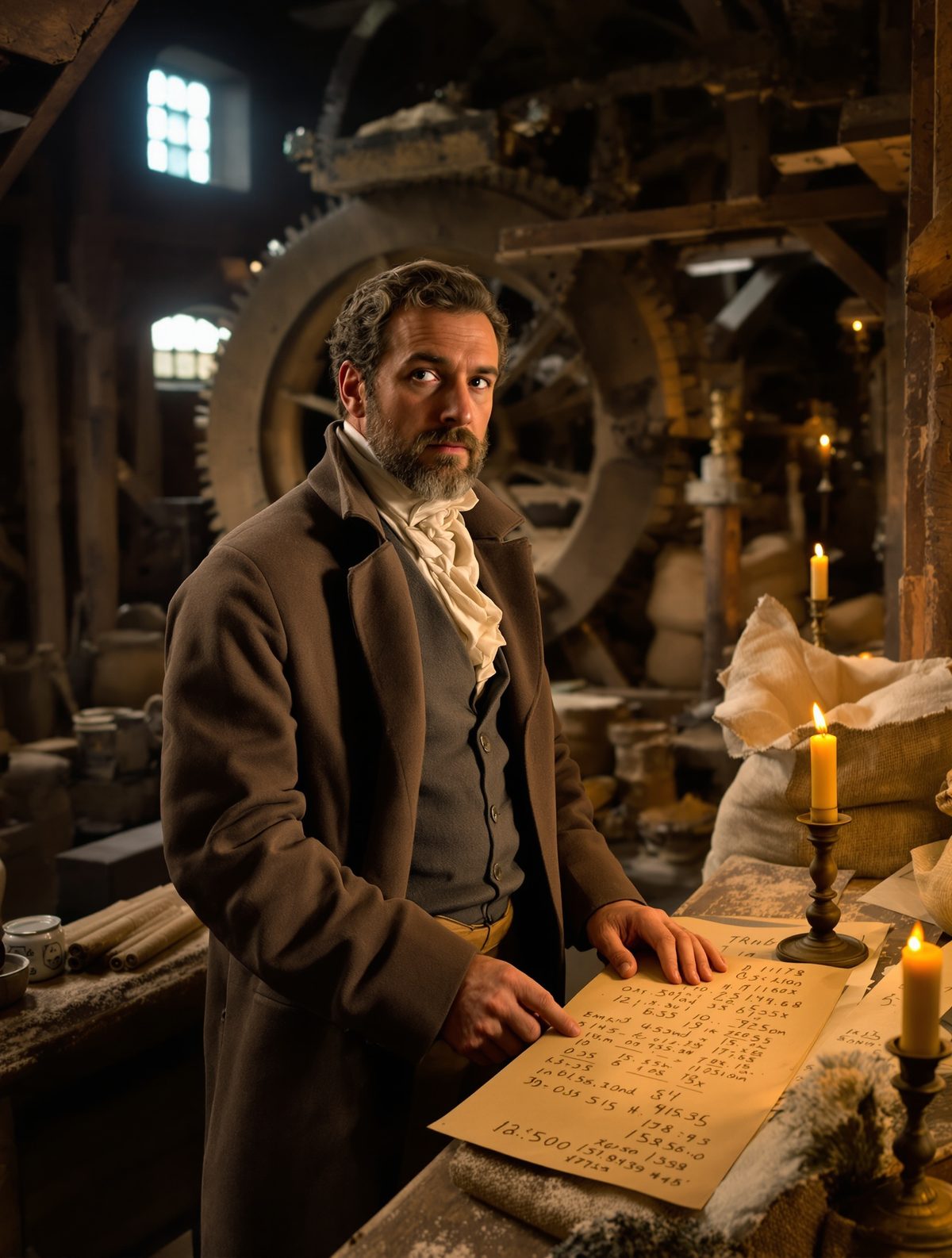
Picture this: it's 1828, and the most brilliant mathematical mind in Britain is grinding wheat in a windmill above Nottingham. George Green has never set foot in a classroom, yet he's about to publish theories so revolutionary that Cambridge professors will scratch their heads in bewilderment. In his flour-dusted hands lies a manuscript that will one day power your mobile phone, enable GPS satellites, and unlock the secrets of quantum mechanics. The only problem? The mathematical establishment has never heard of him.
This is the extraordinary story of how a miller's son taught himself to reshape our understanding of the universe—one equation at a time.
The Windmill Scholar of Sneinton
In 1793, George Green was born into a world where education was a luxury reserved for the wealthy. His father, also named George, owned a brick windmill in Sneinton, then a rural village overlooking Nottingham. The younger Green's formal schooling lasted exactly four years—from age 8 to 12—at Robert Goodacre's Academy in Nottingham. After that, it was straight into the family business of milling grain.
But something extraordinary was happening in that windmill. While his hands worked the machinery, Green's mind was wrestling with mathematical concepts that wouldn't be taught at universities for decades. With access to just a handful of books—including works by Newton, Laplace, and Poisson—he began teaching himself advanced mathematics with an intensity that bordered on obsession.
Read next: The Day a Weaver's Son Mapped the Invisible World
The mill itself became his laboratory. Standing 40 feet tall with its distinctive white-painted brick construction, it offered the perfect isolation for contemplation. As the great sails turned in the Nottinghamshire wind, Green was inside, scribbling calculations by candlelight, developing theories that would revolutionize physics.
An Essay That Baffled Cambridge
In 1828, at age 35, Green published what he modestly titled "An Essay on the Application of Mathematical Analysis to the Theories of Electricity and Magnetism." He printed it himself—just 52 copies—and sold subscriptions for 7 shillings and sixpence each to local gentlemen interested in science. Most of his subscribers probably had little idea they were purchasing one of the most important mathematical works ever written by an Englishman.
The essay introduced what we now call Green's theorem, Green's functions, and the mathematical concept of potential theory. These weren't just abstract mathematical exercises—they provided the fundamental tools for understanding how forces like electricity and magnetism behave in space. Green had essentially created the mathematical language needed to describe invisible fields permeating the universe.
But here's the remarkable thing: when Green's work eventually reached Cambridge University, the professors were stumped. His mathematical techniques were so advanced, so far ahead of contemporary teaching, that even the brightest academic minds struggled to comprehend them. It was as if someone had sent blueprints for a jet engine to the Wright brothers.
The Gentleman Scholar's Secret Life
While Green was revolutionizing mathematics, he was also living a double life that would have scandalized Regency society. In 1824, he had begun a relationship with Jane Smith, a young woman from a mill-working family. The catch? She was unmarried, and he was establishing himself as a gentleman scholar. Their relationship produced seven children, but Green never married her—a decision that reflected the rigid class distinctions of the era.
This domestic arrangement allowed Green an unusual freedom. While gentlemen scholars of the time often had to navigate complex social obligations, Green could retreat to his mill whenever inspiration struck. Jane managed their growing household while he lost himself in mathematical reveries that sometimes lasted for days.
The mill provided not just solitude but also financial independence. Unlike university mathematicians dependent on patronage or academic politics, Green could pursue pure research without compromise. His grinding stones literally ground the grain that bought him the freedom to grind out revolutionary equations.
Recognition at Last—and Tragedy
Green's breakthrough came through an unlikely champion: Sir Edward Bromhead, a mathematician and baronet who discovered Green's essay in 1832. Bromhead was astonished by what he read and immediately began promoting Green's work in academic circles. He encouraged Green to publish more papers and, crucially, to pursue formal education at Cambridge.
In 1833, at age 40, Green enrolled as an undergraduate at Gonville and Caius College, Cambridge. Picture the scene: a middle-aged miller sitting alongside teenage aristocrats, learning elementary mathematics that was far beneath his proven capabilities. It was academic bureaucracy at its most absurd—the man who had revolutionized mathematical physics had to pretend to learn basic algebra.
Green graduated in 1837 as Fourth Wrangler (fourth in the mathematical honors list)—a respectable showing that probably undersold his true abilities. He became a fellow of the college and seemed poised for a brilliant academic career. Then tragedy struck. In 1841, just four years after graduating, George Green died suddenly at age 47, returning to Nottingham in his final illness.
Read next: The Day a Clockmaker's Son Rewired How We See the Stars
The Legacy Hidden in Plain Sight
Green's death might have marked the end of a curious historical footnote, but his mathematical legacy was just beginning its true journey. His techniques lay dormant for decades until a new generation of physicists discovered they had inherited exactly the tools they needed for the next great scientific revolution.
When James Clerk Maxwell formulated his famous equations describing electromagnetic fields in the 1860s, he relied heavily on Green's mathematical framework. Those equations, in turn, predicted the existence of radio waves—leading directly to wireless communication, broadcasting, and eventually your smartphone. Every time you send a text message, you're using technology that depends on mathematical tools George Green invented in his windmill.
The story gets even more extraordinary in the 20th century. When physicists developed quantum mechanics to explain atomic behavior, they found Green's functions were perfectly suited to describing the probability waves of subatomic particles. His work became essential to understanding everything from nuclear reactors to computer chips to MRI scanners.
Today, Green's functions are fundamental to fields he could never have imagined: satellite navigation systems use them to process signals bouncing around Earth's curved surface, weather forecasting models use them to predict atmospheric behavior, and engineers use them to design everything from car engines to concert hall acoustics.
George Green's windmill still stands in Sneinton, now restored as a science center and museum. Visitors can climb to the upper floors where he worked and peer out at the modern city of Nottingham sprawling below. It's a perfect metaphor for Green's legacy—a man who saw farther into the mathematical future than anyone could have imagined, using nothing but his own extraordinary mind and an unquenchable curiosity about how the universe really works.
In an age when we often assume that breakthrough science requires massive laboratories and international collaborations, Green's story reminds us that revolutionary insights can emerge from the most unexpected places. Sometimes all it takes is a brilliant mind, a quiet space to think, and the courage to imagine that the universe might be far stranger and more beautiful than anyone has yet dared to suppose.