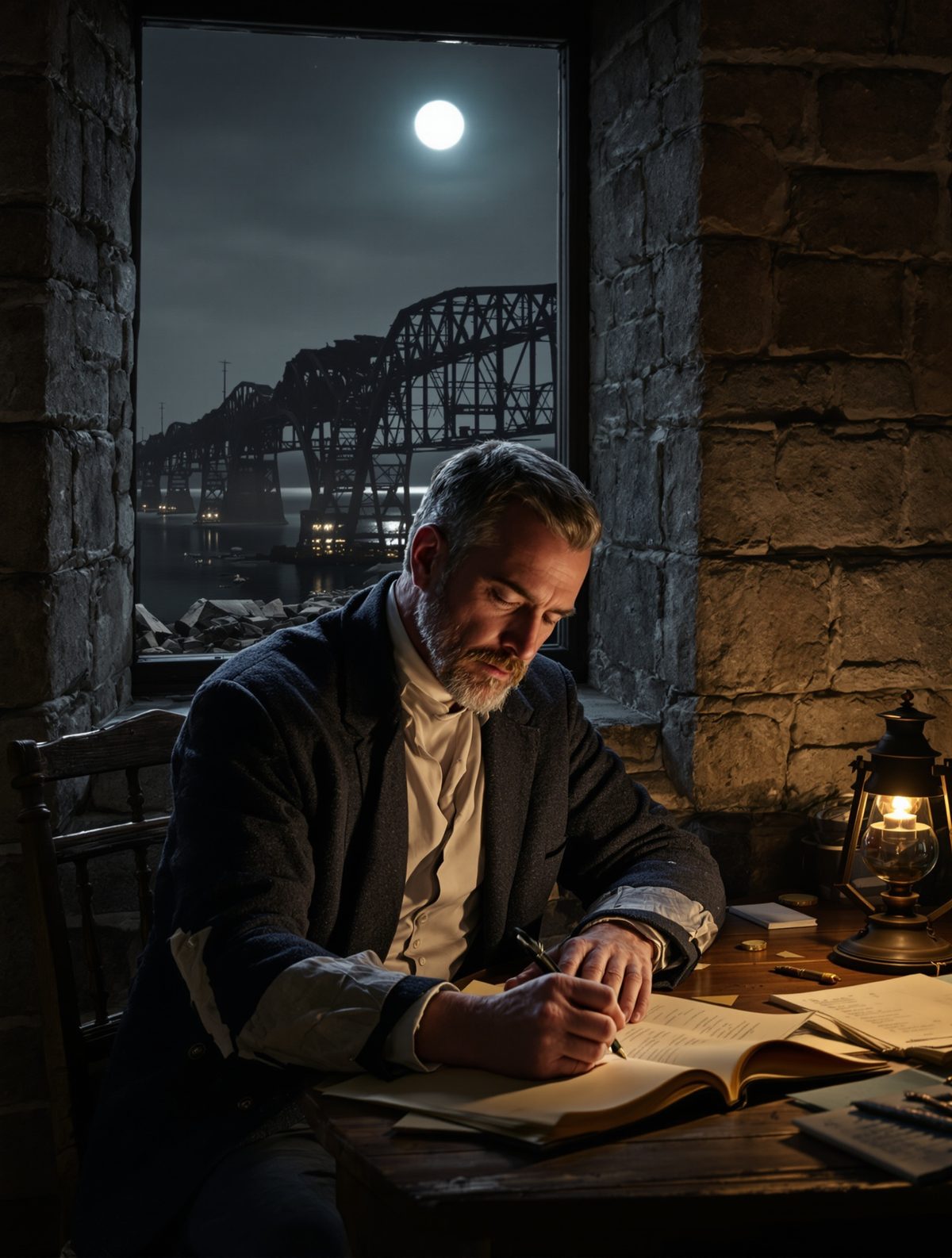
The ink was still wet on the newspaper reports when William Topaz McGonagall dipped his quill and began to write. Outside his cramped Dundee tenement, the December wind howled with the same fury that had claimed seventy-five souls just days before. Scotland was in mourning, but the nation's most ridiculed poet was about to ensure that those victims would never slip quietly into history's shadows.
What McGonagall wrote that night would be mocked across Britain for generations. Critics would call it the worst poem ever penned. Yet in his fumbling, clumsy verses lay something profound: the power to transform tragedy into immortal memory.
The Night the Iron Giant Fell
December 28th, 1879. The Tay Bridge stretched across the murky waters like a Victorian triumph of engineering ambition. At nearly two miles long, it was the wonder of Scotland—a lattice of iron girders that had taken six years and £300,000 to build. Local newspapers had hailed it as proof that mankind could tame even the wildest Scottish weather.
They were catastrophically wrong.
Read next: The Day a Scots Girl Thrust Her Arm Through a Door to Save a King
As the 7:15 Edinburgh express thundered onto the bridge that Sunday evening, hurricane-force winds were already testing every rivet and joint. Passengers pressed their faces to rain-lashed windows, peering into the December darkness. Among them sat families returning from Christmas visits, businessmen heading home after the holidays, and children who would never see another dawn.
At approximately 7:20 PM, witnesses on both shores watched in horror as the bridge's central spans—thirteen massive sections—simply vanished into the storm. The train, its six carriages, and all seventy-five people aboard plummeted ninety feet into the icy Tay. In less than a minute, Scotland's engineering pride had become its greatest disaster.
The bodies began washing ashore three months later, when the spring thaw loosened winter's grip on the riverbed. But by then, William McGonagall had already begun his unlikely rescue mission.
The Poet They Loved to Hate
If central casting had sought the least likely candidate to become a disaster's chief chronicler, they might have chosen William Topaz McGonagall. The self-proclaimed "Poet and Tragedian" was already famous across Scotland—but for all the wrong reasons.
Born in Edinburgh around 1825, McGonagall had spent decades as a handloom weaver in Dundee before discovering his supposed calling at age 47. His "poetic awakening" came, he claimed, when "the spirit of poetry" descended upon him like a divine inspiration. Unfortunately, whatever spirit visited McGonagall that day had apparently skipped the lessons on metre, rhyme, and basic literary competence.
His performances had become the stuff of legend. Theatre audiences would pelt him with vegetables and rotten eggs, but McGonagall—seemingly immune to irony—interpreted the chaos as enthusiasm. He would bow gracefully as potatoes bounced off his head, convinced he was witnessing the passionate response of devoted admirers.
Critics savaged his work with gleeful brutality. One Edinburgh reviewer described his poetry as "so bad it achieved a kind of inverted genius." Another suggested that McGonagall's verses could "murder the English language more efficiently than any foreign invasion."
But McGonagall possessed something his detractors lacked: an unshakeable belief that poetry should serve the common people. While literary elites crafted obscure verses for drawing-room consumption, McGonagall wrote about railway disasters, local festivals, and everyday tragedies that touched ordinary lives.
When Tragedy Became Verse
Within days of the Tay Bridge collapse, McGonagall had completed his response: "The Tay Bridge Disaster." The poem was everything critics expected from Scotland's worst poet—metrically chaotic, awkwardly rhymed, and bluntly sentimental. Its opening lines would become infamous:
"Beautiful Railway Bridge of the Silv'ry Tay!
Alas! I am very sorry to say
That ninety lives have been taken away
On the last Sabbath day of 1879
Which will be remember'd for a very long time."
Literary purists cringed. McGonagall had mangled his metre, forced his rhymes, and gotten the death toll wrong (it was actually seventy-five, not ninety). His language lurched between archaic formality and conversational directness, creating an effect one critic likened to "a drunk vicar attempting Shakespeare."
Yet something remarkable happened as McGonagall's poem spread across Scotland. People began reciting it—not with mockery, but with recognition. Here was grief expressed in language they understood, by a poet who shared their shock and sorrow rather than observing it from scholarly distance.
The poem's very clumsiness became its strength. McGonagall didn't intellectualise the tragedy or wrap it in classical allusions. He simply declared it terrible and sad, using words any mill worker or shop clerk might choose. His obvious sincerity—however awkwardly expressed—resonated with readers who found other commemorations too refined for their raw emotions.
The Unlikely Guardian of Memory
While newspapers moved on to other stories and official inquiries buried the disaster in bureaucratic language, McGonagall's poem refused to fade. It appeared in chapbooks sold at Scottish markets, was recited in public houses from Glasgow to Aberdeen, and spread through the oral tradition that still connected Scotland's scattered communities.
More importantly, it preserved details that might otherwise have vanished. McGonagall meticulously researched his subject, incorporating specific facts about the bridge's construction, the storm's intensity, and the train's fatal journey. His poems became inadvertent historical documents, recording not just events but how ordinary people experienced and understood them.
The disaster's victims found immortality in McGonagall's ungainly verses. While official memorials focused on engineering lessons and bureaucratic culpability, his poem insisted on the human cost. He transformed statistics into stories, engineering failure into personal tragedy.
Even Queen Victoria reportedly knew of McGonagall's Tay Bridge poem, though whether through appreciation or amusement remains unclear. What's certain is that his crude verses achieved something more sophisticated poetry couldn't: they made the disaster unforgettable.
The Last Laugh
By the time McGonagall died in 1902, his Tay Bridge poem had become part of Scottish cultural DNA. Children learned it in schoolyards, adults quoted it at Burns suppers, and music hall performers built entire acts around its memorable awfulness.
The new Tay Bridge—stronger, safer, and still standing today—opened in 1887. But it was McGonagall's words, not engineering improvements, that ensured the original bridge's victims weren't forgotten. His poem had accomplished what marble monuments and bronze plaques couldn't: it had made tragedy into living memory.
Modern literary scholars have begun reassessing McGonagall's work with grudging respect. While his technical incompetence remains undeniable, his social function has become clearer. In an age when poetry was increasingly the preserve of educated elites, McGonagall democratised verse, making it accessible to audiences that "proper" poets ignored.
The Persistence of Awful Art
Today, more than 140 years after that terrible December night, William McGonagall's Tay Bridge poem remains more widely known than any scholarly account of the disaster. His worst verse has outlasted the best criticism of his era, proving that sincerity and social purpose can triumph over technical skill.
The victims of the Tay Bridge collapse found their guardian in the most unlikely place: the pen of Scotland's worst poet. McGonagall may have murdered metre and assassinated rhythm, but he saved seventy-five souls from the ultimate tragedy—being forgotten. In our age of viral content and instant fame, perhaps there's something to be learned from a man whose earnest incompetence proved more durable than polished perfection.
Sometimes the worst art serves the best purposes. And sometimes, when tragedy strikes, we need not beautiful words but true ones—however clumsily they may fall.