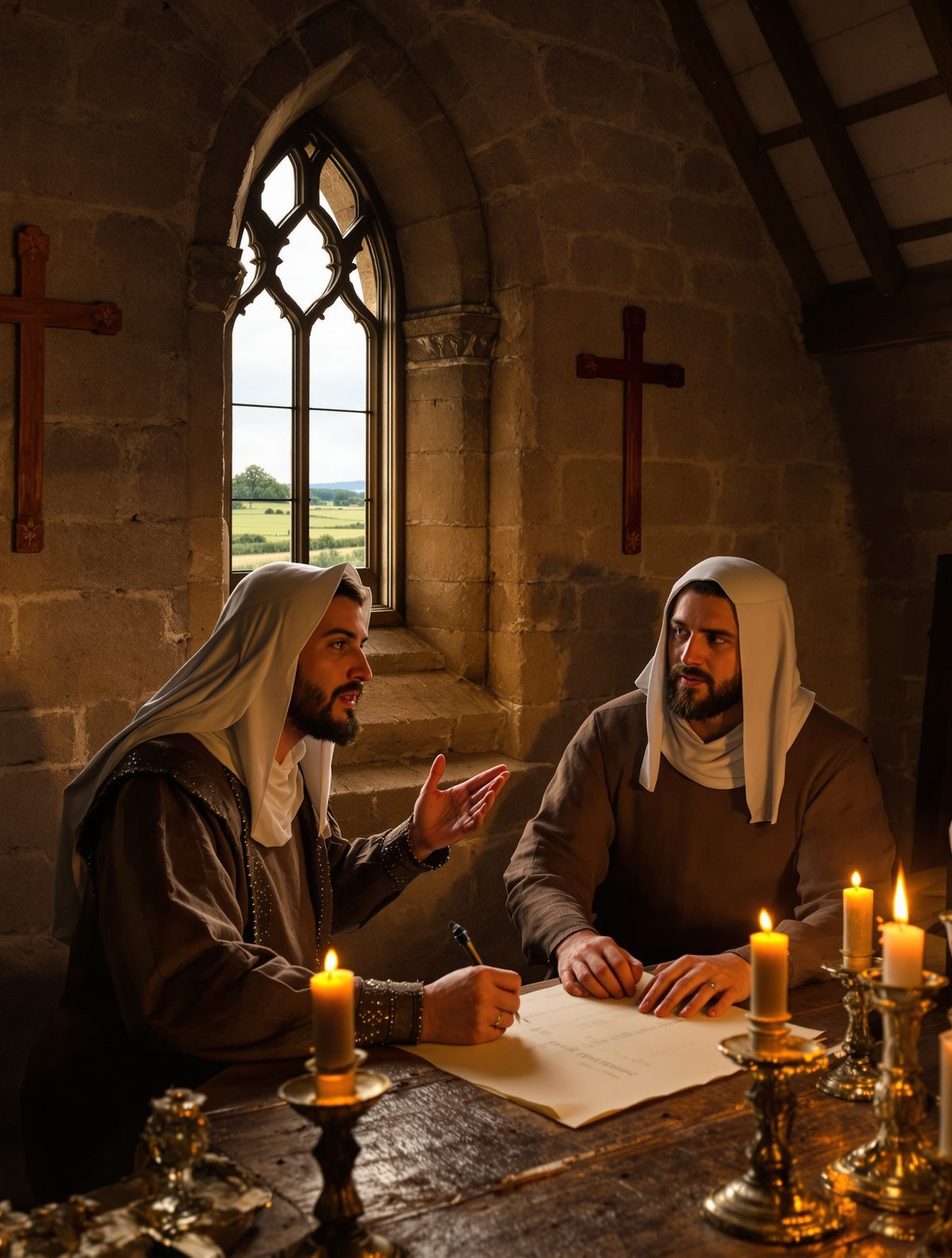
Picture this: a middle-aged woman sits in a modest chamber in King's Lynn, Norfolk, in the year 1436. She cannot read a single word, yet she's about to create something that will outlast cathedrals and kingdoms. As candlelight flickers across worn wooden beams, Margery Kempe begins to speak her truth to a patient scribe, unaware that she's making history. Her words, raw and unfiltered, will become the world's first autobiography in English—a revolutionary act that transforms an illiterate merchant's wife into literature's most unlikely pioneer.
The Woman Who Wouldn't Be Silenced
Born around 1373 into King's Lynn's merchant class, Margery Kempe lived in a world where women's voices were meant to be heard only in whispers. Her father, John Brunham, was a prosperous businessman and mayor of the bustling port town—a place where goods from across Europe filled warehouses and foreign tongues mixed in the marketplace. At twenty, Margery married John Kempe, a fellow merchant, and seemed destined for a life of quiet domesticity.
But Margery Kempe was never destined for quiet anything.
After the traumatic birth of her first child around 1393, Margery suffered what we would now recognize as severe postpartum depression. Medieval medicine had no name for her condition, attributing her "madness" to spiritual causes. For eight months, she was tormented by visions of demons and overwhelming despair. In an age when mental illness was seen as divine punishment or demonic possession, Margery's recovery was nothing short of miraculous—and it came with a twist that would scandalize her neighbors.
Read next: The Day a Queen Walked Into a Rebel Camp Alone
She claimed Christ himself had appeared to her, dressed in a purple silk mantle, sitting on her bed's edge. This vision, she later dictated, transformed her from a broken woman into someone with an unshakeable sense of divine purpose.
Mother, Mystic, and Medieval Entrepreneur
What makes Margery's story so remarkable isn't just her spiritual experiences—it's how thoroughly human she remains throughout her tale. After bearing fourteen children (a staggering number even by medieval standards), she made a decision that shocked her community: she negotiated with her husband for a celibate marriage so she could pursue her spiritual calling.
But first, she tried her hand at business. In a move that would make modern entrepreneurs proud, Margery launched not one but two ventures. She established a brewery that initially thrived, employing several workers and competing with established operations. When mysterious brewing failures destroyed that business—which she attributed to divine intervention steering her away from worldly pursuits—she pivoted to running a horse mill for grinding grain.
Both ventures ultimately failed, but they reveal something extraordinary: in medieval England, a married woman could operate independent businesses. Margery's commercial ambitions show us a side of medieval women's lives that rarely makes it into textbooks—their entrepreneurial spirit and economic agency, even within a patriarchal society.
The Pilgrim Who Wept Her Way Across Europe
Around 1413, Margery embarked on the adventure that would define her: pilgrimage. But she wasn't your typical medieval pilgrim quietly mumbling prayers. Margery wept. Loudly. Uncontrollably. These weren't gentle tears of devotion—they were body-wracking sobs that could be heard across crowded churches and busy streets.
Her crying fits, which she called "the gift of tears," made her simultaneously famous and notorious across Europe. In Jerusalem, her wailing at holy sites became so disruptive that fellow English pilgrims threatened to abandon her. In Rome, some dismissed her as a fraud while others venerated her as a living saint. The crying wasn't performance—Margery genuinely couldn't control these overwhelming emotional responses to religious experiences.
She traveled extensively: Jerusalem, Rome, Compostela, Danzig, and Aachen. For a woman who had never ventured far from Norfolk, these journeys were epic adventures fraught with dangers from bandits, disease, and suspicious authorities. She negotiated with ship captains, argued with bishops, and somehow managed to fund these expensive expeditions—likely through a combination of personal savings, donations from supporters, and her husband's merchant connections.
The Scribe Who Made History Possible
Here's where the story takes its most crucial turn. Sometime around 1436, when Margery was in her sixties, she convinced a local priest to serve as her scribe. This wasn't her first attempt—an earlier scribe had produced a manuscript so illegible that no one could read it. The identity of her successful scribe remains a mystery, but his patience and skill preserved what might otherwise have been lost forever.
The process was revolutionary. While other medieval religious texts were written in Latin by educated clergy, Margery dictated her story in Middle English—the language of common people. She didn't sanitize her experiences or present herself as a perfect saint. Instead, she included embarrassing details: her business failures, her arguments with fellow pilgrims, even her struggles with sexual temptation well into middle age.
The resulting manuscript, known simply as "The Book of Margery Kempe," runs to about 100,000 words. It contains conversations reconstructed from memory, detailed descriptions of places and people, and most remarkably, psychological insights that wouldn't seem out of place in modern memoir writing. She describes her internal thoughts and emotional states with startling honesty—something virtually unprecedented in medieval literature.
Lost and Found: A Literary Resurrection
For nearly 500 years, Margery's book vanished. Scholars knew it had existed because of brief references in other medieval texts, but the manuscript itself seemed lost forever. Then, in 1934, something extraordinary happened in the library of Parkminster Charterhouse, a monastery in Surrey.
A manuscript catalogued simply as "a treatise of mixed life" caught the attention of scholars. Upon closer examination, it proved to be the complete text of Margery Kempe's autobiography—the only surviving medieval copy. The discovery sent shockwaves through academic circles and completely rewrote the history of English literature.
The manuscript's survival was nothing short of miraculous. It had somehow escaped the dissolution of monasteries under Henry VIII, two world wars, and centuries of neglect. When scholars finally published it in 1940, readers encountered a voice from the Middle Ages unlike any they had heard before—intimate, fallible, and utterly compelling.
A Voice That Still Resonates
Why does Margery Kempe matter today? In an age of personal blogs, social media confessions, and memoir bestsellers, she might seem like just another voice sharing her story. But consider this: she lived in a world where women's spiritual experiences were often dismissed or controlled by male religious authorities, where literacy was a privilege of the elite, and where autobiography as a literary form simply didn't exist.
Margery Kempe broke barriers we're still fighting to dismantle. She insisted on the validity of her own experiences, refused to be silenced by social conventions, and found a way to preserve her voice for posterity despite being unable to write a single word herself. Her book predates the printing press, yet it feels remarkably modern in its psychological complexity and emotional honesty.
Perhaps most importantly, she reminds us that history's most fascinating figures aren't always the ones wearing crowns or commanding armies. Sometimes they're the difficult women who refuse to stay quiet, who cry too loudly in church, who insist their stories matter even when the world tells them otherwise. In giving us the first autobiography in English, this illiterate merchant's wife from Norfolk didn't just tell her own story—she invented a new way for all of us to understand what it means to be human.