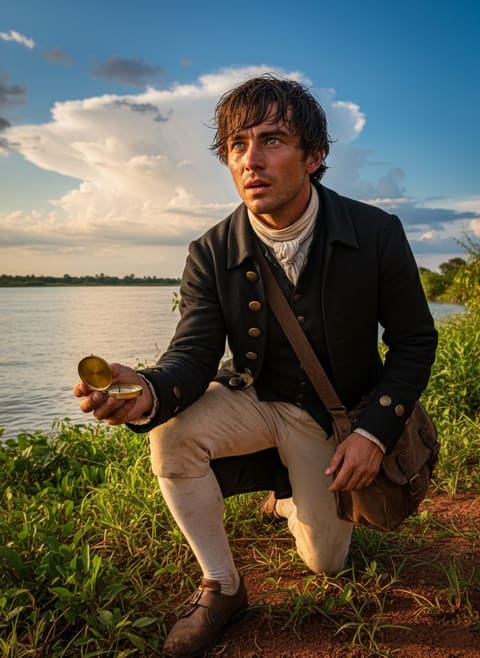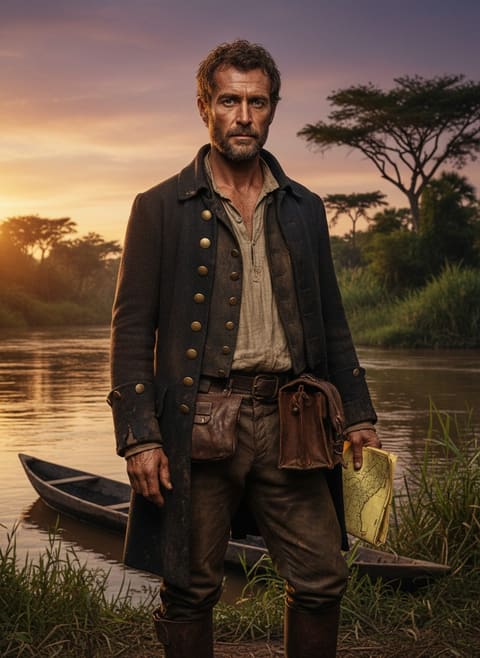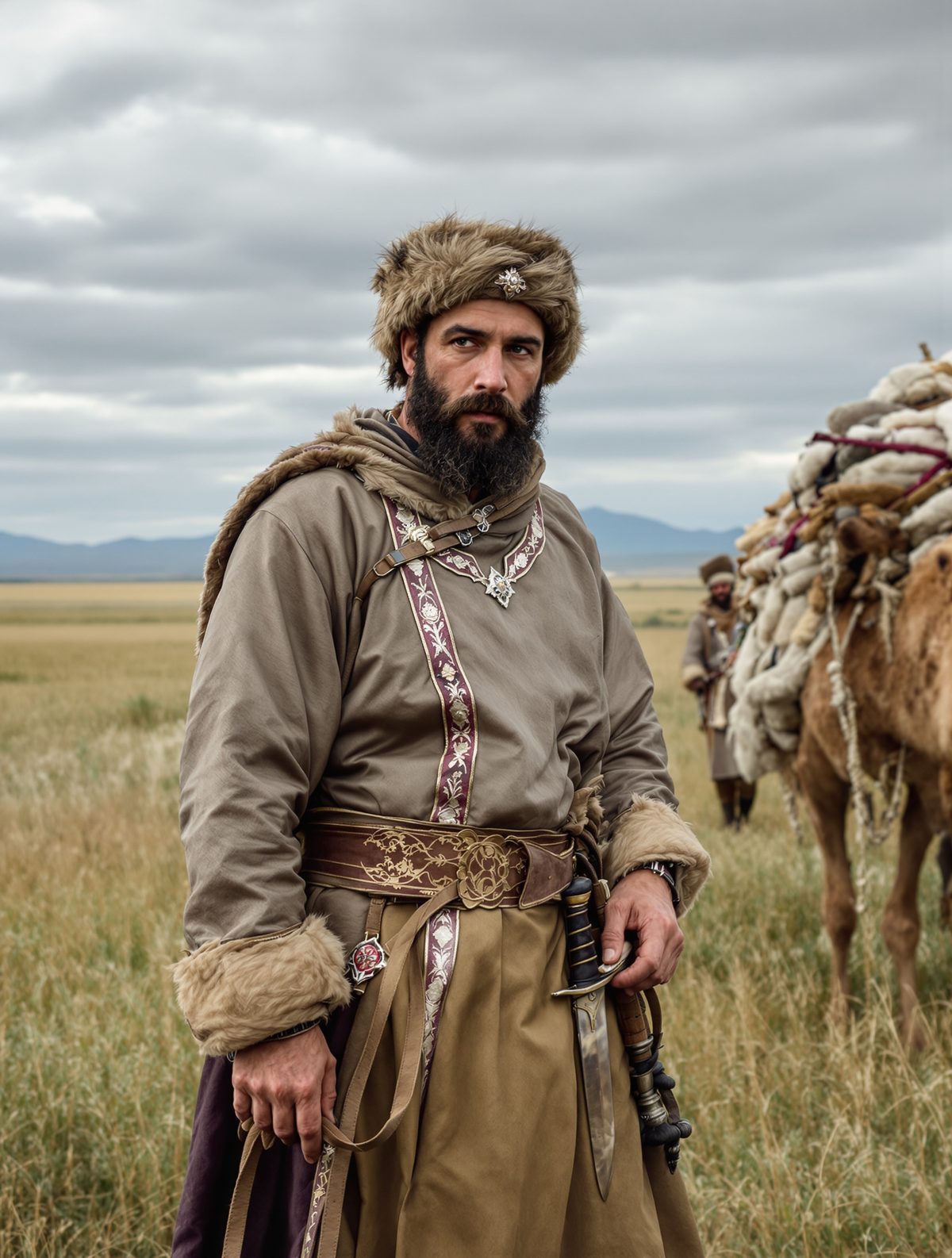
In a candlelit room in the Kremlin, an English merchant carefully wound a false beard around his jaw and pulled rough Tatar robes over his doublet. The date was May 23rd, 1558, and Anthony Jenkinson was about to embark on a journey that would make him the first European in over two centuries to reach the Caspian Sea by land. As he adjusted his disguise one final time, checking that no trace of his English identity remained visible, Jenkinson knew that a single slip in his performance could mean death in the lawless steppes ahead.
What drove this Tudor merchant to risk everything on such a perilous masquerade? The answer lay in Elizabeth I's desperate need for new trade routes and England's burning ambition to challenge the monopolies that strangled her economy.
The Merchant Who Dared
Anthony Jenkinson was no ordinary trader. Born around 1529, this son of a Leicestershire gentleman had already proven himself one of England's most daring commercial adventurers. By his late twenties, he had navigated the treacherous politics of the Levant Company, survived Mediterranean pirates, and walked the bazaars of Aleppo and Constantinople. But his greatest test lay ahead in the vast, uncharted wilderness between Moscow and the Caspian Sea.
The Muscovy Company had sent Jenkinson to Ivan the Terrible's court with a specific mission: find a land route to Persia and the riches of the East. The traditional sea routes were dominated by Portuguese and Spanish fleets, while the Ottoman Empire controlled the overland passages through Turkey. England needed alternatives, and Jenkinson represented their best hope of breaking through the commercial blockade that threatened the realm's prosperity.
Read next: The Day a Devon Captain Charted the Pacific and Changed the World
Ivan the Terrible, despite his fearsome reputation, proved surprisingly cooperative. Perhaps he saw opportunity in English ambitions, or maybe he simply enjoyed the audacity of Jenkinson's proposal. The Tsar granted the Englishman letters of safe passage and permission to travel wherever he wished within Russian territories. But beyond the Russian frontier lay a different world entirely—one where the Tsar's protection meant nothing.
Into the Costume of Deception
The decision to adopt Tatar dress wasn't mere whimsy—it was survival strategy born from cold calculation. The steppes between Moscow and the Caspian were dominated by Tatar tribes, descendants of the Golden Horde who viewed Europeans with deep suspicion. Christian merchants were prime targets for robbery, enslavement, or worse. But a fellow Tatar trader? That was different.
Jenkinson's transformation was meticulous. He studied Tatar customs, learned key phrases in their language, and practiced the subtle gestures and mannerisms that would sell his deception. His false beard was crafted to match Tatar styling, while his robes bore the authentic wear patterns of a seasoned steppe merchant. Most crucially, he assembled a convincing cargo of goods that a Tatar trader would realistically carry—furs, amber, and Russian metalwork that wouldn't immediately scream "English spy."
On that May morning in 1558, Jenkinson set out from Moscow with a small caravan, his heart pounding beneath his foreign robes. The first test of his disguise would come at the frontier posts, where Russian officials who knew his true identity would have to play along with the charade. But the real examination awaited in the lawless lands beyond, where suspicious eyes would scrutinize every detail of his performance.
Across the Steppe of Skulls
The journey south from Moscow revealed landscapes that seemed designed by nightmares. Jenkinson's route took him through territories that contemporary maps marked simply as "waste land"—vast stretches of grass punctuated by the bleached bones of previous travelers. The steppe had earned its reputation as Europe's most dangerous frontier, where bandits moved like wolves and entire caravans could vanish without trace.
Jenkinson's disguise faced its first serious test at Kazan, the former Tatar capital that Ivan had brutally conquered just six years earlier. The city still seethed with resentment, and the wrong word or gesture could expose him as an ally of the Russian oppressors. But his performance held. Speaking in carefully practiced phrases, he presented himself as a simple trader seeking passage to Astrakhan, avoiding political discussions and keeping his true mission hidden.
The real trial came in the open steppe. Here, his small caravan encountered the nomadic bands that preyed on travelers. Time and again, fierce horsemen would surround Jenkinson's party, demanding to know their business and examining their goods with predatory eyes. Each encounter was a life-or-death audition, where the slightest inconsistency in his story could trigger violence.
One particularly terrifying moment came when a Tatar chieftain, suspicious of Jenkinson's accent, began questioning him closely about his supposed homeland. The Englishman's heart hammered as he spun an elaborate tale about growing up on the distant edges of Tatar territory, mixing truth with fiction in a performance that would have impressed London's finest actors. The chieftain's eyes narrowed, studying Jenkinson's face for tells. After what felt like an eternity, the warlord nodded and waved the caravan onward. Jenkinson had passed the test, but barely.
The Glittering Prize
After weeks of nerve-shredding travel, Jenkinson finally crested the hills overlooking the Caspian Sea. The sight that greeted him was worth every terrifying moment of the journey—a vast inland ocean stretching to the horizon, its waters glittering under the summer sun. This was the gateway to Persia, to the silk routes of Central Asia, to commercial possibilities that could transform England's fortunes.
Read next: The Day a Devon Sailor Mapped the Roof of the World Alone
At Astrakhan, the Russian fortress guarding the Caspian's northern shore, Jenkinson could finally drop his exhausting masquerade. The relief must have been overwhelming as he shed the Tatar robes that had both protected and confined him for so many dangerous weeks. But his achievement went far beyond personal survival—he had proven that the overland route to Asia was not just possible but potentially profitable.
The merchant didn't stop there. Emboldened by his success, Jenkinson continued across the Caspian itself, becoming the first Englishman to set foot in Persia proper. His arrival at the court of Shah Tahmasp in 1561 represented the culmination of one of the most audacious commercial expeditions of the Tudor age. Though the Shah proved less cooperative than Ivan the Terrible, dismissing Christianity as inferior to Islam, Jenkinson had opened a door that would never fully close again.
The Ripples of a False Beard
Jenkinson's journey might seem like a curious footnote to history, but its implications resonated across centuries. His detailed reports provided Europe with its first accurate description of the Caspian region in generations, correcting medieval misconceptions and revealing commercial opportunities that would shape international relations for centuries to come.
More immediately, his success encouraged other English adventurers to attempt similar journeys. The routes Jenkinson pioneered became highways for subsequent English traders, diplomats, and eventually soldiers. In a sense, his false beard and Tatar robes represented the first steps of England's long march toward becoming a global imperial power.
The psychological impact was equally significant. At a time when England felt hemmed in by hostile Catholic powers, Jenkinson's achievement demonstrated that there were always alternative routes to prosperity—if one had the courage to disguise oneself and walk among strangers as an equal. His journey embodied the Elizabethan spirit of adventure that would soon propel English ships around the globe and establish colonies on distant continents.
Perhaps most remarkably, Jenkinson's disguise saved not just his own life but potentially altered the course of English history. Had he traveled as an obvious European and been killed by suspicious Tatars, England might have abandoned its eastern ambitions for generations. Instead, his successful masquerade opened pathways that would eventually contribute to the commercial wealth that funded England's rise to global prominence. In the annals of history, few false beards have carried such momentous consequences.