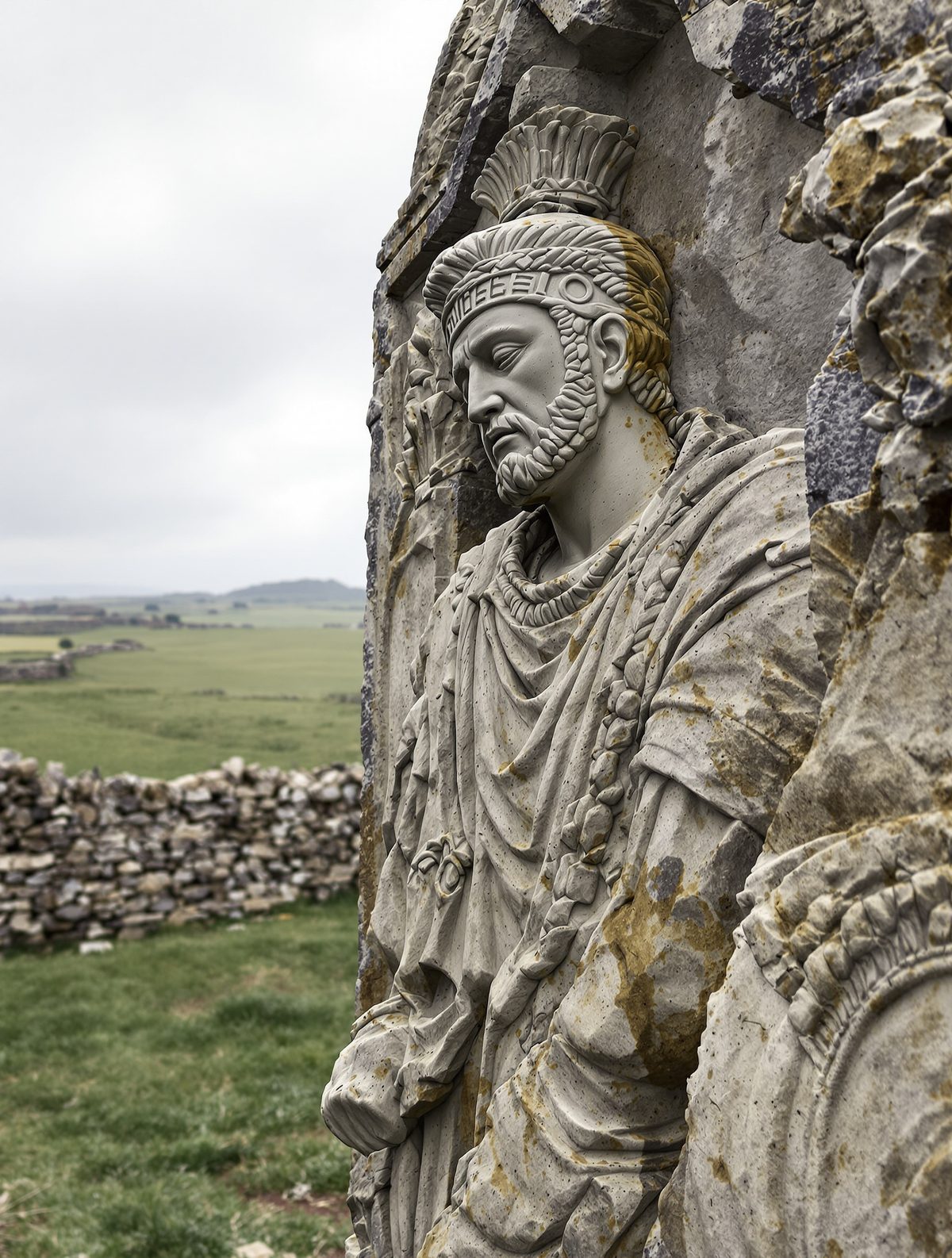
In a quiet churchyard in Hexham, beneath the shadow of what was once Hadrian's mighty wall, stands a piece of Roman stone that breaks your heart. Most Roman tombstones boast of glory, of enemies slain and territories conquered. But this one is different. This one weeps.
The carving shows a Roman cavalry officer on horseback, his mount rearing above a fallen barbarian warrior—the classic image of imperial triumph that decorated countless memorials across the Empire. Yet look closer at the rider's face, and you'll see something that Roman sculptors almost never dared to show: genuine human sorrow. Not the stoic mask of duty, not the proud sneer of victory, but the raw grief of a man who knew he would never see home again.
This is the tombstone of Flavinus, and it tells us a story that the history books forgot—about love, loss, and what it really meant to die at the edge of the world.
The Man Behind the Mask
Flavinus served as a cavalry commander somewhere along Hadrian's Wall during the 2nd century AD, when the great barrier was still fresh stone and mortar, not the romantic ruin we know today. His full name—Flavinus, son of Lucianus—suggests he came from a family with some social standing, probably from Gaul or Germania where Rome recruited many of its finest horsemen.
Read next: The Day a Roman Slave Left a Message That Outlasted an Empire
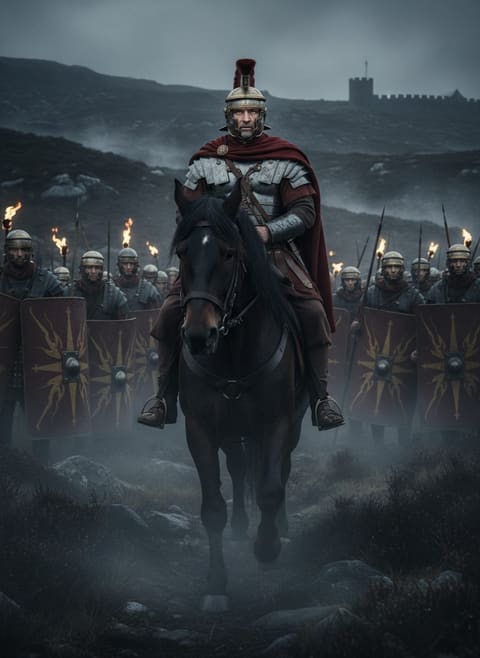
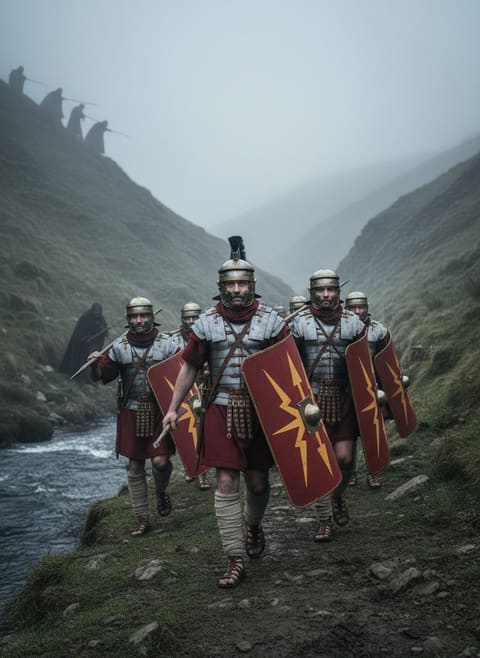
We know precious little about his life, but archaeology tells us volumes about his world. The cavalry units stationed along the Wall were elite forces, often recruited from tribes that had mastered the art of fighting on horseback centuries before Rome even existed. These weren't the heavy legionaries we picture when we think of Roman soldiers—these were fast, mobile warriors who could strike like lightning across the harsh Northumberland landscape.
Flavinus would have commanded an ala—a wing of cavalry typically numbering between 300 and 500 men. These units bore exotic names that hint at their origins: Ala Petriana from the Balkans, Ala Augusta from Gaul, Ala Hispanorum from Spain. Each brought their own traditions, their own gods, their own ways of remembering the dead.
But Flavinus died young, probably in his twenties or early thirties. Whether he fell in battle against the Pictish tribes beyond the Wall, succumbed to disease in the damp British climate, or met some other fate, we'll never know. What matters is what happened next.
A Brotherhood Carved in Stone
When a Roman soldier died far from home, his contubernales—his tent-mates and closest comrades—became his family. They pooled their money to ensure he received proper burial rites, and more importantly, a tombstone that would speak his name to eternity. This wasn't just sentiment; Romans believed that to be forgotten was to die twice.
For Flavinus, his men commissioned something extraordinary. Working with local craftsmen who had learned Roman techniques but retained their own artistic traditions, they created a memorial that broke every rule in the imperial playbook.
The iconography starts conventionally enough. Flavinus sits astride his war horse, spear in hand, trampling a naked barbarian beneath his mount's hooves. This was the standard calcatio motif—the treading down of Rome's enemies—that appeared on everything from coins to monumental arches. It was visual propaganda, designed to show Roman superiority over the "uncivilized" tribes.
But something went wonderfully wrong in the execution. Perhaps the sculptors were locals who understood grief differently. Perhaps Flavinus's comrades gave specific instructions about how they wanted their commander remembered. Whatever the reason, the face that emerged from the stone wasn't the marble mask of imperial triumph—it was achingly, recognizably human.
The Face That Launched a Thousand Questions
Look at any other Roman cavalry tombstone—there are dozens scattered across Britain and the Empire—and you'll see faces carved according to strict conventions. The deceased stares out with divine composure, sometimes even smiling slightly, embodying the Roman virtues of gravitas and dignitas. Death, these monuments suggest, is just another posting in service to the Empire.
Flavinus's face tells a different story entirely. His brow is furrowed, his eyes downcast, his mouth set in an expression of profound melancholy. This isn't a man celebrating victory over barbarians—this is someone saying goodbye. Art historians have puzzled over this expression for decades, because it appears nowhere else in Roman Britain.
Some scholars argue that we're reading too much into weathered stone, that centuries of British rain have softened features that were once more conventionally heroic. But the craftsmanship elsewhere on the tombstone is too precise, too deliberate, for this to be an accident. Every fold in Flavinus's cloak, every detail of his horse's bridle, every muscle in the fallen warrior's body was carved with meticulous care. This face was exactly what someone wanted to preserve.
The inscription below the carving is equally remarkable for what it doesn't say. Most military tombstones in Roman Britain read like a CV—listing units served, campaigns fought, honors earned. Flavinus's simply reads: "Flavinus, horseman of the cavalry regiment, son of Lucianus, aged 25, lies here." No boasting. No grand claims. Just a young man, far from home, remembered by those who loved him.
Reading Between the Lines of Empire
What makes Flavinus's tombstone so extraordinary isn't just its artistry—it's what it reveals about the human reality of Roman occupation. For too long, we've understood Hadrian's Wall through the lens of imperial grand strategy, as if it were simply a line on a map drawn by emperors in Rome. But the Wall was built and defended by real people, far from their own families, facing an uncertain future in a harsh and foreign land.
Recent archaeological work along the Wall has revolutionized our understanding of life in the garrisons. These weren't grim military camps populated by homesick soldiers counting days until discharge. They were vibrant, multicultural communities where Romans, Britons, Germans, Spaniards, and Africans lived, worked, married, and raised children together.
The soldiers wrote letters on wooden tablets that have survived in the waterlogged conditions at sites like Vindolanda. They complained about the weather ("the Britons are unprotected by armor and there are very many cavalry"), requested care packages from home ("I have sent you... pairs of socks, two pairs of sandals and two pairs of underpants"), and worried about money, relationships, and their families' welfare. They were, in short, recognizably human.
Flavinus's tombstone captures this humanity in a way that no written record could. Here was a young officer who inspired such devotion in his men that they insisted on remembering not his victories, but his vulnerability. In doing so, they created something that speaks across nearly two millennia with startling immediacy.
Read next: The Day a Roman Officer Freed His Captive and Walked Away
The Barbarian's Tale
But there's another figure in this stone drama that deserves our attention: the barbarian warrior trampled beneath Flavinus's horse. In most Roman art, such figures are depicted as subhuman—wild-haired savages whose defeat is both inevitable and deserved. Yet the sculptor of Flavinus's tombstone carved this enemy with remarkable dignity.
The fallen warrior is young, muscular, and noble in death. His face, though turned away, lacks the exaggerated features that Roman artists typically used to mark "otherness." His body, though defeated, retains its strength and grace. Some historians have suggested that this figure represents not just any barbarian, but perhaps the specific Pictish or Celtic warrior who killed Flavinus—honored even in defeat by men who respected courage regardless of which side it served.
This interpretation gains weight when we consider how warfare actually worked along Hadrian's Wall. Despite popular imagination, the frontier wasn't a site of constant battle between civilization and barbarism. More often, it was a complex zone of trade, diplomacy, and cultural exchange, punctuated by periods of raiding and retaliation that could be brutal but were rarely existential.
Roman cavalry units like Flavinus's often recruited locally, and many soldiers would have had British wives, British friends, even British relatives on the other side of the Wall. The enemy who killed you might speak your language, worship gods you recognized, even share some of your blood. In such a world, simple narratives of us versus them become impossible to maintain.
Echoes Across Time
Today, Flavinus's tombstone sits in Hexham Abbey, where it has served as a curious ornament for over a thousand years. Medieval monks, who knew nothing of its original context, incorporated it into their church walls as exotic decoration. Victorian antiquarians rescued it, polished it, and tried to decode its mysteries with the tools of their age. Modern archaeologists continue to study it, finding new details and interpretations with each examination.
But perhaps the tombstone's greatest power lies not in what it tells us about the past, but in what it reveals about the present. In an age when military service is often discussed in abstractions—strategic objectives, geopolitical considerations, casualty statistics—Flavinus's memorial reminds us that wars are fought by individuals with hopes, fears, and relationships that extend far beyond any political cause.
The sorrow carved into his stone face speaks to anyone who has ever said goodbye to someone they might never see again, anyone who has tried to find meaning in loss, anyone who has wondered whether they'll be remembered when they're gone. It's a reminder that the human heart beats the same way across centuries, regardless of the uniform it wears or the flag it serves.
In choosing to remember their commander's grief rather than his glory, Flavinus's soldiers created something far more powerful than conventional propaganda. They carved a piece of truth into British stone—and in doing so, they ensured that a young Roman cavalry officer who died at the edge of the world nearly two thousand years ago still has the power to break our hearts today.