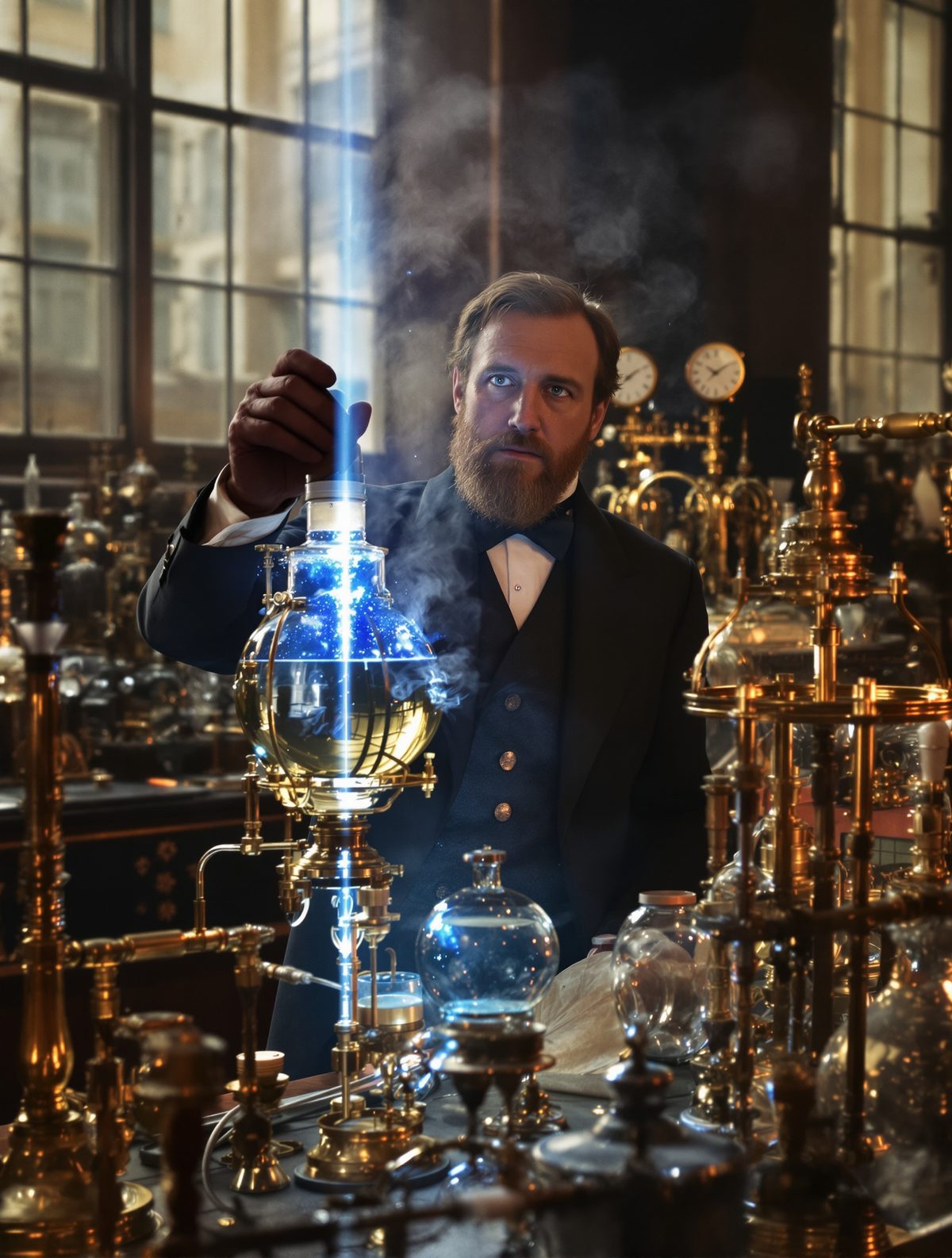
The gas lamps flickered in the Royal Institution's basement laboratory as Professor John Tyndall adjusted his apparatus one final time. It was a crisp London morning in 1869, and the Irish physicist was about to solve a mystery that had puzzled humanity since the first person looked up and wondered: why is the sky blue? Armed with nothing more than a beam of light, a glass tube, and some carefully prepared cloudy water, Tyndall was moments away from an epiphany that would illuminate one of nature's most beautiful secrets.
For centuries, the greatest minds had grappled with this question. Leonardo da Vinci had theorized it was tiny water droplets. Lord Rayleigh would later refine the mathematics. But on this particular day, in a dimly lit Victorian laboratory, the answer was about to reveal itself in the most elegant way possible—through the simple act of shining light through murky water.
The Professor Who Dared to Question Everything
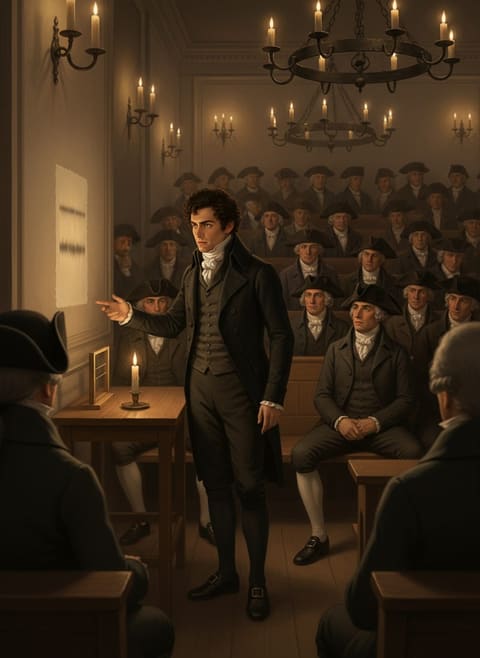
John Tyndall was no ordinary Victorian gentleman. Born in 1820 in County Carlow, Ireland, he had clawed his way up from humble beginnings to become one of Britain's most celebrated scientists. By 1869, he was already famous for his work on heat radiation and his dramatic public lectures at the Royal Institution, where he would dazzle audiences with spectacular demonstrations that made science accessible to the masses.
But Tyndall possessed something rarer than brilliance—he had an insatiable curiosity about the everyday phenomena that others simply accepted. While his contemporaries were content to enjoy a blue sky, Tyndall wanted to understand it. This restless intellect had already led him to groundbreaking discoveries about greenhouse gases and the role of water vapor in climate, work that wouldn't be fully appreciated until a century later when climate science emerged.
Read next: The Day a Weaver's Son Mapped the Invisible World
On that fateful day in 1869, Tyndall was investigating something called the Tyndall effect—though he didn't know it would bear his name. He was exploring how light behaved when it encountered tiny particles suspended in a clear medium, work that seemed arcane to outsiders but held the key to understanding our azure heavens.
The Experiment That Changed Everything
Tyndall's experimental setup was deceptively simple, yet revolutionary. He filled a long glass tube with crystal-clear water, then gradually began adding tiny amounts of various substances—a few drops of milk, some particles of mastic, or wisps of chemical precipitates that created an almost imperceptible cloudiness. The water remained virtually transparent to the naked eye, but contained millions of microscopic particles floating in suspension.
Then came the magic moment. Tyndall directed a powerful beam of white light from a carbon arc lamp—the brightest artificial light available in Victorian times—through his cloudy water. What happened next must have made him gasp with recognition. The beam, which should have remained white as it passed through the clear water, turned distinctly blue.
But here's where Tyndall's genius showed: he didn't just observe the phenomenon, he analyzed it. Moving to different angles around the apparatus, he noticed something extraordinary. When he looked at the light beam from the side, it appeared blue. But when he positioned himself at the end of the tube, looking through the entire length of the liquid, the emerging light appeared orange-red. The tiny particles were somehow separating white light into its component colors.
The Moment of Revelation
Standing in his laboratory, surrounded by the acrid smell of gas lamps and the hum of Victorian London filtering through the windows, Tyndall experienced one of those rare eureka moments that punctuate scientific history. He suddenly understood what was happening in that glass tube—and by extension, what was happening in the atmosphere above his head every single day.
The microscopic particles in his water were scattering light, but not equally across all colors. Blue light, with its shorter wavelength, was being scattered far more than red light with its longer wavelength. This selective scattering was creating the blue beam he observed from the side, while allowing more of the longer wavelengths to pass straight through, creating the reddish light at the end.
In that instant, Tyndall realized he was witnessing in miniature exactly what happens in Earth's atmosphere. The air isn't empty—it's filled with tiny particles of dust, water droplets, and even molecules of gas itself. When sunlight strikes these particles, blue light gets scattered in all directions while red light passes through more easily. We see the scattered blue light as the color of the sky itself.
The Elegant Solution to an Ancient Mystery
What made Tyndall's discovery so remarkable was how it explained not just why the sky is blue, but why it changes color throughout the day. During sunrise and sunset, sunlight must travel through much more atmosphere to reach us. By the time it arrives, most of the blue light has been scattered away in other directions, leaving the reds and oranges to paint the horizon in those glorious warm hues we associate with dawn and dusk.
Tyndall's experiment also explained why distant mountains appear blue-gray, why smoke from a cigarette looks blue when backlit, and why the beam of a car's headlights becomes visible on a foggy night. All of these phenomena stem from the same principle he observed in his Royal Institution laboratory: tiny particles scattering short wavelengths more than long ones.
The scientific community was initially skeptical. Some dismissed his findings, preferring more complex explanations involving water vapor or atmospheric chemistry. But Tyndall was undeterred. He refined his experiments, varied his approach, and consistently arrived at the same conclusion. Light scattering by small particles was the key to understanding the sky's color.
Read next: The Day a Clockmaker's Son Rewired How We See the Stars
Beyond Blue Skies: The Unexpected Consequences
What Tyndall couldn't have foreseen was how his discovery would ripple through science and technology for generations to come. His work laid the foundation for understanding atmospheric optics, which would prove crucial for early aviation and weather prediction. The same principles he discovered became essential for developing fiber optic communications—those tiny glass threads that now carry internet signals around the world work partly because of light scattering effects Tyndall first described.
Even more remarkably, Tyndall's investigation of particles in the atmosphere contributed to the development of sterilization techniques. His studies revealed how tiny particles could harbor microorganisms, leading to improved methods for creating sterile environments in medical and scientific applications.
But perhaps most poetically, Tyndall's work gave us the scientific language to describe beauty itself. No longer was a blue sky simply a gift to be admired; it became a physical phenomenon to be understood, measured, and predicted. He had taken one of nature's most sublime spectacles and revealed the elegant physics hiding in plain sight.
The Light That Lives On
Today, as we gaze up at a brilliant blue sky, we're witnessing the same phenomenon John Tyndall first captured in his glass tube over 150 years ago. Every azure morning, every crimson sunset, every time we see distant mountains shrouded in blue haze, we're seeing his discovery played out on a planetary scale.
But there's something profoundly moving about imagining that moment in 1869 when a curious Irish physicist, working by gaslight in a basement laboratory, first understood why our world is painted blue. In an age when we often take scientific knowledge for granted, Tyndall's story reminds us that behind every natural wonder lies a human being who dared to ask "why?"—and had the ingenuity to find out.
The next time you step outside and look up at that endless blue canopy, remember Professor Tyndall and his cloudy water. Remember that the most beautiful mysteries often have the most elegant solutions, waiting patiently for someone curious enough to shine a light and see what happens.