
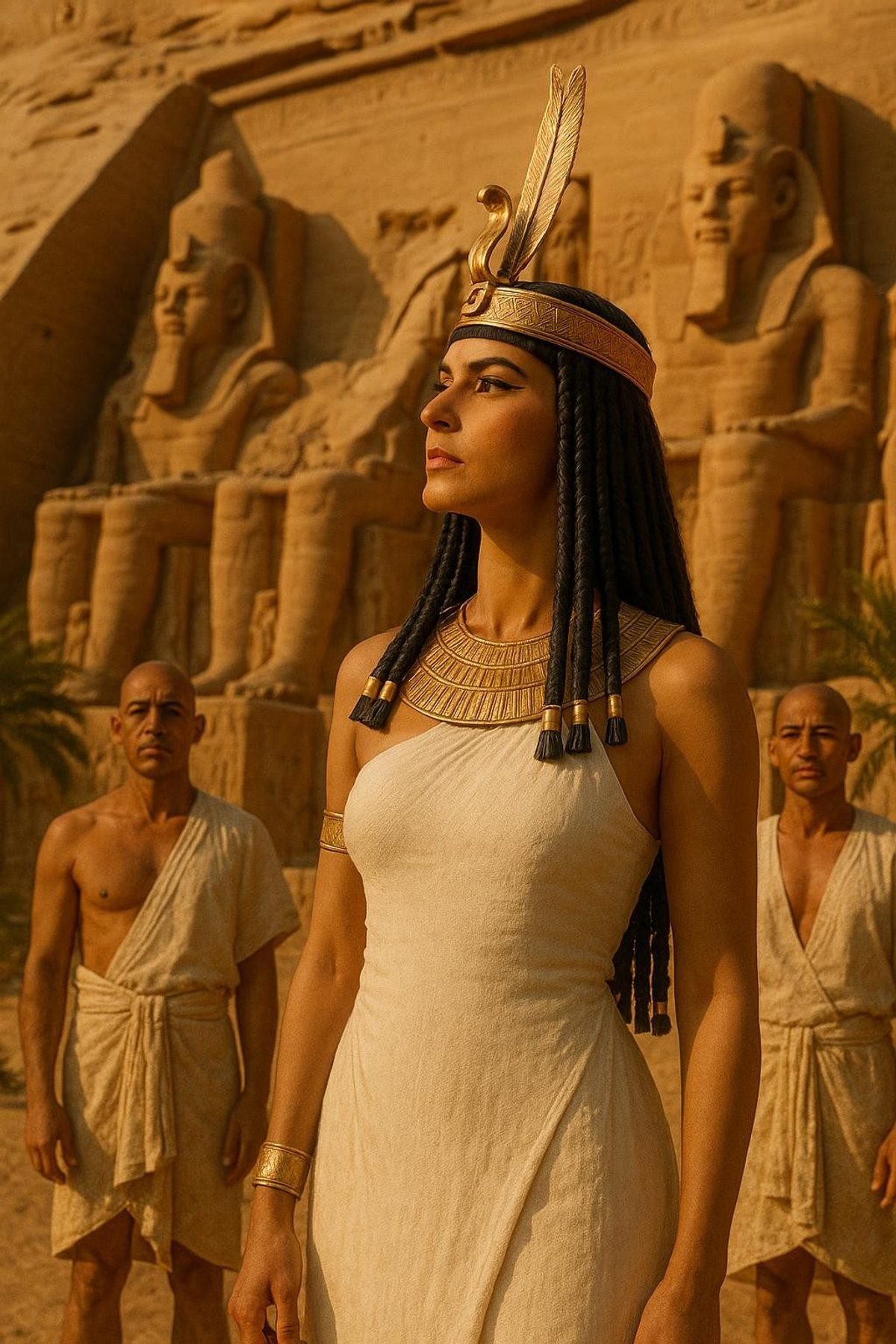
The desert air was thick and still under the relentless blaze of the Egyptian sun. It was a silence almost tangible, broken only by the rhythmic beating of papyrus fans wielded by temple attendants. This was the great stone façade of Abu Simbel, standing proud, carved into the living rock, its statues resolute and majestic. A line of people stretched along the golden sands, eyes wide and mouths agape. They were here for a momentous occasion — something so unprecedented that it defied the traditions of millennia; a queen was about to take her place among the gods.
The Birth of an Unparalleled Legacy
In the year 1255 BC, Ramesses II, a pharaoh hailed as a deity among men, made a decision that resonated through time. Known for his architectural ambition, he had already started to etch his legacy in the stones of Egypt, building monuments so grand that their echoes reached beyond the desert sands to the farthest corners of the ancient world. Yet, it was at Abu Simbel that Ramesses created something unique — a temple that was not for himself but for his queen, Nefertari.
Nefertari, the queen whose name meant "beautiful companion of the one who shines," was no ordinary royal consort. She was both a symbol and an individual of considerable influence. Her marriage to Ramesses was a mix of love, politics, and religious synthesis. Ramesses, the warrior king, stood a giant among Egypt’s rulers, yet he sought to elevate his queen not only in the eyes of men but also in the eyes of the gods.
Amidst the harsh and arid landscape of Nubia, contrasting with the rich fertility of the Nile valley, the twin temples of Abu Simbel were fashioned. The larger temple was dedicated to Ramesses, while a slightly smaller yet equally majestic edifice was constructed for Nefertari. This was not merely an appendage to Ramesses' glory. Instead, Nefertari's image was carved as tall as the gods themselves: Hathor and statues match the pharaoh's own stature, something never before seen in Egyptian history.
Read next: Sennefer Walked Into the Tomb. He Left a Garden.
This rebuke to tradition was not just an architectural marvel; it was a powerful statement. It demonstrated Ramesses' innovative leadership and his reverence for Nefertari. Surpassing cultural norms, Ramesses carved into stone a dramatic declaration — a queen was of equal divine consideration.
The Day the Stone Spoke
The anticipation was palpable on the day Nefertari walked into her temple. It was unprecedented for a woman, even a queen, to hold such a place of prominence. The grandeur of the temple was breath-taking, its façade guarded by six colossal statues, four of Ramesses and two of Nefertari, placed symmetrically like guardians of the entrance. As the sun climbed high into the sky, its light spilling over the figures, a hush fell over the gathering.
Inside the temple, the dimly illuminated walls were meticulously adorned with vibrant paintings and carvings, depicting the queen in various divine acts. She was shown offering to the goddess Hathor, adorned in the crown of feathers, symbols of her power, wisdom, and beauty. As she stepped through the grand entrance, each stride resonated like a heartbeat through the air — the very stones seemed to come alive.
The atmosphere was charged with both reverence and astonishment. It was peculiar, a scene out of legend — a living queen portrayed as a goddess, forever encased in rock. Her steps echoed beyond the halls, challenging the sands to forget what it had witnessed. The temple became alive with whispers, ones that would echo for centuries. This was not just the entrance of a queen into her sanctuary; it was a redefinition of the divine narrative itself.
What made this event so significant was the symbolism that spirited every inch of the structure. The ancient Egyptian pantheon, in Egyptian society and religion, was imbued with rigid hierarchies and immense power. For Nefertari to be immortalized alongside deities elevated her status beyond mortality — she was to be worshipped eternally.
A Monumental Shift
The construction of the temple at Abu Simbel played a part in redefining the role of queenship in ancient Egypt. To etch Nefertari's likeness next to gods' changed how the world could perceive power and statehood. Though the concept of divine kingship was as ancient as the Pharaohs themselves, Ramesses' gesture to dedicate a temple to his wife exemplified a shift towards acknowledging the importance of the queen beyond an auxiliary figure.
The inspiration drawn from this act reverberated through time. Indeed, there were queens before Nefertari with recognized power and influence, such as Hatshepsut, who reigned as pharaoh, but in the case of Nefertari, it was her delineation in timeless stone that solidified her deified status. This was a subtle yet crucial step in broadening the scope of female roles in governance and spirituality. At the same time, it suggested a possible reflection of change in the sociopolitical dynamics of the time, where love, respect, and reverence were interwoven with power structures.
This exceptional gesture by Ramesses II was not forgotten. Tutankhamun's tomb is often noted for its opulence, but the recognition of Nefertari at Abu Simbel was a reverence for more than wealth or power; it was an acknowledgment of a queen’s place in eternity. It was a tribute paid to a ‘beautiful companion’, encapsulating what was culturally radical — that a queen could stand shoulder to shoulder with the gods.
Today, as visitors stand before the mighty temples of Abu Simbel, one cannot help but feel a sense of reverence, as if the statues themselves whisper their stories into the wind. This tale of architectural magnificence, royal grandeur, and cultural progressiveness exemplified through Nefertari’s temple remains a beacon illuminating the nuanced pathways of human history. It is a reminder that behind every stone lies a story — a story not just of what was but of what could be, should modern eyes dare look beyond the façade.