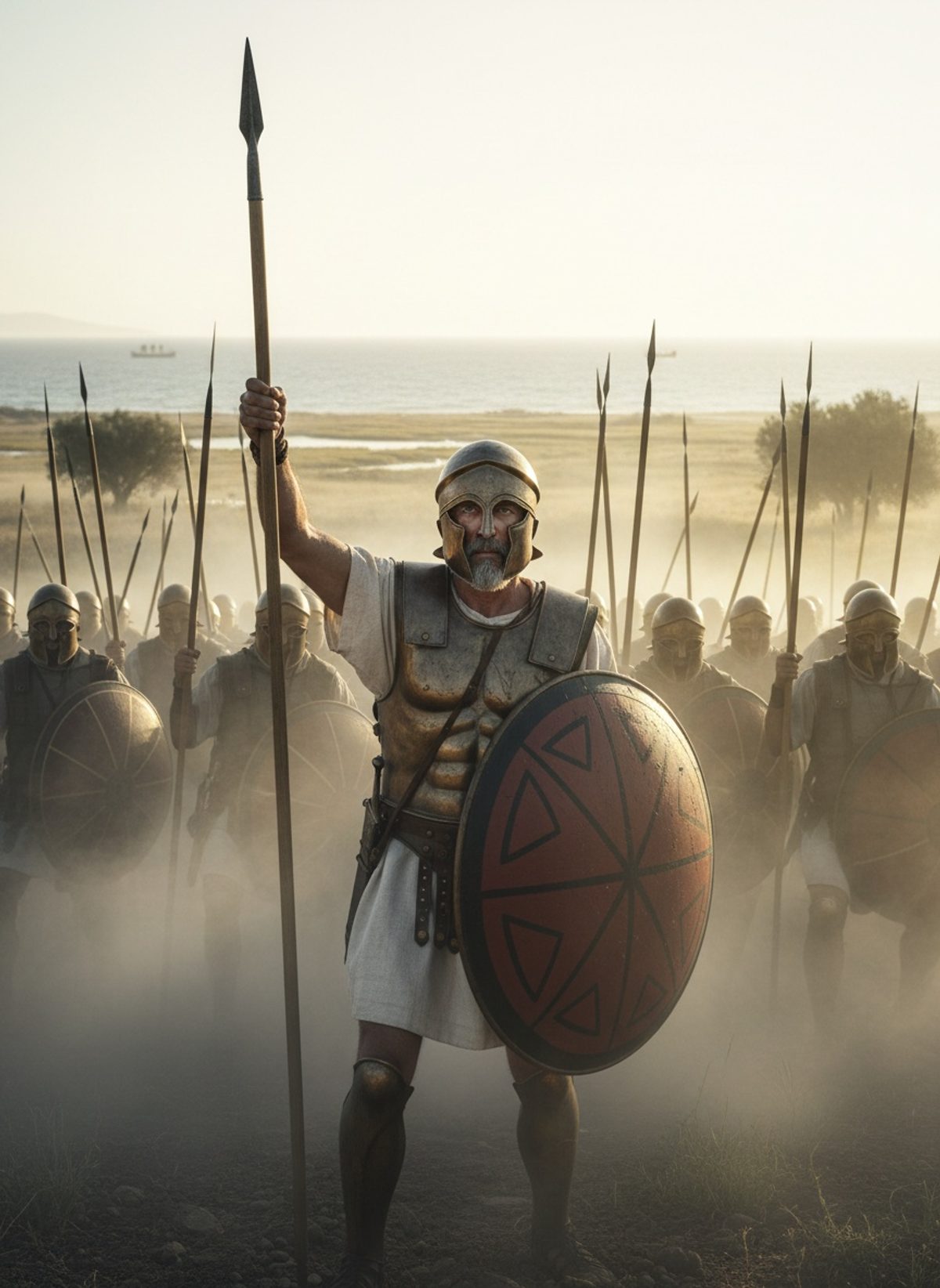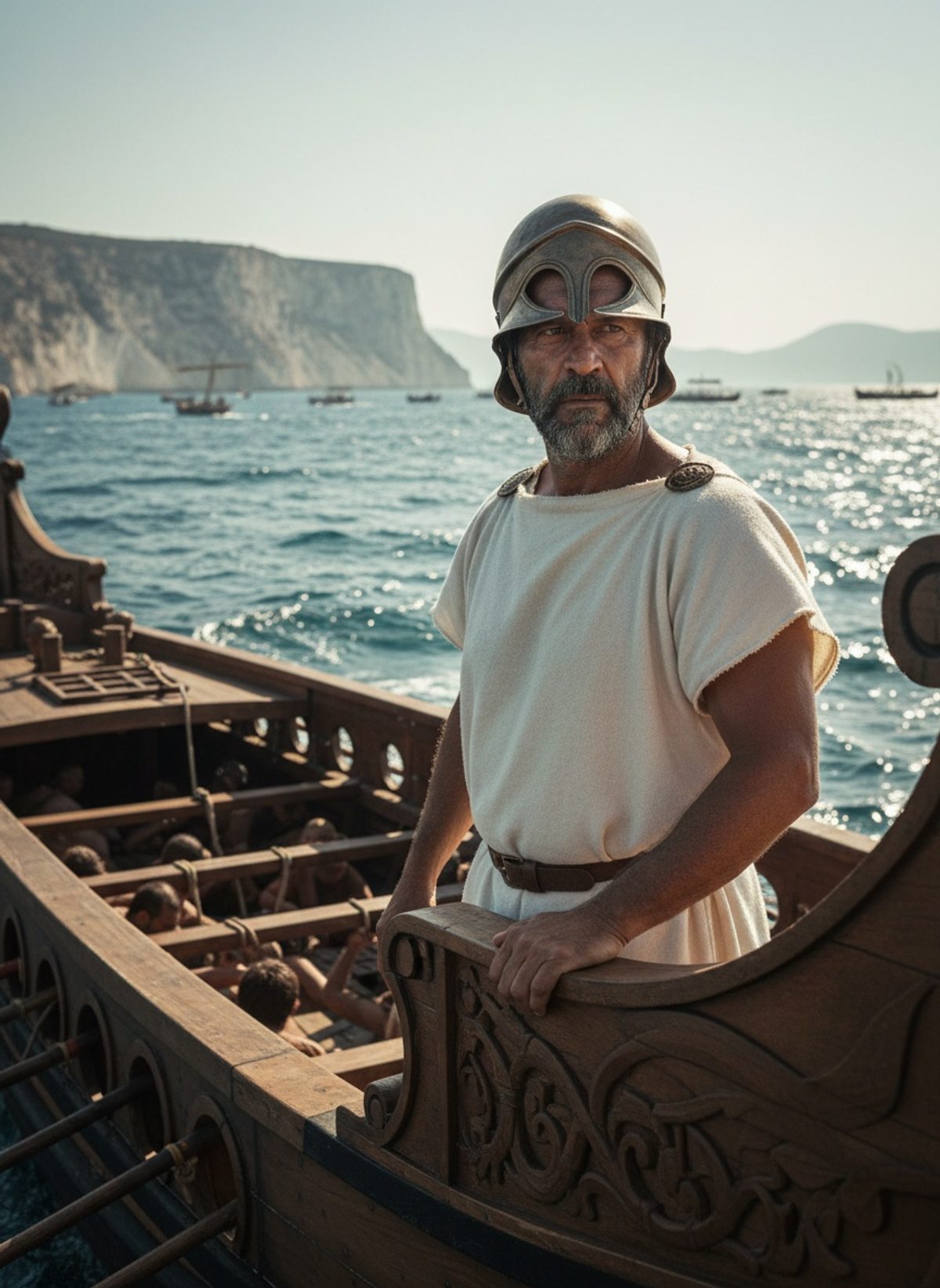
Phormio was fifty. He had already rewritten the rules of naval warfare.
Phormio of Athens was not only a brilliant strategist but also a master navigator, famous for his unfaltering ability to maneuver through desperate situations with a handful of triremes at his command. In 429 BC, amid the throes of the Peloponnesian War, Phormio found himself at the center of what would become one of the most extraordinary naval engagements in ancient history. Against the odds, his forty Athenian ships were staring down a Spartan fleet of two hundred. The sea, vast and daunting, lay between the two forces in the Gulf of Corinth, a theater of contest that would test Phormio's mettle and ingenuity. But to the seasoned commander, retreat wasn't an option. No doubt drawing from his earlier victories at sea, Phormio prepared to rewrite the outcome of battle through sheer tactical genius.
Phormio was no stranger to commanding Athenian forces. His first appearance in the annals of history was in 440 BC during the Samian War, where he shared command with notable figures like Thucydides and Hagnon. His ability to think ahead and outmaneuver opponents quickly became evident as he led his men skillfully in the siege of Potidaea and a subsequent campaign against Athens' enemies in Chalcidice. Fast forward to 429 BC, Phormio had garnered profound respect as a commander when he was stationed at Naupactus, controlling a fleet of twenty triremes tasked with a blockade of Corinthian shipping. The Spartans, feeling the pinch, were orchestrating an assault to break down the Athenian stranglehold and dominate the region.
The Spartan strategy was clear and bold—overwhelm the Athenians with sheer numbers. As the Peloponnesian fleet maneuvered down the south shore of the Corinthian Gulf, intending to cross to Acarnania, Phormio shadowed their movements along the opposite shore. His keen judgment told him that a direct assault on a much larger enemy would be perilous. Instead, he waited for the right moment to strike. This wasn't the first time Phormio considered nature itself as part of his arsenal. The sea, its winds and currents, was to become an unexpected ally.
Read next: Damon Walked Into the Cell. Pythias Walked Free.
The odds were severely tilted against Phormio, who faced a Peloponnesian armada laden with 200 vessels to his 40. Many ships in the opposing fleet carried heavy infantry, increasing the threat exponentially. Upon the enemy’s advance into the open sea, Phormio’s fleet maintained a close formation as they circled warily at a distance. The Peloponnesian commanders, perhaps anticipating a straightforward encounter, pulled their fleet into a protective ring with their prows pointed outward. This formation, robust in theory, was undercut by a subtle weakness that Phormio's naval acumen was quick to identify.
Phormio executed a carefully calculated maneuver by encircling the enemy formation tighter and tighter. Then, as though guided by foresight, Mother Nature intervened. A sudden wind blew across the Gulf, causing chaos among the enemy's crews, who were inadequately trained to handle such an abrupt turn of events. Phormio seized the moment of confusion, plunging his ships into the heart of the disorderly array, teeth bared, cutting the circular formation apart with surgical precision. The panic-stricken Peloponnesians, their oars hopelessly tangling, were no match for the Athenian onslaught. When the dust settled, over a dozen of their ships lay seized by Phormio’s forces.
But the drama was far from over. A second encounter soon followed. Phormio, despite the stinging odds, again defeated an even larger contingent of 77 ships. Seeking to capitalize on their numerical advantage, the Peloponnesians pressed into the Gulf’s narrow straights, hoping to finish what they'd begun. This time, Phormio's ships were split, pursued vigorously into the harbor at Naupactus. Here, one might have expected the Athenian forces to capitulate, but Phormio wasn't one for ordinariness. With a deft pivot, the Athenians executed a daring counterattack, turning their pursuers into confused quarry. The Peloponnesian fleet disbanded in disarray, granting Phormio yet another miraculous victory.
With unmatched audacity and perseverance, Phormio upheld Athenian dominance in the Gulf, rendering all Spartan ventures ineffective for remainder of the war’s early theater. His mastery of the sea’s dynamics and psychological warfare transformed what seemed a prelude to defeat into a beacon of Athenian strength. Despite these triumphs, there would be no record of other notable victories under his command after 428 BC, yet his legacy endured.
The exploits of Phormio stand as an interplay between human ingenuity and nature’s unpredictability. His tenacity under dire circumstances marks a pivotal chapter in naval warfare, proving that sometimes brains can outbalance brawn. The waters of the Gulf of Corinth, in Phormio’s capable hands, highlighted how tactical brilliance could change the course of history. Master foeman, master seaman, his story teaches that strategic innovation often emerges from the brink of imminent catastrophe. Though the world around us has changed, challenges of overwhelming odds remain. From Phormio, we learn that courage, patience, and wit can craft victory from seeming defeat—a timeless lesson depicted by nature's hand in a theater of wooden triremes on a turbulent Grecian sea.