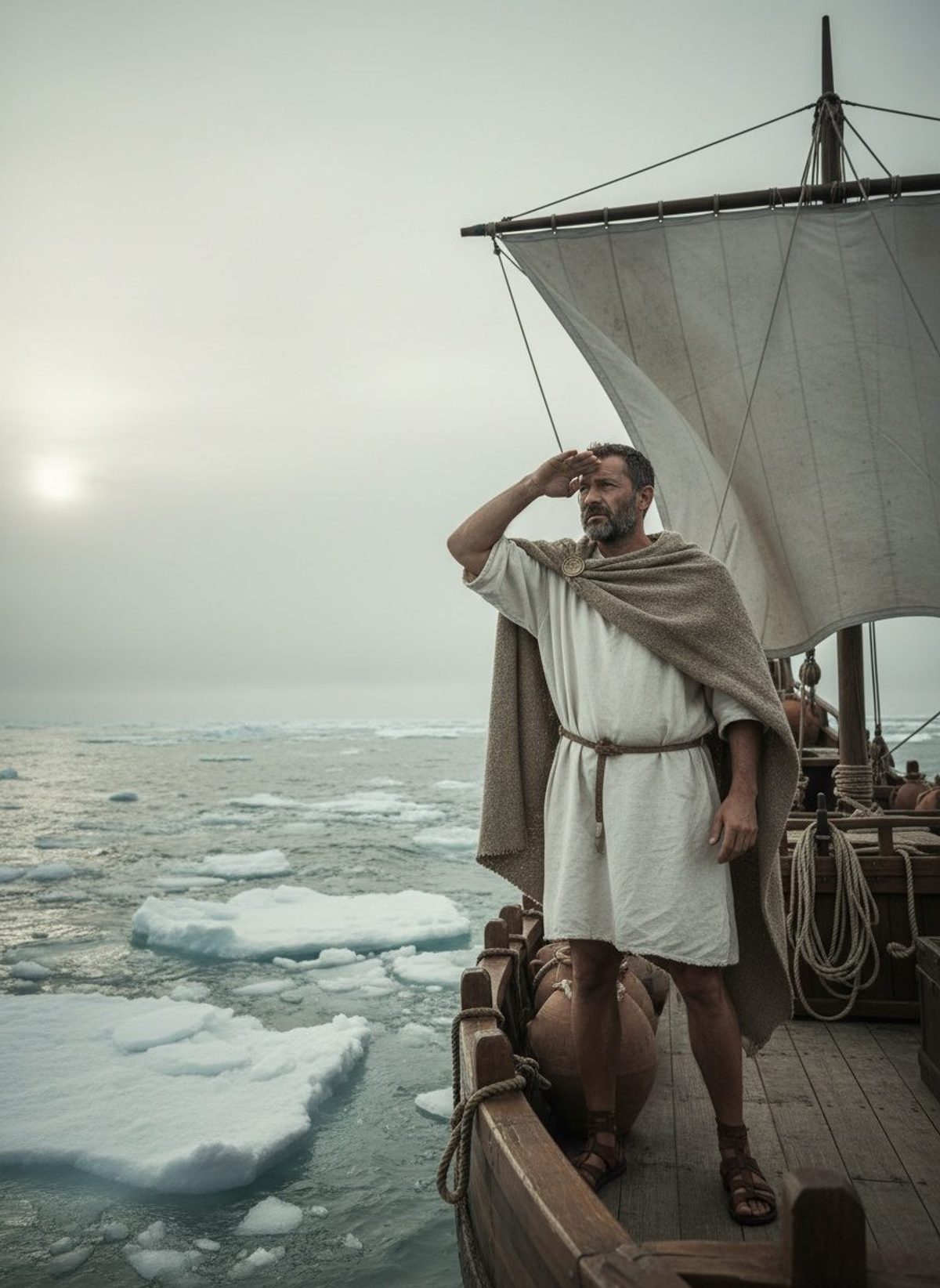
325 BC. The icy waters mirrored the twilight sun.
The Journey Begins
In the bustling port city of Massalia, a hub of commerce and culture in ancient Greece, whispers of the daring voyage planned by Pytheas spread quickly among the merchants and sailors. Known for his insatiable curiosity and enduring fascination with the lands beyond the familiar Mediterranean, Pytheas prepared for a journey that would push the boundaries of the known world. His ambition? To venture further than any Greek had ever dared, past the Atlantic coastline and into waters described only in myths and speculations.
Setting sail alone in an era where navigation relied on the stars and rudimentary maps, Pytheas of Massalia was guided by the promise of discovery. He sailed past the Pillars of Hercules, known today as the Strait of Gibraltar, and entered the vast, unpredictable Atlantic Ocean. For weeks, he traveled north, skirting the western coasts of what are now France and the United Kingdom. As he sailed into the unknown, the familiar landscapes of olive trees and sunbaked hills gave way to unfamiliar shores and colder climates.
To open-water sailors, the Atlantic posed a daunting challenge with its strong currents and unpredictable weather. Yet, Pytheas pressed on, documenting his journey meticulously. He encountered peoples and customs never before chronicled by Greek historians. Most notably, he encountered the fractious yet vibrant tribes of the British Isles, who traded tin—a metal highly prized in Greece. Yet, even as he recorded his observations, he bore witness to phenomena that he knew would be hard for his compatriots to accept—phenomena like the midnight sun that hovered over lands during the endless days of summer.
Read next: Damon Walked Into the Cell. Pythias Walked Free.
Discovering Thule
After months at sea, the increasingly severe climate signaled Pytheas's proximity to the arctic extremities of the North. His writings spoke of passing through the Hebrides and the Orkney Islands of Scotland, describing fierce, paradoxical hospitality: strangers who both welcomed and challenged this lone Greek adventurer. But it was the land beyond, a place he named Thule, that captured Pytheas's imagination—and would later fuel the incredulity of his peers.
Thule, as Pytheas described, lay at the very edges of the world, a place where the sea transitioned from liquid to a strange, icy consistency. Here, days stretched into months of unbroken sunlight, a phenomenon explained only by the distant northern latitude. Pytheas meticulously recorded the natural phenomena he observed, including detailed descriptions of the frozen sea and the slow, rhythmic pulse of the tides.
Though his precise route and the exact location of Thule remain debated, Pytheas's account offered the first explanation of how the moon influences the tides. Such insights suggested a significant understanding of natural laws that surpassed the contemporary knowledge of classical scholars. Yet, the improbability of such remarkable observations—born out of an environment so alien to the Mediterranean experience—would all too easily lead to their dismissal upon his return to familiar shores.
The Return and Skepticism
When Pytheas finally returned to Massalia, he brought with him stories of icebound seas and lands under perpetual daylight. His tales were told with the precision of scientific observation, emphasizing the throbbing rhythm of the tides and the wonders of the Arctic environment. However, to the contemporaries of Pytheas, steeped in the traditions of the known Greco-Roman world, his accounts seemed implausible at best and outrageous at worst.
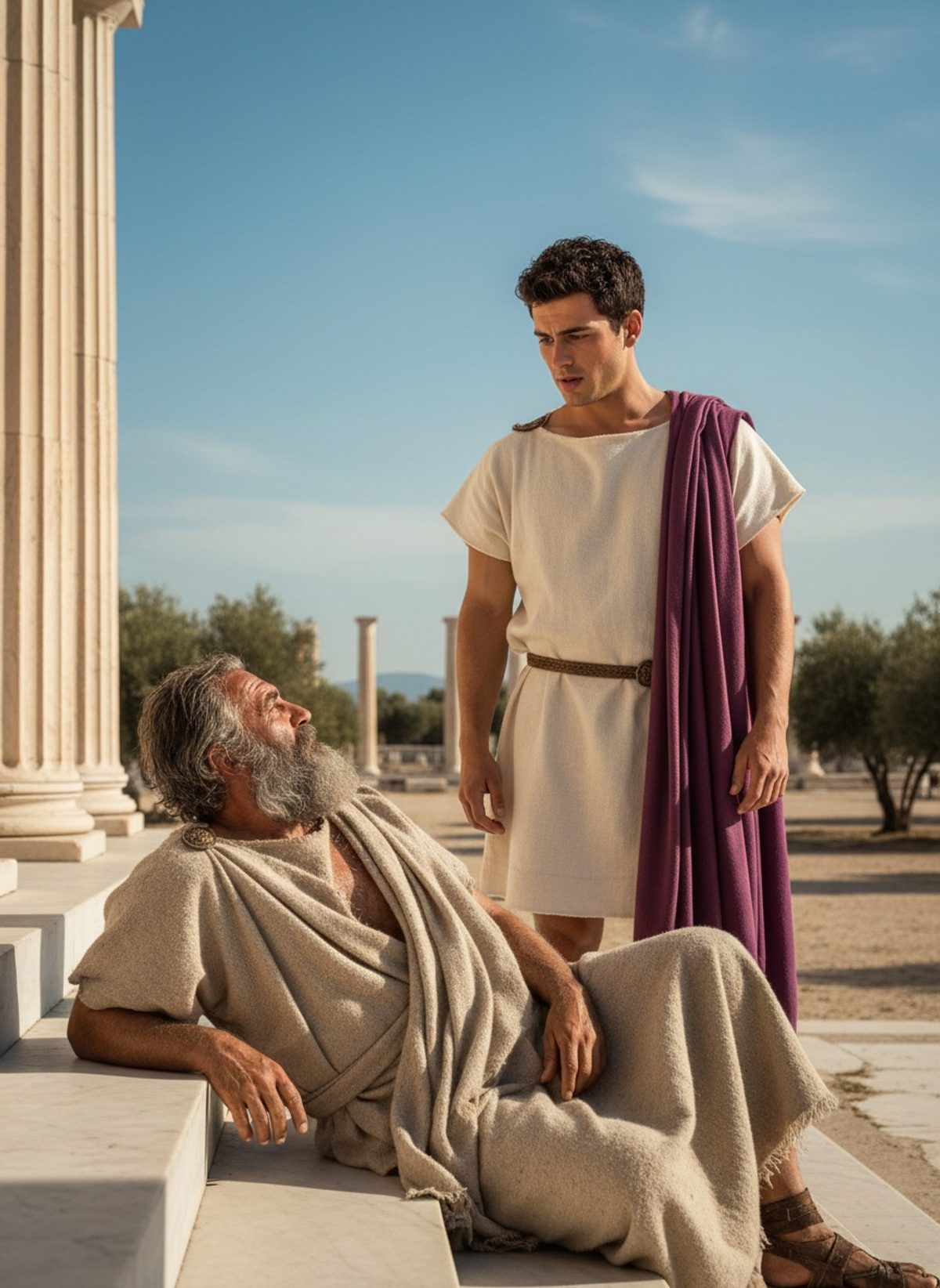
Many of Pytheas's peers, including the learned men of the time, dismissed his reports as fanciful flights of imagination. Men such as the geographer Strabo and the historian Polybius openly questioned the veracity of Pytheas's claims, deeming them impossible based on their limited understanding of the world's geography. Critics were quick to attribute Pytheas's descriptions to deceit rather than daring, skepticism cloaking the truth of his observations in a shroud of disbelief.
Nevertheless, the world would come to vindicate Pytheas, though not until long after his death. The phenomena he described, from the frozen northern seas to the midnight sun, would later be confirmed by generations of explorers who traveled north. Pytheas's insights into tidal mechanics remained largely underappreciated until centuries later, when a more complete understanding of astronomical phenomena validated his accounts. His journey stands as a testament to human curiosity and the courage to chart the unknown, even at the cost of derision from one's own society.
The saga of Pytheas serves as a poignant reminder of the skepticism that often greets pioneers who push the boundaries of human knowledge. In time, his insights proved to be groundbreaking for a civilization that had yet to fully understand the wider world. Yet his story warns us of the danger in dismissing the unbelievable when it springs from earnest inquiry. In every age, true discovery—appearing first as fantasy—reveals the richness and strangeness of a world that continually unfolds and surprises, even in an era suffused with skepticism.