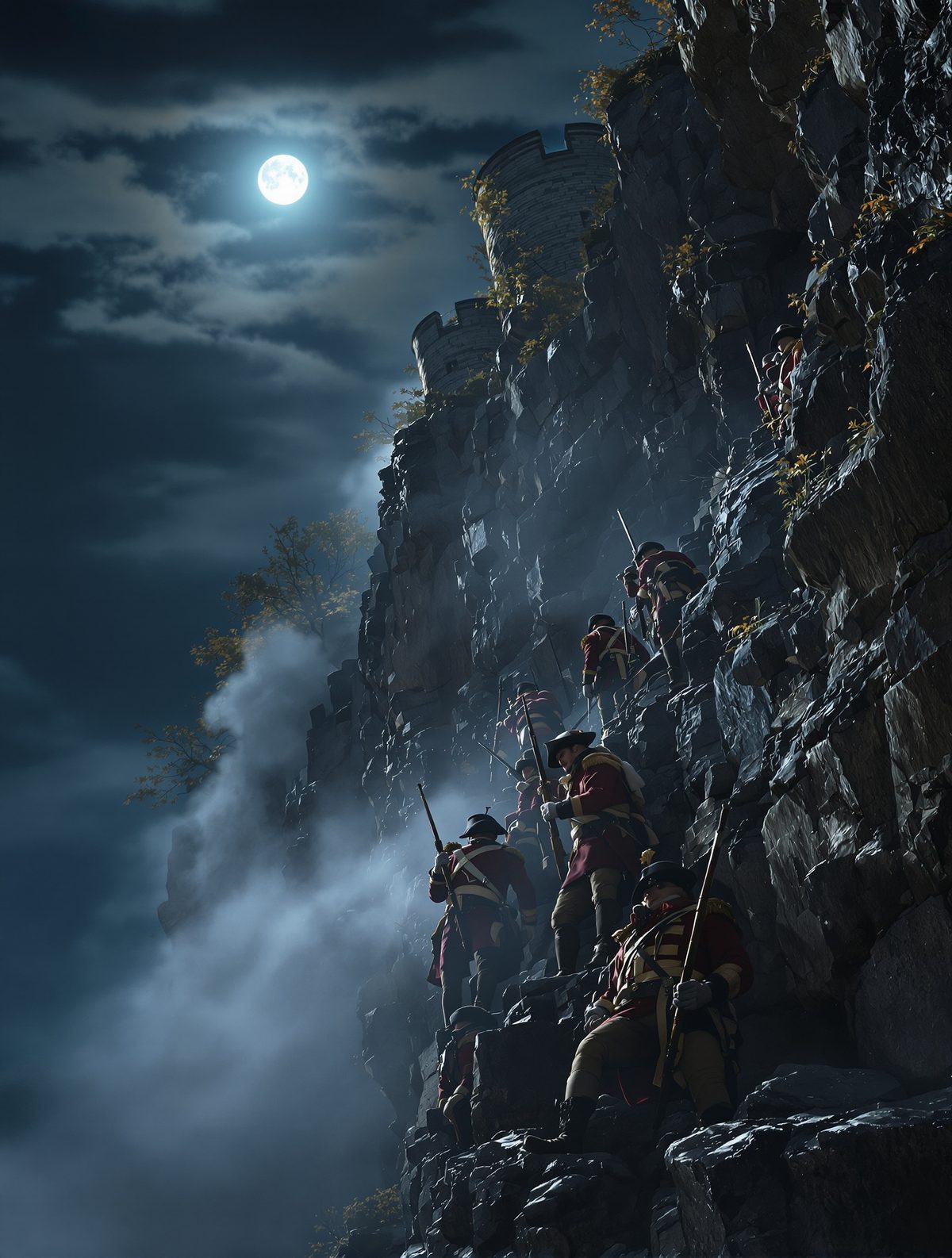
Picture this: 4,000 men clinging to a cliff face in pitch darkness, their boots scraping against limestone as muskets and ammunition weigh down their backs. One slip means death on the rocks below. One cough could alert French sentries above. It's September 13th, 1759, and General James Wolfe is betting the future of an entire continent on what his enemies called an impossible climb.
The cliffs of Quebec loomed 175 feet above the St. Lawrence River—a natural fortress that had kept New France safe for generations. French commander Louis-Joseph de Montcalm was so confident in these towering walls that he'd stationed only a token guard at their summit. After all, who would be mad enough to attempt such a climb?
James Wolfe, apparently. At just 32 years old, this red-headed British general was about to pull off one of military history's most audacious gambles.
The Siege That Nearly Broke Wolfe
By September 1759, Wolfe had been hammering at Quebec's defenses for nearly three months, and frankly, it wasn't going well. His frontal assault at Montmorency Falls in July had been a disaster—210 British casualties for absolutely nothing gained. The fortress city seemed impregnable, perched on its rocky outcrop like a medieval castle transplanted to the New World.
Read next: The Day a Black Sailor Walked Into Court and Freed Himself
Wolfe was running out of time, options, and quite possibly his sanity. His own subordinates were openly questioning his increasingly desperate plans. Brigadier George Townshend was drawing unflattering caricatures of his commanding officer, while Brigadier Robert Monckton worried that Wolfe's obsession with taking Quebec was clouding his judgment.
But Wolfe had spotted something his officers missed. During one of his reconnaissance missions along the river, he'd noticed a narrow goat path zigzagging up the cliff face at a spot called Anse-au-Foulon (now Wolfe's Cove). The French called it Anse du Foulon—"Foulon's Cove"—after a local farmer. It was so steep and treacherous that Montcalm had dismissed it as a non-threat.
Here's what the textbooks often leave out: Wolfe almost didn't live to see his moment of glory. The general was seriously ill, possibly with tuberculosis, kidney stones, or both. He was regularly dosed with laudanum for the pain and had to be helped into his uniform some mornings. His officers genuinely feared he might die before the campaign ended.
The Plan That Shouldn't Have Worked
Wolfe's plan was audacious to the point of madness. Under cover of darkness, a handpicked force would drift silently downriver in flat-bottomed boats, scale the "unclimbable" cliffs, overwhelm the small French guard post, and establish a beachhead. Then, if they weren't all dead by morning, they'd fight a pitched battle on the Plains of Abraham—the flat ground just outside Quebec's walls.
Everything had to go perfectly. The boats had to avoid French sentries along the riverbank. The tide had to be just right. The advance party had to eliminate the French guards without raising an alarm. And 4,000 men had to climb a cliff face in the dark without modern climbing equipment.
Oh, and there was one more delicious detail: the plan relied partly on French incompetence. Wolfe knew that supply boats regularly drifted down the river at night to reach Quebec. When French sentries called out challenges in the darkness, a French-speaking officer named Captain Donald MacDonald would answer back in perfect French, claiming to be a supply convoy. The ruse worked—several times.
On the night of September 12-13, Wolfe made his final preparations. He'd reportedly spent the evening reciting Thomas Gray's "Elegy Written in a Country Churchyard" to his officers, famously declaring he'd rather have written that poem than take Quebec. Whether this actually happened or became part of the Wolfe legend later, we'll never know—but it perfectly captures the melancholy fatalism that seemed to grip him.
The Climb in the Darkness
At 2 AM on September 13th, the boats pushed off from the British fleet. No talking. No lights. Just the sound of water lapping against hulls and the creak of oars in their locks. Wolfe crouched in the lead boat, probably wondering if he was leading his men to victory or wholesale slaughter.
The first challenge came immediately. French sentries spotted the boats but were fooled by Captain MacDonald's impersonation. "Who goes there?" came the call from the darkness. "La France!" MacDonald replied. "Et vive le roi!" The boats drifted past in silence.
Then came the climb itself. The advance party, led by Captain William DeLaune and a company of light infantry, went first. They hauled themselves up using roots, rocks, and whatever handholds they could find. Behind them came the main force—4,000 men scaling a cliff face that would challenge modern rock climbers with proper equipment.
Here's a detail that brings the whole scene into sharp focus: the men had to climb in complete silence while carrying muskets, ammunition, and equipment. Some tied their weapons to their backs. Others passed them up hand-to-hand. One dropped musket could have shattered on the rocks below and alerted every French sentry within miles.
The climb took hours. Men slipped and were caught by their comrades. Equipment had to be hauled up by rope. At any moment, a French patrol could have appeared at the cliff top and ended the whole enterprise with a few well-placed musket volleys.
Dawn on the Plains of Abraham
But somehow, impossibly, it worked. By dawn, 4,000 British soldiers stood on the Plains of Abraham in battle formation. When the French guards at the Samos Battery spotted them, they must have thought they were hallucinating. How had an entire army appeared overnight on ground the French considered unreachable?
Montcalm's reaction was swift and, in hindsight, probably wrong. Rather than waiting for reinforcements from other parts of the city's defenses, he chose to attack immediately with the forces at hand. Perhaps he thought the British position was still precarious. Perhaps he feared that delay would only allow Wolfe to strengthen his foothold. Either way, at 10 AM, French forces advanced across the plains.
Read next: The Day a London Clerk Walked Into Court for a Dying Slave
The battle that followed was brief but decisive. Wolfe deployed his men in the classic British line formation—two ranks deep, every musket aimed at the approaching French columns. At 40 yards, the British fired a devastating volley that shattered the French advance. A second volley sent Montcalm's forces into retreat.
Both commanders paid the ultimate price for their audacity. Montcalm, wounded by grapeshot, died the next morning. Wolfe took three bullets—in the wrist, the groin, and finally the chest—but lived long enough to hear that the French were retreating. "Now God be praised, I will die in peace," he reportedly said, though like many famous last words, this may be more legend than fact.
The Impossible Gamble That Changed History
The fall of Quebec effectively ended French power in North America. Though fighting continued for another three years, New France was finished. The British now controlled the continent from Hudson Bay to the Gulf of Mexico—setting the stage for everything that followed, from the American Revolution to the expansion westward.
But here's what makes Wolfe's cliff assault truly extraordinary: it succeeded despite violating nearly every principle of military common sense. Attacking uphill against a fortified enemy? Terrible idea. Dividing your forces in the face of the enemy? Military suicide. Gambling everything on a single desperate throw? The kind of plan that gets you court-martialed if it fails.
Yet sometimes the impossible plan works precisely because it's impossible. Montcalm's confidence in those cliffs was so complete that he'd left them virtually unguarded. The French military establishment couldn't imagine anyone attempting such a climb, which is exactly why it succeeded.
Today, you can visit the spot where Wolfe's men made their historic ascent. Modern Quebec City has grown around the Plains of Abraham, but the cliffs remain as steep as ever. Standing at the bottom and craning your neck upward, it's hard to believe anyone attempted such a climb, let alone succeeded with 4,000 men in the dark.
Wolfe's desperate gamble reminds us that history's turning points often hinge on moments of individual audacity—those pivotal instances when someone looks at the impossible and decides to try anyway. In our age of calculated risks and focus-grouped decisions, there's something both thrilling and terrifying about a plan that succeeded simply because it was too crazy to expect.