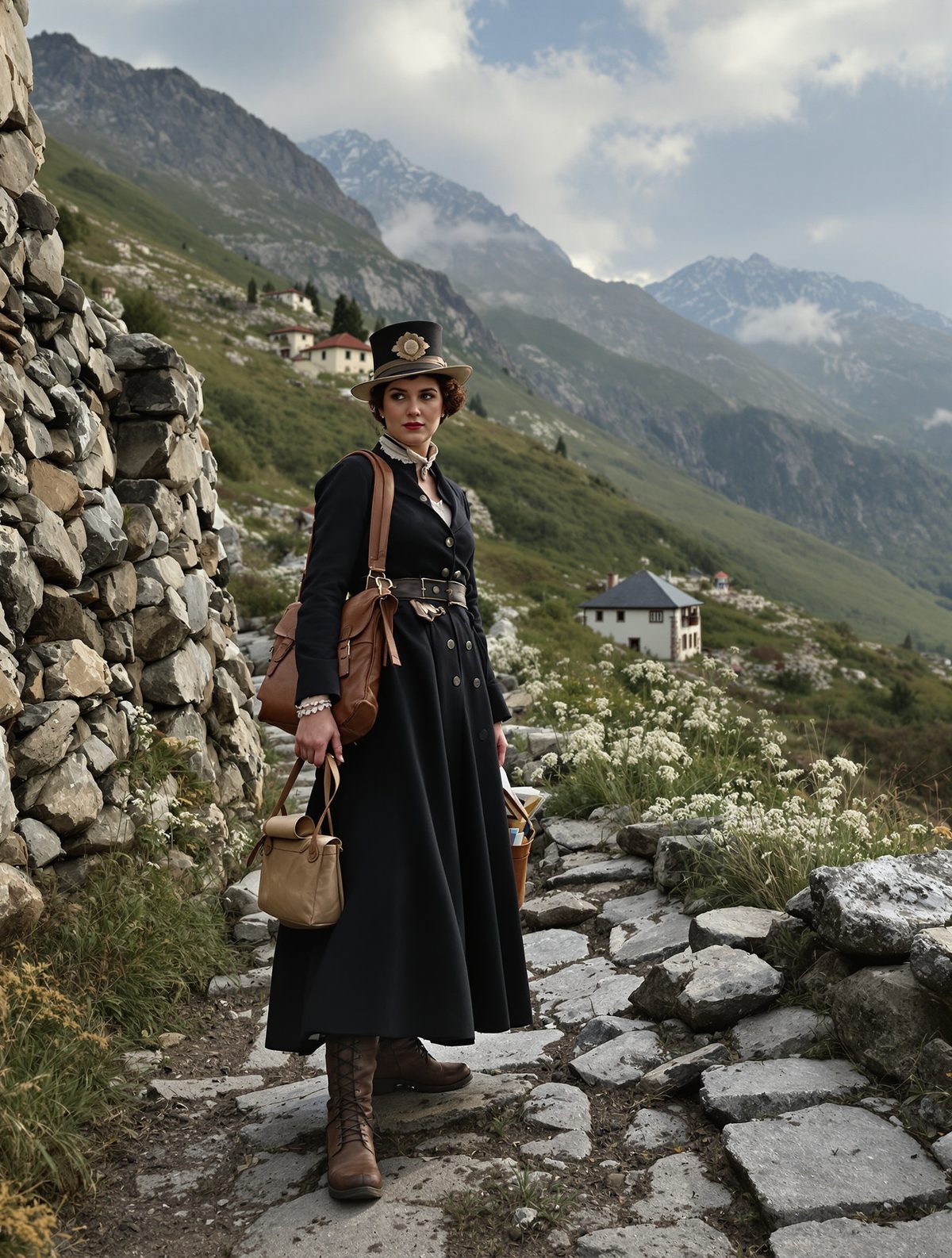
The rifle barrels glinted in the Albanian sun as two dozen mountain warriors surrounded the slight English woman in her dusty traveling clothes. She was three days' hard ride from the nearest British consul, armed with nothing but a sketching pad and an umbrella. Any sensible person would have been terrified. Instead, 37-year-old Edith Durham calmly opened her medical bag and began treating the infected wound of their chieftain's son. It was August 1900, and she was about to become the most unlikely diplomatic force the Balkans had ever seen.
Back in London, the Foreign Office had been blunt: venture into the Albanian highlands and you'll be murdered within a week. The Ottoman officials in Constantinople were equally pessimistic. Even the seasoned travelers at the Royal Geographical Society shook their heads. But Durham had already made up her mind. What had started as a recuperative holiday from nursing her invalid mother was about to transform into a three-decade odyssey that would make her the most trusted mediator in one of Europe's most volatile regions.
The Spinster Who Wouldn't Stay Put
Edith Mary Durham was born in 1863 into comfortable middle-class respectability in Belgravia. Her father was a surgeon, her expectations thoroughly conventional: marriage, children, and a life lived within the narrow confines of Victorian propriety. But Durham had always been different. She studied at Bedford College when few women attended university, learned to paint with enough skill to exhibit at the Royal Academy, and possessed what her contemporaries politely called "an independent spirit."
When her mother died in 1900, Durham faced the classic Victorian spinster's dilemma: fade into genteel obscurity or forge her own path. She chose adventure. Her first destination was Montenegro, then still a wild principality where tribal law trumped Ottoman authority. Most Victorian ladies traveled with companions, servants, and enough luggage to stock a small hotel. Durham packed light: sturdy boots, practical clothes, art supplies, and a basic medical kit that would prove worth its weight in gold.
Read next: The Day a Cornish Surgeon Walked Into a Condemned Cell
The journey from London to the Montenegrin capital of Cetinje took six days by train and carriage. What she found there astonished her. This wasn't the "primitive" backwater described in British newspapers, but a complex society with its own honor codes, ancient traditions, and fierce independence. When local officials warned her against venturing into the Albanian territories beyond their borders, Durham's response was characteristically direct: "If they can live there, so can I."
Into the Land That Time Forgot
Northern Albania in 1900 was Europe's last frontier. The Ottoman Empire's writ barely extended beyond the main towns, leaving the mountain clans to govern themselves according to the Kanun — a 15th-century legal code that prescribed blood feuds lasting generations. Murder was not just common but obligatory under certain circumstances. Hospitality to guests was sacred, but step outside your host's protection and you might not live to see sunset.
Durham's first expedition into this landscape took her up the treacherous mountain paths to Nikaj, a remote valley where the chieftain, Ded Gjo Luli, held court like a medieval king. She traveled by mule, slept in stone towers built for defense, and ate whatever her hosts provided — often just cornbread and sheep's cheese. Her sketching pad caused immediate fascination; many of the mountain people had never seen accurate drawings before, and word spread that the English woman could capture a person's soul on paper.
But it was her medical knowledge that truly opened doors. Durham had trained in basic nursing and first aid, skills that were desperately needed in regions where the nearest doctor might be a week's journey away. She cleaned wounds, treated fevers, and delivered babies. In return, the mountain clans offered her their most precious gift: trust. Within months, tribal leaders who had been feuding for decades were asking the "English sister" to mediate their disputes.
The Queen of the Mountain People
Durham's transformation from tourist to tribal diplomat happened gradually, then all at once. By 1903, she was spending months at a time in the mountains, learning Albanian dialects and documenting customs that had remained unchanged since the Middle Ages. She witnessed blood feuds that had claimed hundreds of lives over imagined slights, but also saw how quickly these ancient enemies could unite against outside threats.
Her breakthrough moment came in 1908, when a dispute between two powerful clans threatened to engulf the entire Mirdita region in warfare. Ottoman officials had given up trying to restore order. Local priests had been ignored. Then someone suggested sending for "Edith of the English" — Durham's Albanian nickname. She arrived to find over 300 armed men glowering at each other across a valley, each side convinced that honor demanded bloodshed.
What happened next became legend throughout the Albanian highlands. Durham pitched her tent exactly halfway between the two camps and announced she would not leave until the chiefs agreed to meet. For three days, neither side moved. On the fourth morning, curiosity got the better of them. The negotiations took two weeks, conducted in a mixture of Albanian, Turkish, and sign language, with Durham serving as translator, mediator, and often the only voice of reason in the room.
The agreement she brokered prevented what could have been years of fighting. More importantly, it established her reputation as someone who could achieve the impossible. From that moment, Durham found herself at the center of Albanian politics, consulted by everyone from village elders to would-be revolutionaries plotting independence from Ottoman rule.
Artist, Anthropologist, and Accidental Spy
Durham never intended to become a political figure, but in early 20th-century Albania, neutrality was impossible. The Ottoman Empire was crumbling, Austria-Hungary and Italy were eyeing Albanian territory greedily, and local nationalist movements were gaining strength. Durham found herself uniquely positioned to observe and influence events that would reshape the Balkans.
Her sketches and photographs from this period provide an invaluable record of a vanishing world. She documented traditional costumes that would soon disappear, recorded folk songs that existed nowhere else, and mapped regions that appeared as blank spaces on European charts. Her books, including "High Albania" (1909) and "The Burden of the Balkans" (1905), introduced English readers to a culture they knew nothing about.
But Durham was also gathering intelligence. Her reports to the Foreign Office, recently uncovered in British archives, reveal the depth of her political knowledge. She tracked troop movements, reported on local sentiment, and provided early warnings of brewing conflicts. When the First Balkan War erupted in 1912, Durham's predictions proved remarkably accurate.
Read next: The Day a Vicar's Son Walked Into a Debtor's Cell and Freed Them All
The creation of independent Albania in 1913 owed much to her advocacy. Durham had spent years arguing that the Albanian tribes, despite their feuds, shared a common identity and deserved self-determination. When the Great Powers finally agreed to Albanian independence, they consulted Durham's maps to draw the new nation's borders.
The Long Goodbye
World War I ended Durham's golden age in the Albanian mountains. The country became a battlefield, occupied successively by Serbian, Austrian, Italian, and French forces. Durham spent the war years in London, writing, lecturing, and raising funds for Albanian refugees. When she finally returned in 1921, she found a world transformed.
The old tribal leaders were dead or displaced. A new generation of Albanian politicians, educated in European universities, had little use for the English woman who had mediated their fathers' quarrels. Durham continued visiting until the early 1930s, but Albania was becoming a modern dictatorship under King Zog, and there was no place for freelance diplomats.
She made her final journey to the Balkans in 1933, aged 70, to attend the funeral of Crown Prince Danilo of Montenegro. The tribal chiefs who gathered to pay their respects still called her their "English mother," but the world they had shared was disappearing. Durham returned to London, where she lived quietly until her death in 1944, just as another war was consuming the region she had loved.
The Legacy of an Unlikely Peacemaker
Today, as diplomats struggle to resolve conflicts from Syria to Ukraine, Edith Durham's methods seem almost quaint. She carried no official credentials, commanded no armies, and controlled no budgets. Her authority came from something more fundamental: genuine respect for the people she worked with and an unshakeable belief that even the most bitter enemies could find common ground.
In an age of professional peace-builders and conflict resolution experts, Durham's story reminds us that sometimes the most effective diplomats are those who arrive not with briefing papers and strategic objectives, but with simple human curiosity and the willingness to listen. She succeeded where governments failed because she understood what too many officials miss: that lasting peace comes not from imposed solutions but from helping people discover their shared humanity.
The Victorian spinster who packed her sketching pad for what she thought would be a brief holiday adventure became something far more significant — proof that one person, armed with nothing but courage and compassion, can indeed change the world.