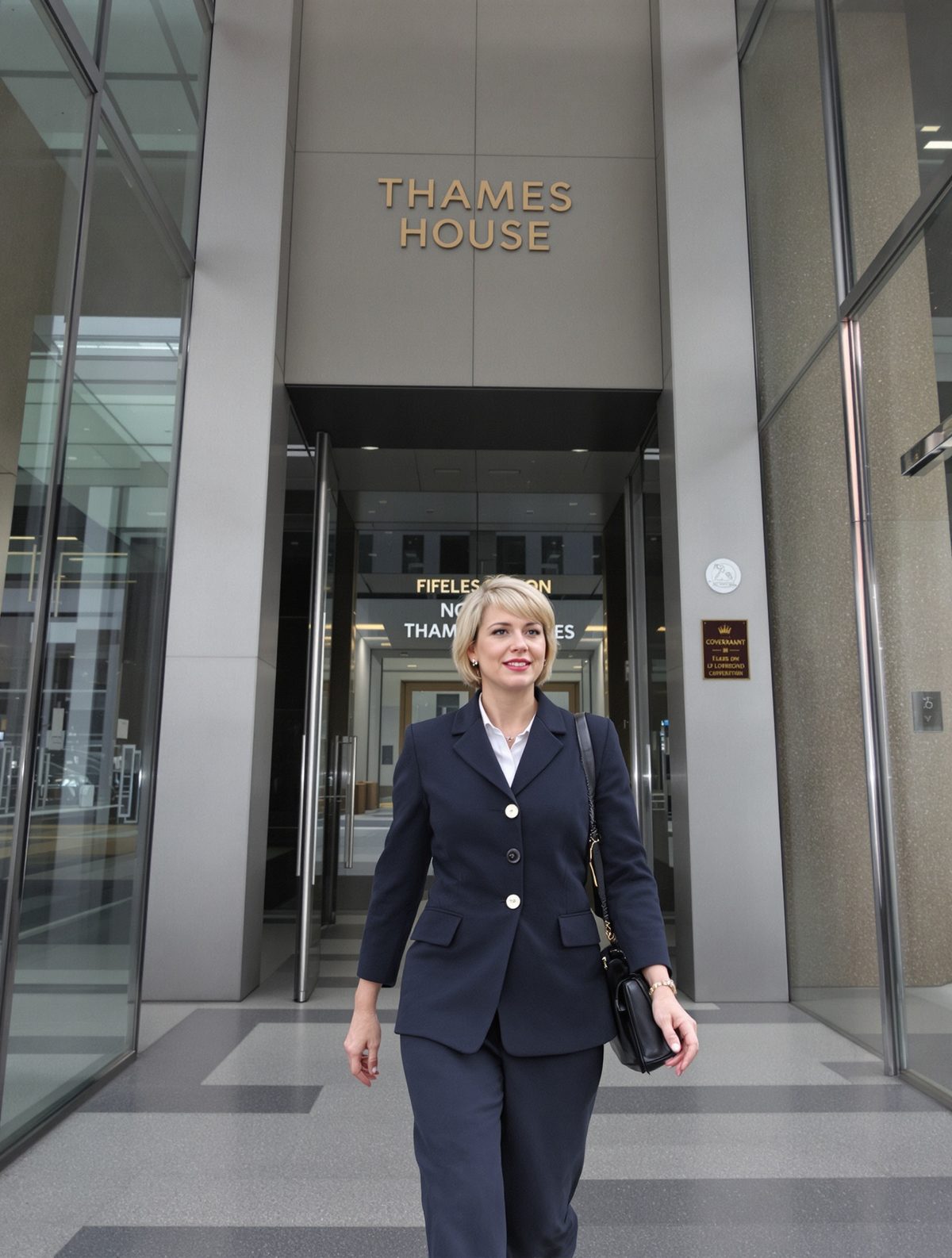
On a crisp December morning in 1992, photographers gathered outside Thames House on the South Bank of the River Thames, their cameras trained on the imposing Art Deco building that housed Britain's Security Service. For 83 years, no lens had ever captured the face of an MI5 Director General. The very idea was preposterous – these were the ultimate men in the shadows, their identities as classified as the state secrets they guarded. But today, everything was about to change.
Walking through those doors was Dame Stella Rimington, a 57-year-old grandmother who had just done something that would have been unthinkable to the founding fathers of MI5: she had become not only the first woman to lead Britain's domestic intelligence service, but the first Director General whose name and photograph would grace newspaper front pages across the nation.
The old boys' club of British intelligence was about to get a very public wake-up call.
The Secret Service That Wasn't So Secret Anymore
To understand the magnitude of Rimington's appointment, you have to grasp just how obsessively secretive MI5 had been since its founding in 1909. For eight decades, the Service had operated under what intelligence historians call "the doctrine of deniability" – officially, it didn't even exist. Parliament couldn't question its activities, journalists couldn't report on its operations, and its Director General was known only by the mysterious designation "Director General of the Security Service" in Whitehall's most classified documents.
Read next: The Day a Cornish Surgeon Walked Into a Condemned Cell
Even within the intelligence community, MI5's chiefs were legendary for their invisibility. Vernon Kell, the Service's first Director General, was so secretive that when he attended meetings at the War Office, other officials were told simply that he represented "a special department." His successors maintained this tradition with religious devotion – some didn't even tell their own families exactly what they did for a living.
But by the early 1990s, this wall of secrecy was crumbling. The end of the Cold War had fundamentally changed the intelligence landscape, and Prime Minister John Major's government was under pressure to make Britain's security services more accountable to democratic oversight. In 1989, MI5 had been officially acknowledged for the first time. Now, in a move that sent shockwaves through the intelligence community, they were about to give it a very public face.
The Unlikely Spymaster
Stella Rimington was hardly the stereotypical candidate for Britain's top spy job. Born in South London in 1935, she had started her career as a secretary – a role that, in the 1960s intelligence world, was seen as definitively auxiliary. She joined MI5 in 1969, initially working on what the Service euphemistically called "protective security" – essentially, making sure sensitive government departments weren't infiltrated by hostile agents.
What made Rimington different wasn't just her gender – it was her approach. While her male colleagues often came from military backgrounds or the rarified world of Oxbridge academia, she brought something refreshingly practical to the job. During her early years, she specialized in counter-subversion work, tracking Soviet agents and monitoring communist organizations in Britain. She wasn't interested in the gentlemanly traditions of intelligence work; she wanted results.
Her big break came in the 1980s when she took charge of MI5's counter-espionage operations. This wasn't a ceremonial role – Britain was still very much in the grip of the Cold War, and Soviet intelligence services were running some of their most sophisticated operations ever on British soil. Under Rimington's leadership, MI5 successfully identified and neutralized several major spy rings, including operations that had penetrated the heart of British military research.
But perhaps most remarkably, Rimington managed to rise through MI5's ranks while raising two daughters and maintaining what she insisted was a normal family life. In a service where officers traditionally lived monk-like existences devoted entirely to the crown's secrets, this was revolutionary.
Breaking the Ultimate Boys' Club
When Conservative Home Secretary Kenneth Clarke announced Rimington's appointment on December 16, 1992, the reaction was immediate and explosive. The Daily Mail ran the headline "The Spy Who Came In From The School Run," while The Sun went with "MI5's Mum's The Word." Suddenly, Britain's most secretive organization had a human face – and it belonged to a woman who shopped at Marks & Spencer and worried about her daughters' university applications.
Inside Thames House, the reaction was more complex. Many of Rimington's colleagues were genuinely supportive – she had earned their respect through two decades of exceptional service. But there was also significant resistance from what she later described as "the old guard." Some senior officers were horrified by the publicity surrounding her appointment. They argued that making the Director General's identity public compromised operational security and broke with traditions that had served MI5 well for nearly a century.
The criticism wasn't just about secrecy – it was about gender. In her memoirs, Rimington revealed that some colleagues questioned whether a woman could handle the pressures of leading Britain's domestic intelligence service. One senior civil servant reportedly wondered aloud whether she would be "tough enough" to make the hard decisions that the job required.
They would soon find out just how tough Stella Rimington could be.
The Media Circus and the Security Nightmare
Rimington's public profile created unprecedented challenges for MI5's security team. For the first time in the Service's history, they had to protect a Director General whose face was plastered across newspaper front pages and whose home address was theoretically discoverable through public records. The Service's protective security department had to completely reinvent their procedures.
The media attention was relentless. Photographers camped outside her London home, hoping to catch glimpses of Britain's spy chief walking her dog or collecting her mail. Television news programs ran features about "the housewife spy," complete with speculation about how she balanced running MI5 with domestic responsibilities. The Times even published details about her shopping habits and favorite restaurants.
What many journalists missed, however, was that Rimington was using this publicity strategically. In a series of carefully planned public appearances and speeches, she began the delicate work of making MI5 more transparent and accountable while maintaining operational effectiveness. She testified before Parliamentary committees, gave interviews to selected journalists, and even wrote articles explaining MI5's role in post-Cold War Britain.
This was revolutionary. Previous Director Generals had been so secretive that most Members of Parliament didn't even know their names. Now, Rimington was actively engaging with democratic oversight, explaining MI5's work to the very people it was supposed to protect.
Read next: The Day a Vicar's Son Walked Into a Debtor's Cell and Freed Them All
Transforming Britain's Secret Service
During her four years as Director General, Rimington transformed MI5 from a Cold War relic into a modern intelligence service capable of handling 21st-century threats. She shifted resources away from monitoring communist organizations (which, with the Soviet Union's collapse, were no longer significant threats) toward counter-terrorism, organized crime, and what would later be called cyber security.
Perhaps more importantly, she began the process of making MI5 a more diverse and representative organization. When she took over, the Service was overwhelmingly white, male, and recruited from a narrow slice of British society. Under her leadership, MI5 actively began recruiting women, ethnic minorities, and people from non-traditional backgrounds. She argued that to understand and counter modern threats, the Service needed officers who reflected the diversity of modern Britain.
This wasn't just political correctness – it was operational necessity. The IRA bombing campaigns of the 1990s required intelligence officers who could blend into different communities. Monitoring organized crime syndicates required linguistic skills and cultural knowledge that the traditional MI5 officer corps simply didn't possess.
By the time Rimington retired in 1996, she had overseen the most dramatic transformation in MI5's history. The Service was more professional, more accountable, and more effective than it had ever been. She had also established the principle that Britain's intelligence services should be led by the most qualified candidates, regardless of gender.
The Legacy of the Visible Spymaster
Today, the idea of a secret intelligence chief seems almost quaint. Rimington's successors at MI5 routinely give public speeches, testify before Parliament, and maintain professional social media profiles. The heads of MI6 and GCHQ have followed suit, becoming public figures who explain their organizations' work to democratic audiences.
But Stella Rimington's real legacy isn't just about transparency – it's about proving that excellence in intelligence work has nothing to do with gender, class background, or adherence to traditional boys' club customs. In a profession that had been defined by exclusivity and secrecy, she demonstrated that diversity and openness could actually enhance security rather than compromise it.
As we face new challenges in an age of global terrorism, cyber warfare, and disinformation campaigns, the intelligence services that protect us look very different from the gentlemen's clubs of the Cold War era. They are more diverse, more accountable, and more connected to the democratic societies they serve. That transformation began on a December morning in 1992, when a grandmother from South London walked into Thames House and changed British intelligence forever.