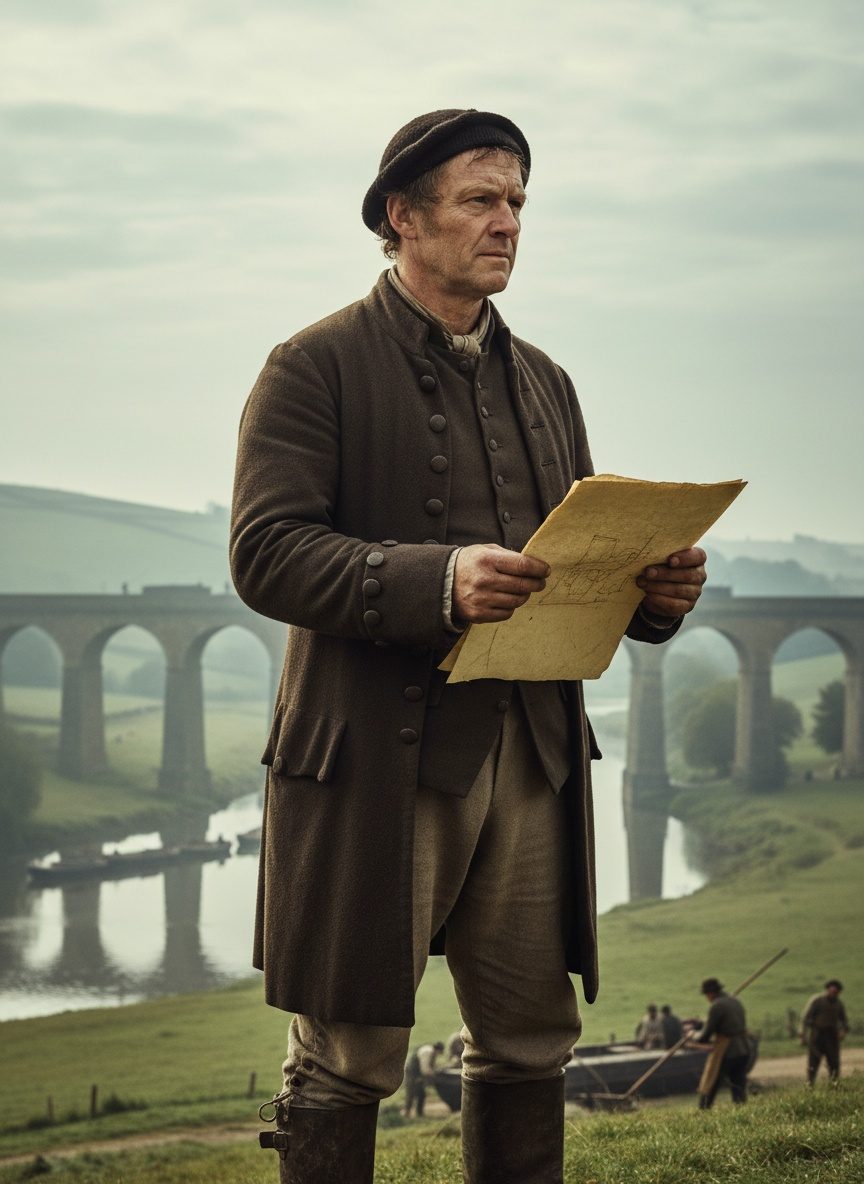
Close your eyes and imagine the quiet charm of 18th-century England, a time when horses plodded muddy roads and small towns bustled with the vibrant exchange of goods in flickering candlelight. The year is 1766, and England is on the cusp of transformation, though most don’t yet see it. Somewhere in the heart of this industrious nation, a blacksmith’s son sits at a table, fingers stained with ink he can barely read, ears straining to catch the faintest whispers of conversation. Yet within his mind lies a vision—an untapped network of waterways that could revolutionize transport and trade. This is the tale of James Brindley, the man who held the rivers and canals of Britain in his mind, mapping them not with pen and paper, but with a memory you’d scarcely believe.
The Unlikely Engineer
James Brindley was born in 1716, in the modest hamlet of Tunstead in Derbyshire. The son of a blacksmith, his upbringing offered no foreshadowing of the brilliance to come. By age 17, he had apprenticed himself to a millwright, a decision that would set him on an uncharted course. The craft was not just in his hands but in his mind, for Brindley had a rare talent: an ability to visualize and manipulate complex mechanical systems in his imagination.
At the time, England's roads were notoriously poor, making land travel cumbersome and limiting economic development. The Industrial Revolution was whispering at the door, but without efficient transport routes, progress stalled. Though Brindley could neither spell his name consistently nor hear clearly, his lack of formal education never impeded him—his work spoke volumes. His reputation grew as he transformed clunky watermills into efficient marvels, turning grains into flour with surgical precision.
A Bold New Vision
Brindley's notoriety brought him to the attention of the Duke of Bridgewater, who was keen to transport coal from his mines in Worsley to the booming markets of Manchester. In 1759, Brindley faced his first foray into canal building—a project that would either cement his legend or unravel his dreams. Without any formal plans, he embarked on what would become the Bridgewater Canal, an aqueduct of staggering imagination.
Read next: The Day a Baronet Stood Up in Court and Freed His Slaves
Many at the time saw canals as impractical folly, but Brindley envisioned a gleaming network of water roads knitting together the scattered industries of Britain. His aqueduct was poised to cross the River Irwell without disrupting its flow—a feat unheard of at the time. When questioned by Parliament, Brindley stunned the committee with not diagrams but with words, explaining each turn and elevation as vividly as though it were already stirring in front of them.
The Day Parliament Fell Silent
Brindley's pitch to Parliament was no ordinary presentation. As they questioned him on the plausibility of water crossing water, Brindley fetched a small round cheese and set it in the middle of the table. With deft precision, he carved canals into its surface, demonstrating precisely how his aqueduct would rise above the river. His impromptu model rendered the skeptics speechless. Not one drawing needed, his audacity and eloquence painted a vision that would change Britain’s landscape forever.
The Bridgewater Canal opened in 1761 to great success, changing the very pace at which the country moved. Transporting goods by canal slashed costs significantly; what used to take a packhorse forty shillings and Manchester a fortnight to deliver could now travel for just four shillings in as little as two days.
Mapping with Memory
Inevitably, success begot more opportunities. By 1764, Brindley steered the construction of the Grand Trunk Canal, a colossal project connecting the Trent and Mersey Rivers across 93 miles and rising over 500 feet. Brindley managed his projects by storing sheer volumes of information in his head, coordinating efforts without blueprints or sketches. He was known to construct intricate models to help collaborators visualize the plan he held within him, his mind serving as the Grand Master of multiple terrains.
His method was so unconventional, it had contemporaries shaking their heads in bemusement and admiration. As if stepping inside his mental map, Brindley could grasp the network’s vast scope, all while planning each nook and cranny as if it were a cherished garden path.
The Legacy of a Genius
James Brindley passed away in 1772 at the age of 56, barely a decade after his projects changed the course of British commerce and civilisation. His canals, though pioneering in themselves, were dwarfed by the impact they had on the future of engineering and industry. Britain’s waterways, as envisioned by Brindley, would inspire a full sweep of canals that formed the nation's lifeblood, ushering in the industrial age.
In today’s world of profound technological advancements, it’s easy to overlook the profound simplicity of Brindley’s vision. He didn’t just build canals—he wove threads that stitched the very fabric of Britain's socioeconomic makeup. Today’s engineers, armed with advanced degrees and cutting-edge technology, still gaze back in respect and awe at a man who shaped the land with a mind as precise as any modern computer.
So as you traverse Britain’s waterways, remember the son of a blacksmith who couldn’t spell his own name but mapped an empire’s rivers. Remember how one mind harnessed the power of nature and engineering to propel a nation into its future. James Brindley’s legacy is a reminder that sometimes vision, when combined with unwavering determination, can lay the foundation for greatness in the most unexpected of forms.