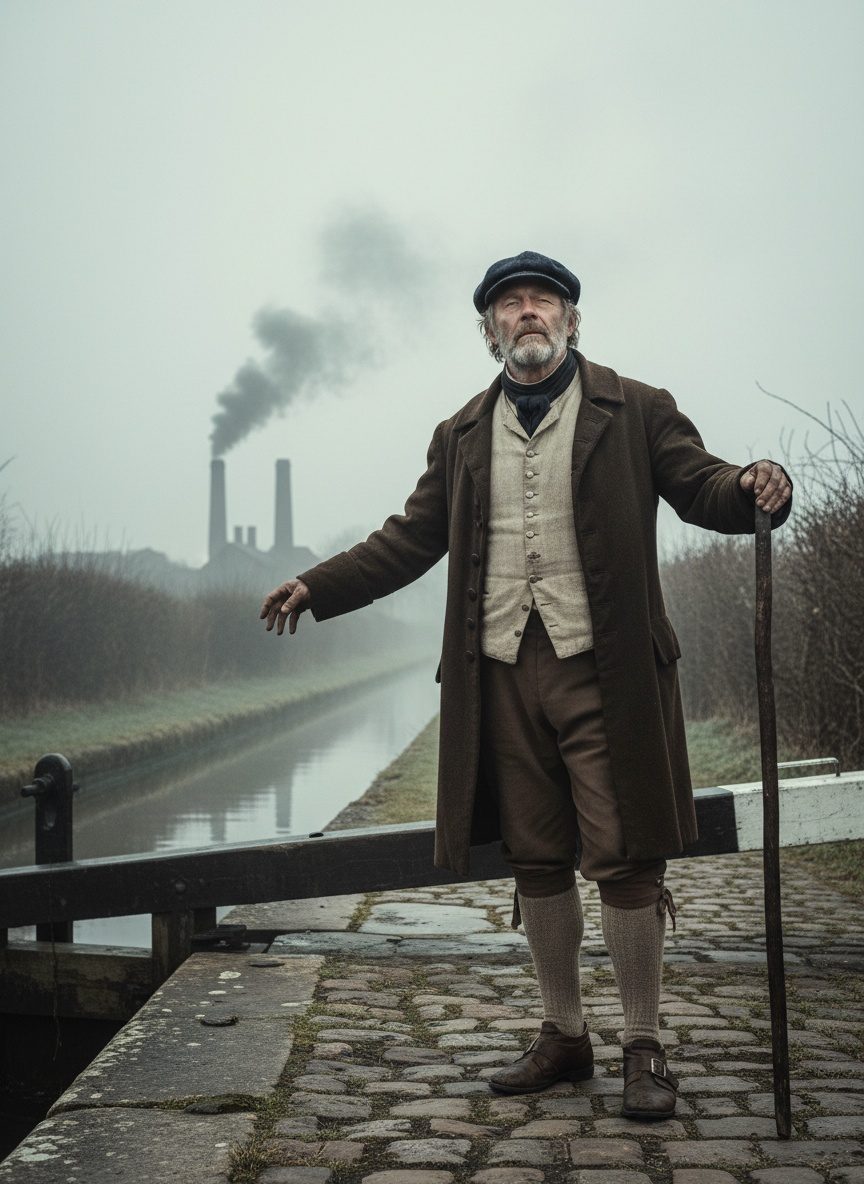
He possessed no maps, charts, or diagrams displaying routes and gradients. Yet, John Metcalf walked the breadth of Britain to feel the land and immortalise its canal paths in his mind. Blind since the age of six, Metcalf became an unanticipated yet indispensable figure during the Industrial Revolution, a maestro of the waterways before canals even graced the textbooks.
England in the late 18th century was an orchestra of change. The pivotal shift from agrarian societies to an industrial powerhouse set the stage for an evolving nation. Textiles whirred in newly built factories, and steam power sent a pulse through the landscape. One particularly revolutionary innovation was the construction of Britain’s extensive canal network. These artificial waterways connected burgeoning factories and industrial hubs, offering a lifeline for transporting raw materials and finished goods. It was a time when transport was transforming, but such large-scale engineering projects encountered significant challenges, including geographical and logistical hurdles that required exceptional ingenuity to overcome.
Enter John Metcalf, a man whose story defies conventional expectations. Born with sight yet destined to navigate a world without it, Metcalf's life did not follow a straightforward path. Blinded by smallpox at a tender age, he was suddenly plunged into darkness, a blackness that might have spelled the end for many. However, in this void, Metcalf found clarity. With no choice but to develop his other senses, he navigated his world through touch, sound, and intuition, becoming attuned to the subtleties of his environment.
From a young age, Metcalf possessed an adventurous spirit and acute memory, tools that would later prove essential in his work. His fingers memorised textures while his ears noted the echoes of footfalls on varying surfaces. Each step taken doubled as a study session, engraining the landscapes into a mental repository more vivid than any map. Metcalf's skill did not go unrecognized, and as the demand for canals grew, so did his reputation. Despite his blindness, he became a respected and trusted surveyor in an era defined by grand engineering visions.
Read next: The Day a Mill Owner Kept Paying Wages He Could Not Afford
The heart of Metcalf's genius lay in his unerring ability to 'read' landscapes much like a music savant reading sheet music. Walking alongside the canal towpaths, he deciphered each gradient and lock. His method seemed inscrutable yet bore out with infallible precision, attracting the attention of seasoned engineers flummoxed by the same terrains Metcalf so effortlessly traversed. Engineering manuals of the era couldn't contain his intuitive grasp of Britain’s topography—Metcalf set a precedent in a field he could scarcely see but mastered entirely.
One might ask how a man unable to see could claim such mastery over a nascent world of waterway navigation. Channels had to be cut at precise angles, embankments measured to withstand erosion, locks calibrated to step down or elevate water levels. Such technical details could overwhelm even the sharpest sighted minds. Yet, Metcalf applied an unconventional approach: his incessant walks, mental mapping, and tactile learning allowed him to internalize the physical world with a nuance rivaled only by modern-day GPS.
Among the towering figures of his time, often found poring over blueprints or debating mineral quality, Metcalf stood as a living testament to the untapped potential inherent in human adaptability. When stumped by a particularly challenging canal segment, engineers twice his age and experience turned to Metcalf. His advice came swiftly and confidently, a testament not only to his memorization and insight but also to his character. Such trust in an unconventional savant illustrates the restless innovation spirit that defined the Industrial Revolution.
While canal surveying may seem esoteric today, in Metcalf's time, it was the frontline of infrastructure advancement—akin to today’s tech industries revolutionizing global connectivity. His mastery over this burgeoning network ensured smoother, safer transport to bellies of factories hungry for resources. Consequently, Metcalf was not merely navigating canals; he was facilitating the arteries of a nation in transformation, ensuring life-breath flowed to all corners of England's industrious new world.
Sometimes dubbed the preeminent blind canal boy, Metcalf’s legacy diverges from the usual industrial narratives. His life reminds us that ability isn’t solely defined by convention, nor is genius always accompanied by sight. Metcalf's tactile grasp over Britain's waterways sculpted more than canals; it shaped how revolutionary ideas could be implemented, embrace diversity, and elevate understanding for generations to follow.
In reflecting on Metcalf's life, we are reminded that innovation often arises from unexpected places, borne out of necessity and an unyielding spirit. As we navigate our modern flooded pathways of information and technology, Metcalf’s story echoes with inspiration—a poignant reminder of humanity's endless capacity to adapt and overcome obstacles both seen and unseen. Let it inform our understanding and appreciation of history, urging us to look beyond traditional boundaries to identify greatness where it may seem unlikely.