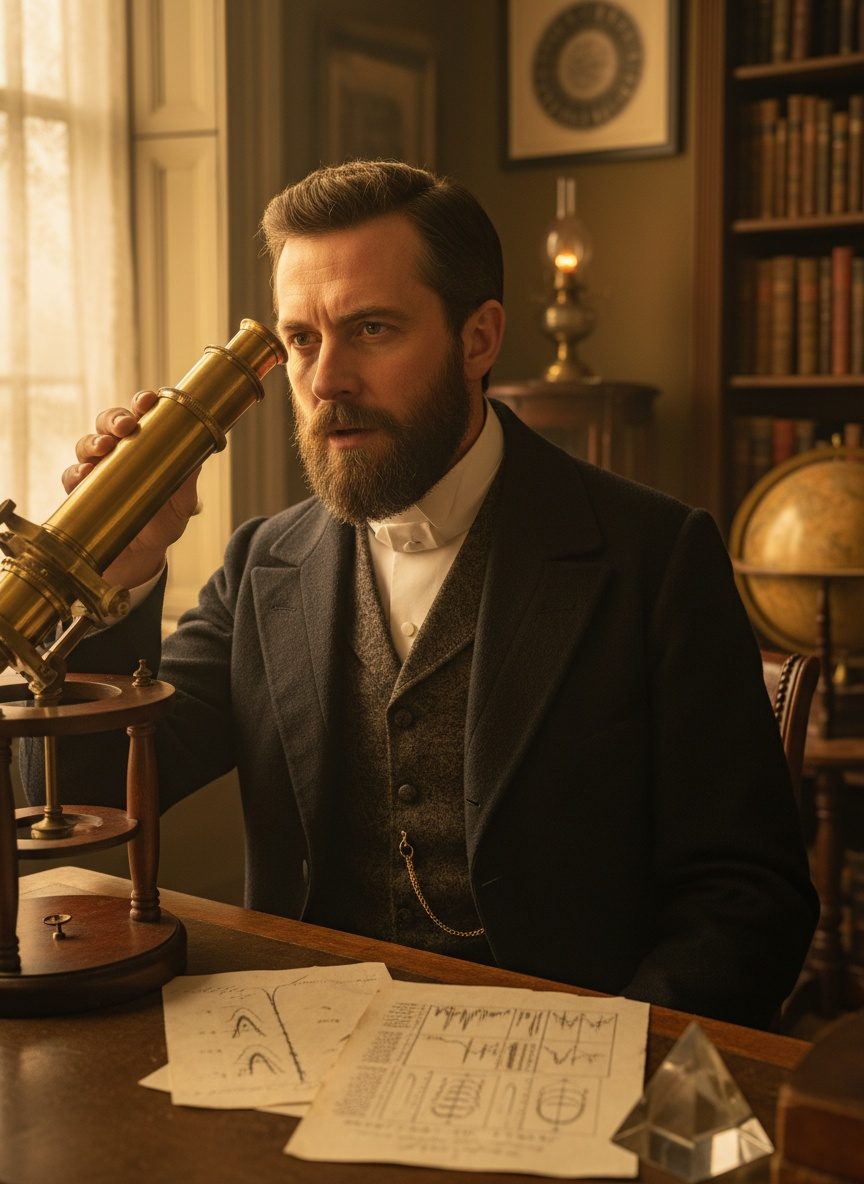
October, 1868. The sun's fierce light momentarily dimmed, revealing its hidden secrets.
The Eclipse That Changed Everything
As Europe's scientific community turned its eyes skyward, the world seemed to hold its breath, entranced by a spectacle that occurs less than once in a lifetime—a total solar eclipse. Onlookers marveled as the moon's silhouette slowly devoured the sun. Among the ranks of eager spectators was a tenacious young British astronomer named Norman Lockyer, armed with a spectroscope and an insatiable curiosity.
In the shadowy midday, when the sun was temporarily veiled, an invisible canvas unfolded itself in the heavens. Lockyer was not merely watching the eclipse; he was dissecting it, through the calibrated eye of his spectroscope, peeling back the layers of the sun's light to find clues about its makeup. He wasn't alone in this scientific vigil. Colleagues across Europe strained their instruments toward the sun, eager to unlock stellar secrets hidden, typically, by the brilliance of its own light.
Yet, fate awarded Lockyer a unique glance into the cosmic unknown. Amid the glowing dance of spectral lines that painted his viewfinder, one line glowed with a peculiar, distinguishably bright yellow hue. It did not match the lines of any known element. This profound observation stood as both a thrilling enigma and an irritating perplexity. What element could paint the sun with this brilliance?
Read next: The Day a Miner's Son Gave the World Safe Light
Lockyer had identified something that Earth itself could not offer — an element yet to be found, nestling its secrets within the furtive light of our nearest star.
Unraveling the Mysteries of the Sun
To the seasoned scientist, spectral lines were like fingerprints, offering proof of identity for elements present in the sun. Lockyer's discovery demanded more than just curiosity; it required a radical reconsideration of both the sun's and Earth’s elemental catalogues. Quickly, the young astronomer dubbed this enigmatic new discovery "Helium," after the Greek god of the sun, Helios.
As journals heralded Lockyer's findings, skepticism lingered. After all, none of Earth's known materials held this peculiar spectral line. How could one definitively proclaim the existence of something never seen or touched, based solely on a phantom glow?
Lockyer's challenge was emblematic of the broader evolution of science during the Victorian era, a time when the traditional bounds of inquiry were continually stretched and refined. His method exemplified the subtlest intrigue the scientific method could offer—an intersection where proof lay not in the tangible, but in the observation of nature's indirect whispers.
The international scientific dialogue sparked by helium’s spectral line transcended national curiosities to become a global pursuit. For years, scientists squabbled and theorized, pushed and pulled by the prospect of isolating on Earth an element that, until then, blushed only in the sun's spectrum.
Earth Would Catch Up Eventually
It would take twenty-seven more years before this particular cosmic mystery unveiled itself more fully to humankind. The conundrum reached its resolution not in the laboratory of another astronomer, but through the efforts of chemists working diligently to coax secrets out of the rare gases of our own planet’s atmosphere. Imagine the surprise mixed with vindication when, in 1895, helium was isolated right under humanity's nose, within the mineral structure of a stable Earth.
The pursuit and delay of helium’s terrestrial identification echoes a peculiar Victorian trope—the unseen was becoming seen, the ethereal made real. Such was the magic of the epoch's scientific revolutions. Lockyer's work thus laid the groundwork not just for the development of the field of atomic spectroscopy, but for a nuanced realization: that the elements composing the celestial heavens could also be inhabitants of the Earth.
Lockyer’s storied observation on that fateful October eclipse left an indelible mark on both science and history — illustrating the majesty of the human capacity to conceive of that which we cannot directly touch or own. It’s a reminder that profound discoveries can sometimes occur when the world seems dark, encouraging not resignation but a closer examination.
Today, long after the Victorian era has dimmed into the amber glow of history, the tale of a single spectral line discovered in the sun stands testament to the unyielding curiosity at humanity's core and the barriers we've breached in pursuit of knowledge. Helium—the unsung child of the sun—reminds us that the mysteries of the universe, ever aloof yet tantalizingly tangible, are intimately intertwined with our earthly journey.