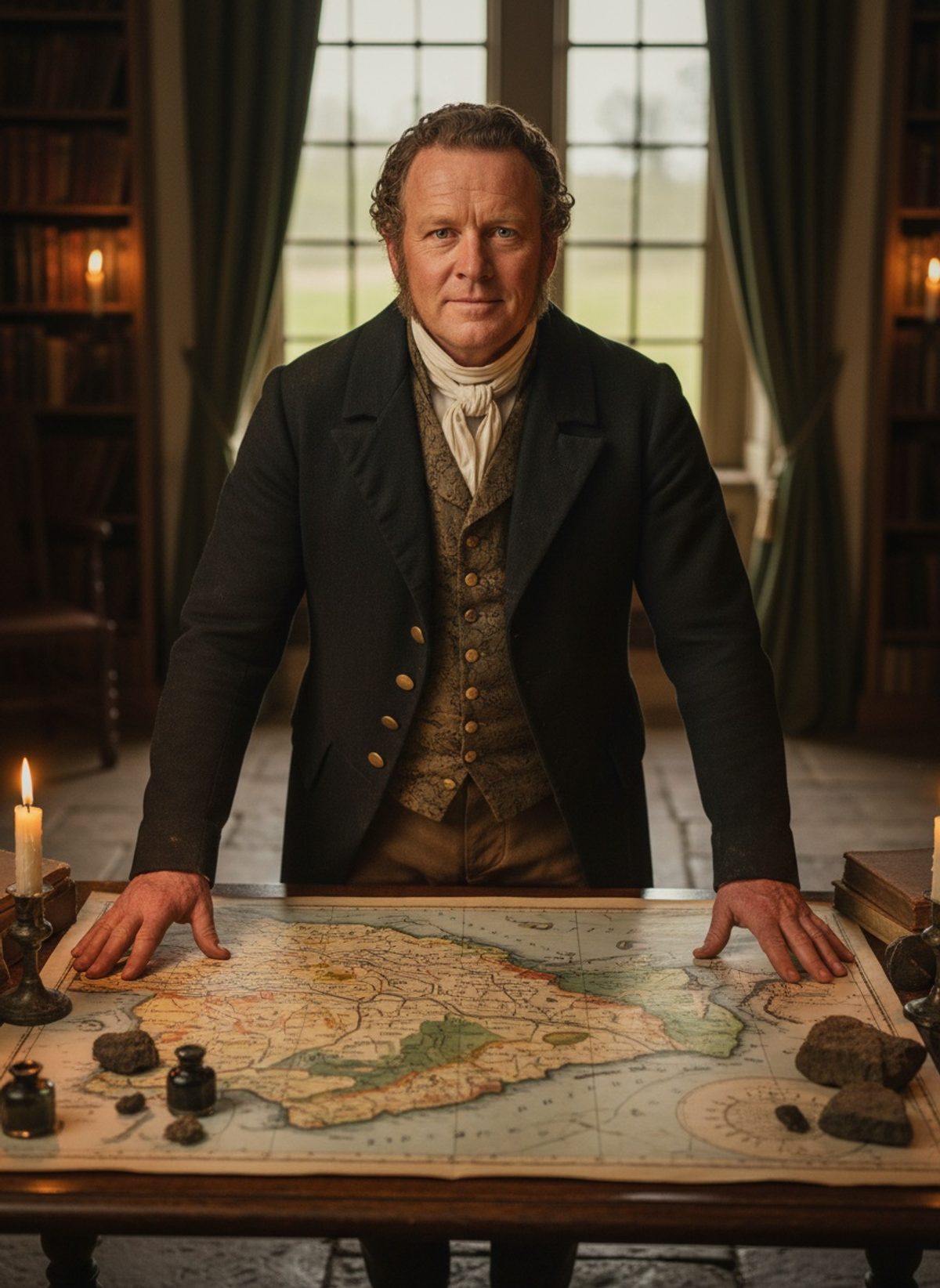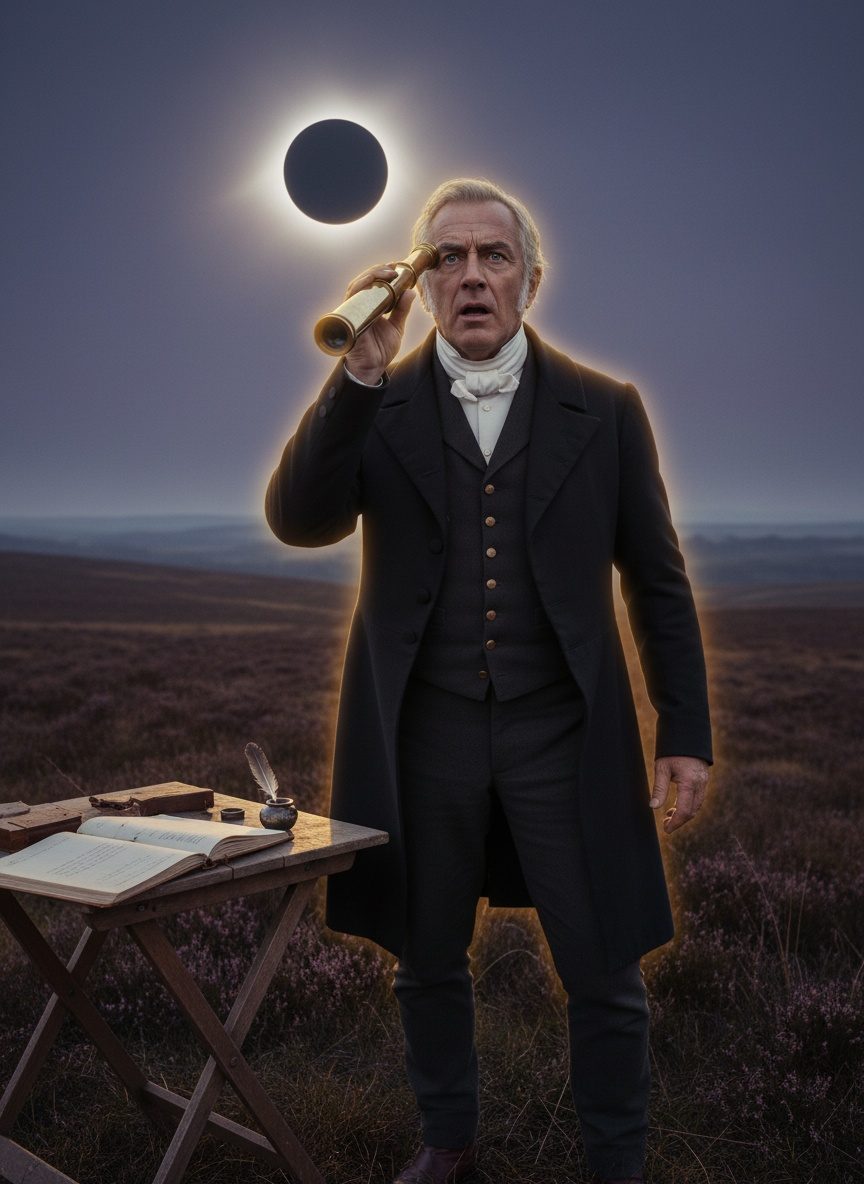
The chill Scottish air tasted sharp, like cold metal, as Francis Baily squinted up at the sky, an odd sensation of anticipation thrumming through his veins. All around him, the landscape lay cloaked in an eerie twilight, casting elongated shadows across the dewy grass. He could hear the distant murmurs of onlookers and feel the collective holding of breath, as if the Earth itself was waiting. Soon, the celestial dance he had traveled so far to witness would reach its crescendo, an occurrence so rare that it promised to etch itself into the annals of astronomical history.
It was May 1836, and Baily found himself in the Scottish countryside, taken far from his usual environs of London - an unlikely setting for a retired stockbroker to make one of the most significant scientific observations of the century. Yet here he was, standing under a patchwork sky, prepared to capture the fleeting ethereal beauty of a total solar eclipse. This astronomical marvel was not unknown, but Baily was determined to see more than just the darkening of the sun. With astute precision, he prepared his equipment, his heart racing in tandem with the celestial clock.
As the moon embarked on its celestial journey across the face of the sun, time seemed to slow. Baily’s eyes remained fixed on the sky, observing the surreal ballet of shadow and light. The moment the sun began to slip behind the moon, he felt an electric thrill course through him. The landscape darkened, suffused with otherworldly tones, casting an alien light across familiar hills and valleys. And then, as if the universe had chosen him specifically for this revelation, he saw them: dazzling beads of light encircling the moon's silhouette, sparkling like a crown of diamonds.
These luminous phenomena, later christened “Baily’s Beads” in his honor, were the points of sunlight filtering through the uneven lunar terrain. The sight was magnificent, bordering on the mystical, leaving even those with only a rudimentary understanding of astronomy in awe. Baily’s methodical descriptions in subsequent reports detailed these points of brilliance with such clarity and creativity that his accounts swiftly became the cornerstone of future eclipse studies.
Read next: The Day a Miner's Son Gave the World Safe Light
The beads appeared and disappeared in the blink of an eye but left an indelible impression that would inform scientific understanding and popular imagination for years to come. Given that no one had ever documented this before, Baily's words leaped off the pages of scientific literature, infused with the urgency and exactitude of his observation. It was not merely a discovery; it was an experience meticulously measured and gracefully communicated.
Francis Baily’s life prior to that remarkable day was not one script-written for scientific fame. Born in 1774, he was a man who initially carved a path in finance, making his way as a London stockbroker. Yet, the stars called to him in ways that numbers never could, and retirement afforded him the luxury of time to pursue his celestial curiosities. Baily was not just an astronomer but a storyteller, a man who translated the complexity of the cosmos into a captivating narrative, revealing the hidden rhythms of the heavens to those bound to Earth.
His dedication to the field was instrumental in advancing public and scientific understanding of astronomical phenomena. But it wasn't solely through his discovery of Baily's Beads. Throughout his career, Baily played a crucial role in the reformation of astronomical tables and stood as a stalwart against the tides of pseudoscience, always emphasizing empirical rigor and open inquiry. Yet, it was the eclipse that defined his legacy, the images of those otherworldly beads inspiring generations, blending the magical with the scientific.
The tale of Francis Baily and his beads is more than a story of celestial observation. It is a narrative of curiosity and preparedness, of an individual whose lifelong passion for understanding the universe led to a moment of profound clarity. His narration was a waking dream, capturing something ethereal and elusive and marking it into the tapestry of human knowledge. It demonstrated that our comprehension of the cosmos commences with an open gaze toward the heavens, with questions and theories nurtured under the sky’s expanse.
Tucked away in history, this tale reminds us why a thousand booming gears and industry smoke stacks did not fully define the Victorian era; whispers of wonder and exploration filled the spaces between, led by those who dared to look upward. In an age just beginning to harness industrial power, Francis Baily’s beads glowed as a symbol of intellectual and philosophical companionship with the universe, reminding all that mysteries remain for those who seek them.
The story of Baily's Beads ripples through time, a testament to the enduring human instinct to observe, to name, and to share our discoveries. As our modern world becomes ever more enmeshed with technology and speed, tales like Baily’s echo as a humbling reminder to pause, look up, and perhaps even record what we see — for in doing so, we become part of the infinite story written across the sky.