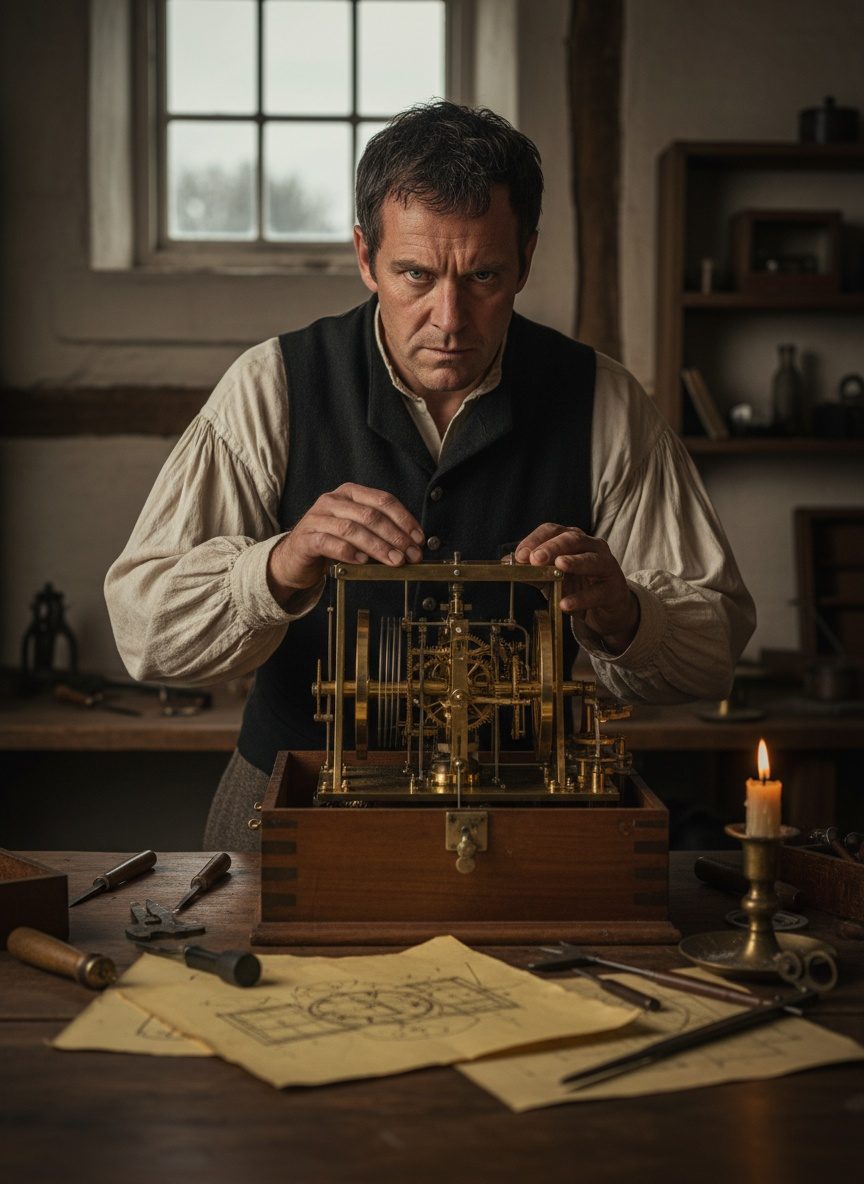
John Harrison was a mere carpenter's son. He crafted a timepiece that transformed the fate of the world’s oceans.
The Ocean's Deadly Secret
In the early 18th century, the promise of global exploration was on the horizon, yet the ocean held a secret that threatened every voyage. Without a reliable way to ascertain their east-west positioning, known as longitude, ships roamed like blindfolded giants across the waters. It wasn’t the tempestuous seas or the raging storms that posed the greatest threat but rather, the mysterious hand of ignorance grasping at the heart of navigation. Ships would unknowingly drift off course, destined to crash upon unseen reefs or vanish into oblivion. This phenomenon claimed countless lives and defied solution, a perplexing riddle even for the illustrious Isaac Newton.
Longitude, unlike latitude, couldn’t be measured by the stars but demanded a correlation with time. The concept was elegantly simple: if a navigator knew the local time at a reference point—such as Greenwich—while determining the local time at their position aboard ship, the difference would translate directly into degrees of longitude. Yet, achieving this accuracy on turbulent seas was another matter entirely. Pendulum clocks, the most accurate regulators of time in existence, were hampered by the motion and humidity of the ocean; they simply could not maintain exactitude over lengthy journeys. It left even the brightest minds baffled, and many ships to an inexorable fate.
A Clockmaker's Dream
Amidst this chaos emerged an unlikely hero: John Harrison, born in Yorkshire, a region more famed for its pastoral beauty than its nautical prowess. Harrison was not nobly born nor formally educated. He had honed his skills crafting wooden clocks for local patrons, an intimate knowledge of time ticking as naturally beneath his fingers as his own pulse. While many of his contemporaries clamored over charts and celestial findings, Harrison applied his self-taught brilliance to machinery, his head buzzing with the harmony of gears and springs.
Read next: The Day a Miner's Son Gave the World Safe Light
In 1735, this quiet genius accomplished what the esteemed intellectuals of the Royal Society deemed impossible. He introduced the world to H1, his first marine chronometer. This revolutionary device was a clock encased in a box of wonders, unaffected by the pitch and roll of a ship. Crafted from wood and precious metal, its heart was a pair of counter-balanced barbalances that ticked in perfect rhythm—a mesmerizing symphony of precision.
Harrison’s clock did not merely tell time; it whispered salvation to every mariner. His creation was a testament to the power of ingenuity over pedigree, as this humble clockmaker’s son, through the simplicity of mechanical precision, presented a solution to a challenge that had eluded even the greatest scientists of his era.
A Promise Fulfilled in the Depths of the Sea
No noble tale ends without trial, and Harrison’s was no exception. His invention, while an undeniable marvel, faced skepticism from the established scientific community. Voices with influence and authority were hesitant to place their faith in such a radical departure from their own scholarly pursuits. Yet, Harrison’s devices excelled at sea trials, proving beyond doubt their capacity to pin down a ship’s longitude with a hitherto unforseen accuracy.
As his chronometers evolved from the H1 to the more compact H4, meticulously crafted with patience and precision, the destiny of countless sailors began to transform. The navigation errors that had haunted naval expeditions and merchant adventures were no longer mysteries lurking beneath the waves. The groundbreaking efficacy of Harrison’s marine timekeepers, and their eventual adoption by the seafaring community, meant that fewer families waited anxiously for ships never to return, and more voyages charted safe and successful courses across the world’s fiercest oceans.
The Timeless Echo of John Harrison
In the unattended cemeteries of time, many remarkable minds rest forgotten. Yet the legacy of John Harrison endures not because of ambitious competition in science, but because he poured his heart into gears and springs until they could follow the rhythm of the universe. He didn’t just save sailors and merchants; he saved adventurers, families, and dreams borne on the back of every ship that navigated safely thanks to his innovation.
The tale of John Harrison is not merely one of mechanical brilliance; it is a reminder of the power that comes from tenacity, passion, and the courage to solve problems in unorthodox ways. Every time a modern ship crosses a line of longitude with precision, it unknowingly echoes the ticking heart of a clockmaker's creation—a testament to human ingenuity and an enduring lesson in the pursuit of innovation. So next time you look to the ocean, remember: all those voyagers owe a debt to a Yorkshire craftsman who dared to redefine what was possible.