He stood barely five feet tall. Yet, the Welsh archer who helped win England her greatest victory forever reshaped the battlefield with his bow.
October 25th, 1415 dawned bleak and bleary upon the lands of northern France. On that feast day of St. Crispin, two exhausted armies faced each other across a wide, muddy field near Agincourt. For Henry V and his English troops, this was a day of reckoning. They were ragged, rain-soaked, and far from the comforts of home. Illness had ravaged their numbers, and a mere six thousand faced an army more than four times larger. The French, resplendent in their noble armor, looked upon their opposition as little more than a nuisance—a raucous band of misfits who had stubbornly lingered on French soil too long. History lives in the whispers of this clash, and it remains forever intertwined with the image of the Welsh archer.
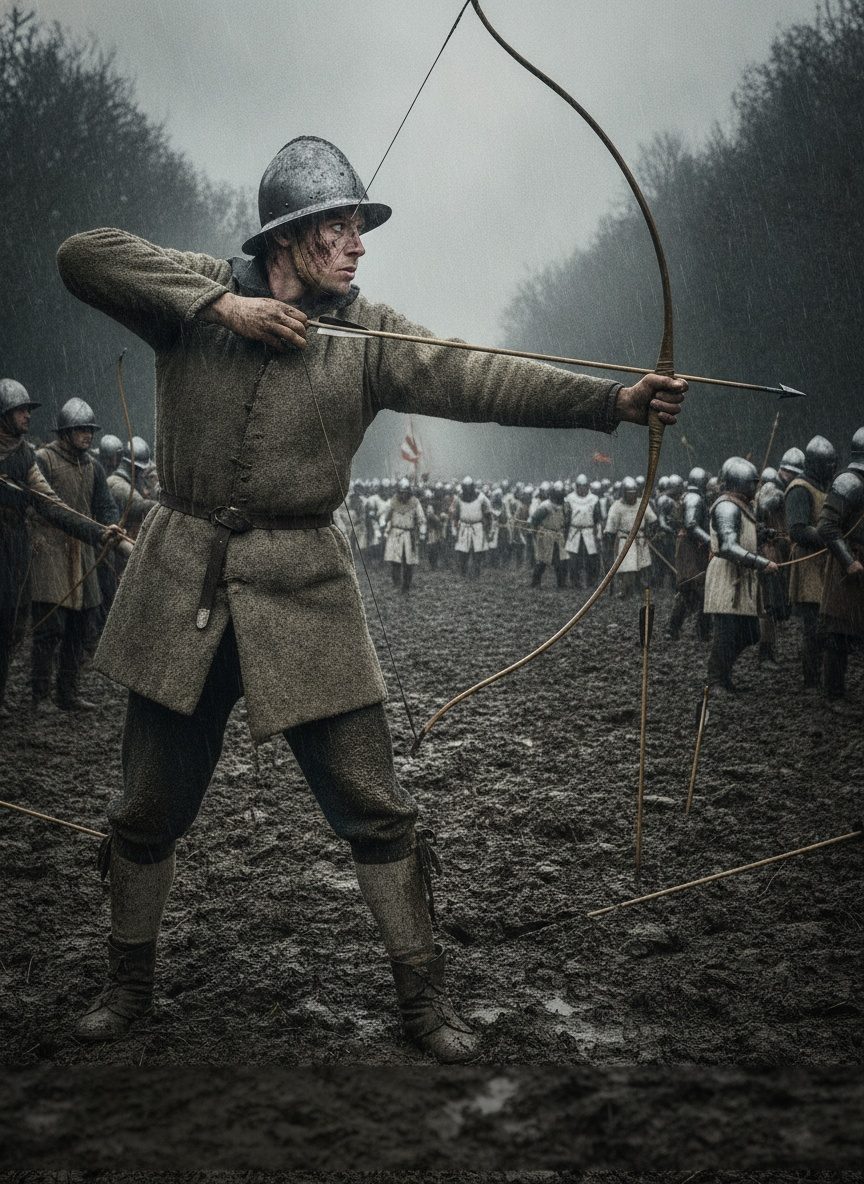
To understand the significance of that fateful day, we must delve into the character and craft of archers in medieval England. At the heart of their legacy lies the longbow, an instrument of war as critical to its time as the tank or aircraft would be in modern warfare. Towering over its wielder, the longbow was a deceptively simple weapon—a length of yew around six feet tall, crafted with careful devotion and wielded with deadly precision. It was here, in the hands of the Welsh, that it transformed into a symbol of the ordinary commoner's potential to alter the course of history.
The mastery of the longbow demanded years of rigorous training, an arduous path often beginning in childhood. From the cold Welsh valleys, where a boy would first pull taut a bowstring of hemp across his chest, to the sun-baked fields of Agincourt, the path was marked by discipline and resilience. Each archer perfected his craft not in classrooms or under royal patronage but through countless hours honing their skills in competitions and on the hunt, where tradition and survival intermingled.
Read next: The Day a Queen Walked Into a Rebel Camp Alone
On that grim morning, King Henry's odds seemed bleak. Yet, he knew well the power of his bowmen. These were not just any men; they were the hardened sons of Wales, veterans of countless skirmishes who had drawn bows alongside their fathers and brothers in both peacetime contests and war. The French knights, meanwhile, hardly concealed their disdain. How could such a rag-tag army hope to challenge valiant chevaliers weighed down with the pride of inherited legacy, armor gleaming under the pale winter sun?
As the battle commenced, the strategic formation laid by Henry relied heavily on the geography of Agincourt itself. A narrow strip between dense woods funnelled the French into an inevitable quagmire. Behind spiked palisades, the Welsh archers awaited, fingers curled expectantly around bowstrings, eyes locked on targets yet to crest the horizon. The command was given, and with a unified purpose, they loosed their first volley.
Arrows arced skyward, a thousand metal-tipped specters descending as if from the heavens. Frenzied by the sudden assault and hindered by the sodden ground, the front ranks of the French were thrown into turmoil. Longbow after longbow sang in relentless symphony, each note biting into advancing armor, seeking the chinks in the chevaliers' mail. Beneath this pounding hail, visions of chivalric glory dissolved. The muddy field became a pit of chaos and death, knights and horses writhing where they fell, as more arrows darkened the already cloudy sky.
Despite being chastened by the barrage, the French fought fiercely, pushing to meet the stubborn English line. Hand-to-hand combat ensued as the battle wore on, forming a grisly tableau of struggle and heroism. Yet, the pivotal impediment remained: those tenacious Welsh archers and their relentless hail of arrows. As the day bled on, French resolve succumbed to the incessant pressure, and what remained of their once-mighty host found itself driven back.
Initially, the outcome seemed miraculous, a divine favor bestowed upon the weary Englishmen. Yet for those who knew the secret of the Welsh archer's strength, there was no mystical mystery here—only the result of grit and the transformation of humble rural life into a tactical masterpiece. The French, numbering twenty-five thousand strong, had underestimated not just the English king’s strategy but the power of his bowmen. The longbow, in its elegance, proved to be the great leveler, rendering knight and commoner equal under its terrible rain.
Reflecting upon that day almost six centuries ago, it is crucial to remember what the Battle of Agincourt represents. The Welsh archers' triumph was not just a victory of military genius over bluster. It was a reminder of the profound impact seemingly ordinary individuals can have upon the unfolding of human events. Far from being nameless figures lost in the march of time, their legacy endures in the beating heart of England's past—a testament to the power that lies in unity, skill, and undying resolve.